
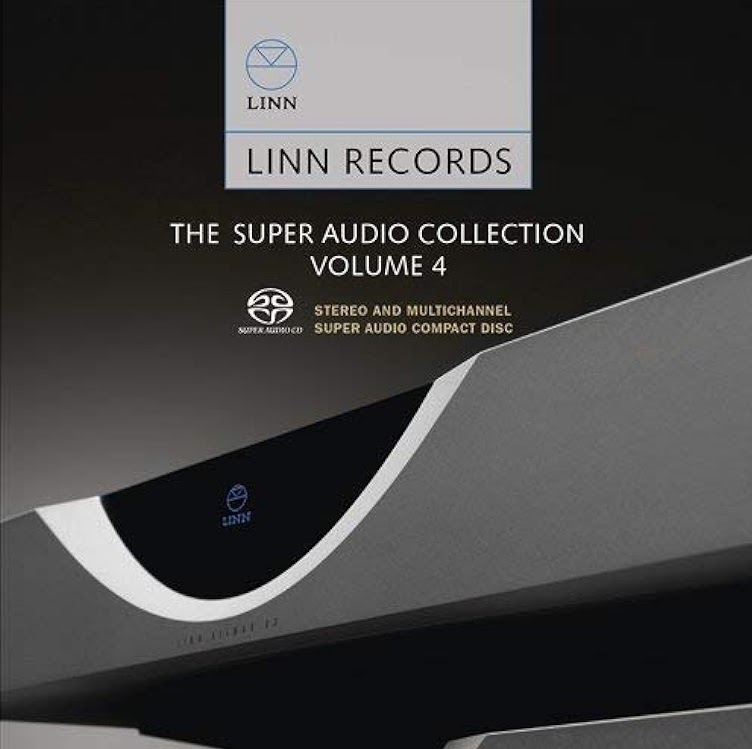
Linn Super Audio Collection vol. 4
GREAT CHOICE: Linn Super Audio Collection vol. 4!
Great music deserves to be discovered, enjoyed and shared.
CAN YOU SPARE A CUP OF COFFEE?
Audiophile-Streaming is a personal passion project, built with countless hours of discovering, selecting and sharing exceptional music.
I personally cover, without sponsors, the ongoing costs of hosting, software and subscriptions to keep the music discoveries coming. If you enjoy my work, your support is always appreciated.
A LITTLE THANK YOU IN RETURN
Just one coffee gives you lifetime access to the Coffee Club and all its playlists.
No subscriptions. No recurring fees.
The first thing that strikes me about Linn Super Audio Collection vol. 4 is how quickly it moves between musical worlds without losing its identity. Released by Linn Records in 2010 as catalogue number AKP 357, this fourth volume in the label’s sampler series brings together fifteen selections from Linn releases of the preceding years. Jazz singers sit alongside chamber music, Bach, Beethoven, Mozart, Ravel, Stravinsky and Messiaen, which sounds like a potentially awkward combination on paper. In practice, I think it works because Linn has chosen recordings with a similar concern for natural instruments, believable voices and plenty of space around the performers. It is clearly intended as a demonstration disc, but fortunately it is much more interesting than a collection of spectacular sounds designed simply to impress your friends.
The opening track, Maeve O’Boyle’s “Pray It Never Happens”, immediately shows why. The song originally appeared on her 2009 Linn album All My Sins, and there is nothing complicated about the arrangement trying to demand my attention. Instead, it is O’Boyle’s voice that does the work. I hear a singer presented clearly in front of me, with enough detail to follow small changes in phrasing without the vocal becoming unnaturally enlarged. This is exactly the type of recording I like for judging vocal realism because the interesting part is not how much detail my system can extract, but whether that detail still sounds like a person singing. On revealing speakers or headphones there is plenty to hear, yet the music remains intimate and uncomplicated.
From jazz voices to acoustic space
Claire Martin follows with “Everything I’ve Got Belongs to You”, the Rodgers and Hart song from her 2009 album A Modern Art. I like the contrast with Maeve O’Boyle because Martin has a very different delivery. Her timing is more obviously rooted in jazz, and the recording lets me hear how she works around the rhythm rather than simply sitting on top of it. The voice has presence without being pushed unnaturally forward, while the accompanying instruments retain their own position and character. It is a useful piece of reference music for midrange transparency, but more importantly, I enjoy the performance itself. A technically excellent recording of an uninteresting performance has very little value to me, and this track comfortably passes that test.
One of my favourites here is Carol Kidd’s “Stars Fell on Alabama”, taken from Dreamsville, her 2008 Linn album. That recording was made in Scotland at The Foundry Music Lab in Motherwell and The Mixing Rooms in Glasgow, with Kidd accompanied by Paul Harrison on piano, Nigel Clark on guitar, Mario Caribé on double bass and Alyn Cosker on drums. Graeme Duffin engineered the sessions and Calum Malcolm handled the mix. Knowing those details is interesting, but what matters to me is how naturally the small group comes together. Kidd’s voice has weight and warmth without becoming thick, and the piano, guitar and rhythm section never seem to fight for space. Listen to the relationship between the voice and double bass in particular. A good system keeps the bass firm and easy to follow while leaving Kidd completely intelligible in the centre, and that balance tells me far more than an artificially spectacular bass demonstration ever could.
The first part of the collection is strongly vocal, with Ian Shaw and Mark Moraghan also appearing, but Linn then changes direction dramatically. Pamela Thorby with Andrew Lawrence-King perform Diego Ortiz, followed by Purcell from the Retrospect Trio, Bach from the Dunedin Consort and John Ward performed by Phantasm. This is where I think Linn Super Audio Collection vol. 4 becomes more useful than many audiophile compilations. It does not simply give me fifteen versions of the same beautifully recorded female vocal. The scale changes, the acoustic changes and the demands on the system change with them.
Classical recordings that really test a system
The classical half becomes particularly interesting with Artur Pizarro and the Scottish Chamber Orchestra in the second movement of Beethoven’s Piano Concerto No. 4, conducted by Sir Charles Mackerras. The original Linn recording was made at Perth Concert Hall in November 2008 and produced by James Mallinson. This movement does not need exaggerated dynamics to reveal a system. The tension comes from the conversation between piano and orchestra, and I want to hear that contrast clearly without either side becoming hard or flattened. Pizarro’s piano should have body behind the notes, while the orchestra needs enough depth for the musical exchange to make sense. When everything is reproduced properly, there is a convincing distance between soloist and ensemble rather than one flat strip of sound between the speakers.
That ability to show depth also benefits the final Presto from Mozart’s Symphony No. 38, the “Prague” Symphony, again with the Scottish Chamber Orchestra under Mackerras. Here the collection finally gets the opportunity to move with real speed. Strings have to remain separate when the music becomes busy, and the rhythmic energy should increase without turning into a bright mass of sound. I find this much more revealing than listening for a single impressive effect because a good DAC, amplifier and pair of speakers have to preserve both the individual instrumental lines and the momentum of the whole orchestra. If the system becomes congested, Mozart exposes it very quickly.
There are other fascinating choices along the way, including Artur Pizarro playing Ravel’s Sonatine, the Chamber Orchestra of Europe in Stravinsky’s Pulcinella Suite and the Hebrides Ensemble performing the opening Liturgie de cristal from Messiaen’s Quatuor pour la fin du Temps. The Messiaen selection is especially useful because of the way separate instrumental colours occupy the acoustic. Instead of giving me one large sonic picture, it encourages me to listen into the recording and follow individual lines. That is exactly the sort of track that becomes more interesting after several plays.
The original release was a hybrid SACD with both stereo and multichannel SACD layers, plus a CD-compatible stereo layer, so Linn was clearly presenting this as a serious demonstration of its recording catalogue. Still, I would not judge it purely as an audiophile test disc. Its biggest weakness is also unavoidable: it is a sampler, and moving from singer-songwriter material and vocal jazz into Renaissance, Baroque and twentieth-century classical music can occasionally feel abrupt. I do not always want to hear all fifteen tracks as one continuous programme. On the other hand, that variety is precisely what makes it useful when I want to hear how a system handles very different recordings instead of flattering one particular type of music.
For me, Linn Super Audio Collection vol. 4 succeeds because the recording quality supports the performances rather than becoming the main event. Maeve O’Boyle gives me an intimate voice, Carol Kidd shows how naturally a small jazz group can be placed in a room, and Beethoven and Mozart test scale, separation and dynamics without needing exaggerated production tricks. There is enough variation here to expose differences between speakers, headphones, amplifiers and DACs, but I can also forget about the equipment and simply listen. That combination is what I value most about this Linn collection: it gives me useful reference recordings while still behaving like a collection of real music rather than a laboratory test.
HiFi’ve, Ronald – Your EarFluencer
