
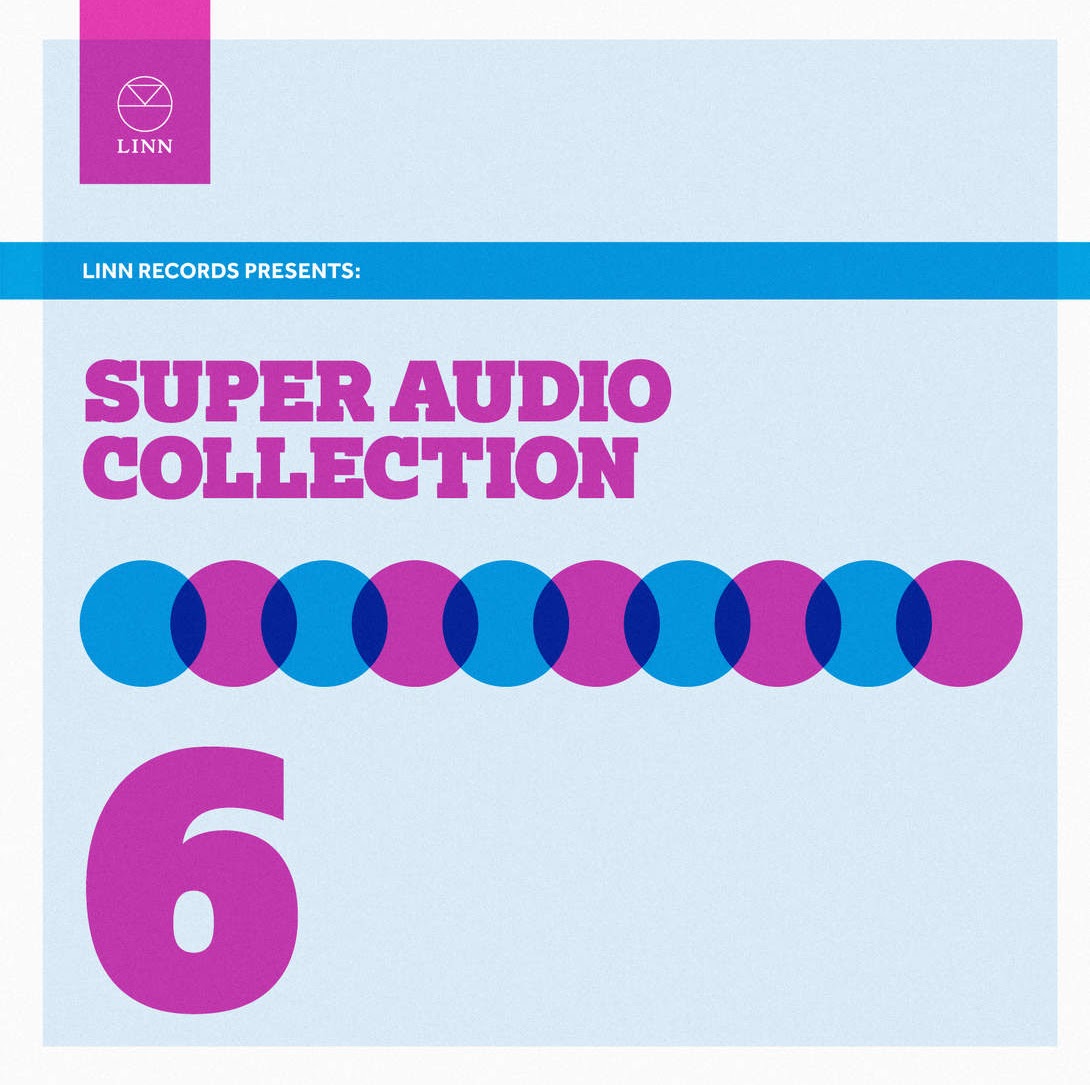
Linn Super Audio Collection vol. 6
Linn Super Audio Collection Vol. 6 – From an Intimate Jazz Voice to the Power of a Symphony Orchestra
A great audiophile collection doesn’t necessarily need to remain within one musical world. In fact, some of the most revealing recordings are those that constantly change the rules, asking an audio system to reproduce an intimate voice one moment and the scale of a symphony orchestra the next. Linn Super Audio Collection Vol. 6 does exactly that. Released by Linn Records in 2012, this fifteen-track collection travels from jazz through contemporary percussion, Renaissance music, Baroque ensembles, piano, chamber music, choral works and orchestral repertoire, creating a remarkably varied journey through the sound and recording philosophy of one of Britain’s best-known audiophile labels.
The collection also demonstrates why Linn Records has occupied such an interesting position in high-end audio. Linn is unusual because its history connects both sides of the listening experience: the company became famous for designing audio equipment capable of extracting more information from recordings, while Linn Records concentrated on capturing performances with the quality necessary to make that equipment worthwhile. The Super Audio Collection Vol. 6 brings those worlds together beautifully, offering music that can reveal transparency, dynamics, tonal accuracy and spatial information without becoming a conventional collection of sterile test tracks.
The journey begins in wonderfully intimate fashion with Claire Martin performing “Lazy Afternoon,” accompanied by Kenny Barron. It is an inspired opening because the human voice provides one of the most familiar references available to an audiophile. Martin should appear naturally positioned within the stereo image, with enough body to sound physically believable but without becoming unnaturally large. The piano needs its own space around her, allowing the listener to hear not simply the attack of individual notes but also their harmonic richness and gradual decay. Through a transparent high-end audio system, the performance has the ability to establish an intimate atmosphere before the collection suddenly changes direction.
That change arrives immediately with Kuniko’s interpretation of Steve Reich’s “Electric Counterpoint,” Movement III, arranged for percussion. Where Claire Martin encourages the listener to concentrate on vocal texture and intimacy, Kuniko introduces speed, rhythm and transient precision. Percussion can be extremely demanding because the system must reproduce the initial impact of each strike almost instantaneously while preserving the smaller resonances that follow. If the presentation becomes too soft, the rhythmic excitement disappears; if the upper frequencies are exaggerated, the performance can become hard and tiring. A well-balanced system preserves both impact and texture, allowing Reich’s intricate rhythmic patterns to develop naturally.
From contemporary minimalism, the collection reaches several centuries into the past with Phantasm performing William Byrd’s “Browning a 5 (The leaves be green).” The change in scale and instrumental character is substantial, but that is precisely what makes this sampler so useful as audiophile reference music. A transparent system shouldn’t make every recording sound equally large, warm or spectacular. It should preserve the individuality of the performance and the acoustic environment in which it was captured.
The Dunedin Consort follows with a scene from Handel’s Esther, bringing voices and instrumental forces together before pianist Gottlieb Wallisch performs the Andante cantabile from Mozart’s Piano Sonata No. 10 in C Major, K. 330. Solo piano is one of the great challenges in high-fidelity reproduction because the instrument combines percussive attack, harmonic complexity and a large resonating body. Reproduced convincingly, it has physical dimensions and weight; reproduced poorly, it can quickly become thin, hard or mechanical. Wallisch’s Mozart therefore provides a beautiful opportunity to listen to tonal balance and natural decay without reducing the performance to a technical exercise.
Tenor James Gilchrist, accompanied by Anna Tilbrook, then performs Britten’s “Nocturne” from On This Island. After the instrumental focus of the preceding tracks, the return of the human voice allows another comparison with Claire Martin’s opening performance. The singers, musical styles and recording environments are entirely different, and a revealing system should make those differences immediately apparent. This is one of the qualities that makes Linn Super Audio Collection Vol. 6 particularly valuable: rather than providing fifteen tracks designed to sound impressive in the same way, it demonstrates how many different forms natural sound can take.
The middle of the collection moves through Purcell with the Retrospect Trio, Mozart’s Apollo et Hyacinthus and Bach’s First Cello Suite performed by Richard Tunnicliffe. The cello is especially revealing because so much of its character lies in the relationship between string, bow and wooden body. There should be warmth and weight, but also enough texture to hear the physical act of playing the instrument. Excessive warmth can make the cello heavy and indistinct, while an overly analytical system may emphasize bowing detail at the expense of the instrument’s natural richness. When the balance is right, the cello gains a believable presence within the room.
With Cappella Nova performing James MacMillan’s “Lux aeterna,” the acoustic environment becomes even more important. Choral recordings are capable of creating extraordinary depth because the voices interact continuously with the space around them. On a good stereo or multichannel system, individual vocal textures remain identifiable while still forming a coherent ensemble, and the reverberation following the choir provides clues about the dimensions of the recording venue. This is where soundstage becomes more than a question of width. A convincing recording creates layers extending backwards from the loudspeakers, giving the listener a sense of entering the acoustic rather than simply observing it from outside.
The arrival of The Avison Ensemble performing the opening Allegro con molto from Vivaldi’s “Winter” brings speed and energy back into the collection. The strings need bite and articulation without becoming aggressive, while the rapid movement of the music demands excellent transient response and timing. The performance provides a useful contrast with the slower and more spacious material around it, again demonstrating how quickly a capable audio system should be able to change character when the recording changes.
Brahms follows with The Prince Consort performing “Am Donaustrande, da steht ein Haus” from the Liebeslieder Waltzes, after which the Scottish Chamber Orchestra Ensemble takes on the final Rondeau Allegro from Mozart’s Oboe Quartet in F Major, K. 370. The oboe introduces yet another distinctive tonal signature, and its combination with violin, viola and cello provides an excellent opportunity to listen to instrumental separation without losing the unity of the ensemble. Good stereo imaging shouldn’t pull musicians apart artificially; instead, it should give each instrument enough space to remain recognizable while preserving the musical conversation between them.
As the album approaches its conclusion, Magnificat performs the Agnus Dei from Philippe Rogier’s Missa Philippus Secundus Rex Hispaniae, once again allowing voices and acoustic space to dominate the presentation. By this point, the collection has travelled through an extraordinary range of musical scales, from the intimacy of Claire Martin and solo piano to chamber ensembles, percussion and choir. The final track therefore feels like the natural destination of that journey: Robin Ticciati and the Scottish Chamber Orchestra performing the “Marche au supplice” from Berlioz’s Symphonie fantastique.
Berlioz asks considerably more of an audio system than the intimate opening track. An orchestra needs space to expand, low frequencies require weight without losing control and powerful passages should develop without compression or hardness. At the same time, quieter instrumental details must remain audible within the larger musical picture. The ability to move effortlessly between those extremes is one of the qualities that separates a merely impressive audio system from a genuinely convincing one.
That enormous contrast between the first and final tracks also explains why Linn Super Audio Collection Vol. 6 works so well as an audiophile demonstration album. Claire Martin can reveal vocal presence and midrange transparency, Kuniko challenges transient speed and dynamics, Gottlieb Wallisch exposes piano reproduction, Richard Tunnicliffe provides a reference for the natural texture of strings, Cappella Nova and Magnificat reveal acoustic depth, while Vivaldi and Berlioz test whether the system can maintain control when musical energy and scale increase dramatically.
For anyone evaluating high-end speakers, headphones, amplifiers, DACs or SACD playback, there is enough variety here to spend an entire evening analysing equipment. The original hybrid SACD format also makes the collection particularly interesting for enthusiasts of high-resolution audio and multichannel SACD, because Linn selected these recordings not simply for musical variety but to showcase the breadth and recording quality of its catalogue.
Yet the best way to enjoy the collection may be to resist the temptation to treat every track as a test. Begin with Claire Martin and allow the album to continue in sequence. The transition into Steve Reich will change the atmosphere immediately, Byrd and Handel will take the journey backwards through musical history, Mozart and Bach will bring individual instruments into focus, while MacMillan and Rogier open the acoustic space around voices. By the time Berlioz fills the room with the Scottish Chamber Orchestra, the modest scale of “Lazy Afternoon” will seem a very long way away.
That is what makes The Super Audio Collection Vol. 6 more than simply another audiophile sampler. It demonstrates that great sound has no single definition. Sometimes it is the texture of a voice accompanied by piano; sometimes it is the resonance of a cello or the delicate interaction of a chamber ensemble. At other moments it is the reverberation surrounding a choir or the enormous dynamic range of an orchestra reaching full power.
A truly capable high-end audio system should allow all of those worlds to exist without imposing itself on any of them. It should become intimate when the recording is intimate, expansive when the music demands scale and powerful only when the musicians ask it to be.
Linn Super Audio Collection Vol. 6 gives it fifteen very different opportunities to do exactly that, making the album both a fascinating tour through the Linn Records catalogue and an exceptionally varied collection for anyone who believes that audiophile sound should ultimately serve the music rather than the equipment.
Hi-Fi(ve),
Ronald – Your EarFluencer 🎧
