
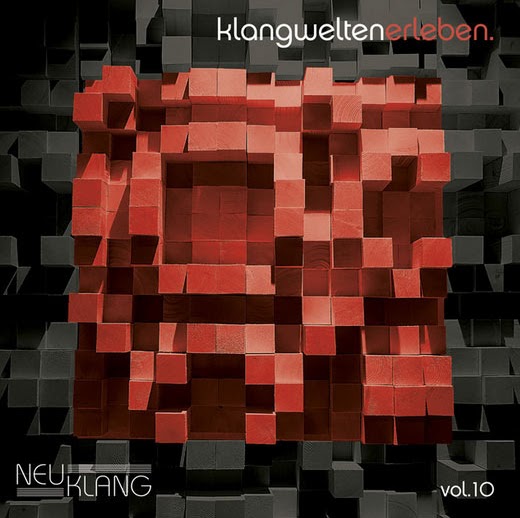
Neuklang Klangwelten
Vol. 10
Neuklang Klangwelten Vol. 10 – Eight Journeys Into the Art of Modern Audiophile Jazz
The word Klangwelten translates beautifully as “worlds of sound,” and few titles could describe the philosophy behind this Neuklang series more accurately. With Neuklang Klangwelten Vol. 10, the German label once again avoids the predictable route of the traditional audiophile sampler. There are no endless variations on the same softly recorded vocal performance and no attempt to make every track conform to a single polished sonic signature. Instead, eight very different recordings open eight doors into contemporary jazz, moving from the intimacy of a piano trio to trombone-led chamber jazz, orchestral colors, experimental ensembles and the energy of a live performance.
Released in 2020, Neuklang Klangwelten Erleben Vol. 10 continues a series that has become an intriguing introduction to the Neuklang catalogue. The selection brings together the Marc Perrenoud Trio, Florian Weiss’ Woodoism, the Sarah Chaksad Orchestra with Guillermo Klein, Still in the Woods, the Silvan Joray Trio, Initiative H and bassist Eva Kess. It is a relatively compact collection, but the musical range is considerable, making it particularly rewarding for listeners interested in modern audiophile jazz, contemporary European jazz and high-resolution recordings that value musical personality as much as technical perfection.
The journey begins with the Marc Perrenoud Trio and “The Reb,” immediately placing the piano trio at the centre of the listening room. Piano, bass and drums may represent one of the most familiar configurations in jazz, but that apparent simplicity makes the format remarkably revealing. The piano demands speed, harmonic richness and natural decay, while the double bass needs physical weight without losing pitch or texture. Drums add another challenge entirely, requiring the system to reproduce the immediate attack of a strike while preserving the resonance that follows it. When those three instruments are captured well and reproduced through a transparent high-end audio system, the attraction lies not simply in hearing them individually but in following the musical conversation taking place between them.
That relationship between musicians is more important than spectacular hi-fi effects. Great stereo reproduction shouldn’t pull a trio apart into three isolated demonstration objects. Instead, each instrument should occupy a believable position while remaining connected to the performance as a whole. The Reb provides a strong opening because it establishes precisely this balance, offering enough resolution for critical listening without sacrificing the rhythmic movement that makes jazz engaging in the first place.
The atmosphere changes dramatically with Florian Weiss’ Woodoism performing “Danse amoureuse.” Woodoism is an unusual quartet built around trombone, alto saxophone, double bass and drums, and that instrumentation immediately creates a different tonal landscape. Brass and reeds can be unforgiving of an audio system that places too much emphasis on the upper midrange, while a system lacking resolution can smooth away the textures that give these instruments their individual personalities. The challenge is to preserve warmth, breath, attack and harmonic complexity simultaneously, allowing the instruments to sound energetic without becoming aggressive.
At more than six minutes, Danse amoureuse also provides enough space for the acoustic character of the recording to become apparent. This is where the distinction between stereo imaging and soundstage depth becomes particularly interesting. Precise imaging allows us to identify where musicians are positioned, but depth determines whether the performance seems to exist within a real space. Small amounts of reverberation and instrumental decay provide clues that allow the listener to perceive layers extending behind the loudspeakers, creating the impression that the room has become larger than its physical dimensions.
The third track expands that world considerably. Sarah Chaksad Orchestra and Guillermo Klein perform “Mehamn,” moving from the relative intimacy of Woodoism into a larger ensemble where instrumental color and arrangement become increasingly important. A large jazz ensemble places very different demands on a playback system. Brass sections need energy without hardness, lower instruments require definition and the system must maintain separation when several musical lines are developing simultaneously. The objective isn’t to isolate every instrument unnaturally but to preserve enough information that the architecture of the arrangement remains understandable.
This makes Mehamn particularly interesting as audiophile reference music. On a system with limited resolution, complex passages can begin to merge into a single mass of sound. A more transparent setup maintains the tonal identity and position of individual sections while still allowing the orchestra to behave as one musical unit. That ability to remain composed as complexity increases is often far more revealing than a spectacular solo instrument recorded in isolation.
The Marc Perrenoud Trio returns for the fourth track, this time joined by guitarist Paul Jarret on “Sjutton År.” At almost thirteen minutes, it is the longest piece on the album and provides room for the musicians to develop ideas gradually rather than rushing towards an immediate conclusion. The addition of guitar changes the texture of the trio considerably, introducing another instrument whose transient attack and harmonic decay can reveal subtle differences in reproduction.
Longer jazz performances also offer something increasingly rare in the age of playlists and instant track skipping: time. A musical idea can develop slowly, musicians can respond to one another and the listener has an opportunity to settle into the acoustic environment rather than constantly preparing for the next song. Through a capable system, this kind of performance can become particularly immersive because the soundstage gradually stops feeling like an impressive technical construction and simply becomes the place where the musicians exist.
Still in the Woods with Raphael Seidel take over with “Fountain,” changing the atmosphere once again before the Silvan Joray Trio performs “See You in June.” These transitions are central to the appeal of Klangwelten Vol. 10. Neuklang isn’t presenting a standardized audiophile aesthetic in which every recording has enormous depth, silky treble and a singer positioned perfectly in the centre. Instead, each performance retains its own scale, tonal character and production style.
That is exactly what a transparent audio system should reveal. If every recording sounds equally warm, equally spacious or equally impressive, the system may be contributing more personality than we realize. True transparency allows differences to survive. A small ensemble should remain intimate when the recording demands it, while a larger performance should expand naturally without becoming artificially oversized.
The seventh track introduces one of the most recognizable compositions in the collection with Initiative H performing Moondog’s “Bird’s Lament” live. Moondog’s music has always occupied a fascinating space between jazz, classical minimalism and rhythmic experimentation, and Bird’s Lament has developed a life far beyond its original context. In a live setting, the surrounding acoustic and performance energy become part of the recording, adding information that a conventional studio production cannot reproduce in quite the same way.
Live recordings can be especially revealing on a high-end system because the audience and venue establish a sense of scale before the music itself is considered. The recording should allow the listener to perceive not simply instruments but the environment around them. Dynamics become equally important, because live musicians rarely maintain the controlled intensity of a carefully constructed studio mix. Small changes in energy need to survive, while larger passages should expand without the system becoming congested.
The album closes with Eva Kess and “Ikigai,” bringing another distinctive instrumental palette to the journey. Kess is a bassist and composer, and the recording incorporates strings, piano and drums around her bass, giving the final track a chamber-like quality that feels particularly appropriate after the different worlds explored earlier in the collection. The Japanese concept of ikigai is often associated with a sense of purpose or reason for being, and whether intentionally symbolic or not, the title makes a fitting conclusion to an album devoted to musicians exploring their own contemporary jazz languages.
Bass reproduction deserves particular attention here because audiophile discussions too often reduce it to depth. A system capable of reaching extremely low frequencies may sound impressive, but bass resolution is equally important. Individual notes should retain pitch, texture and timing rather than becoming an anonymous low-frequency foundation underneath the music. With acoustic or electric bass, the listener should be able to follow the musician rather than simply feel the instrument.
Across only eight tracks, Neuklang Klangwelten Vol. 10 manages to provide a surprisingly comprehensive tour of the qualities that matter in high-end audio. The Marc Perrenoud Trio can reveal piano timbre, bass definition and rhythmic precision; Florian Weiss’ Woodoism explores brass and reed texture; the Sarah Chaksad Orchestra challenges a system with larger-scale arrangements; Initiative H introduces live dynamics and acoustic space; and Eva Kess brings the journey towards a more intimate conclusion.
For listeners evaluating speakers, headphones, amplifiers or DACs, there is therefore plenty to investigate. Listen for transient response during piano and percussion, tonal accuracy with trombone and saxophone, instrumental separation during larger ensemble passages and the ability of the system to preserve soundstage depth without exaggerating it. The availability of these recordings in high-resolution digital formats also makes the collection particularly relevant to listeners interested in 24-bit audiophile music and high-resolution jazz.
Yet the album becomes more interesting when those technical considerations begin to disappear. That is perhaps the defining quality of the Neuklang series. These compilations aren’t merely collections of pristine recordings selected to demonstrate expensive equipment; they are opportunities to discover contemporary musicians who happen to have been recorded with exceptional care.
You may begin The Reb by listening to the piano image between the loudspeakers and spend Danse amoureuse concentrating on the tonal character of the trombone. During Mehamn, you might notice how well the system separates a larger ensemble, while Bird’s Lament reveals something about live dynamics and acoustic space. By the time Ikigai arrives, however, the analytical checklist should have become considerably less important.
That is where Neuklang Klangwelten Vol. 10 succeeds as an audiophile collection. Resolution isn’t presented as an end in itself, and transparency doesn’t exist simply so that the listener can count more details. Both qualities allow the individual character of these musicians to survive the journey from recording session to listening room.
The result is a collection that demonstrates a more adventurous side of audiophile music. Modern jazz can be intimate, complex, melodic, experimental and occasionally unpredictable, and a great recording should preserve all of those qualities rather than polishing them into something safer.
Start with the Marc Perrenoud Trio and allow the album to unfold naturally through Woodoism, Sarah Chaksad, Still in the Woods, Silvan Joray and Initiative H before Eva Kess closes the journey. You may discover plenty about the capabilities of your audio system along the way, but the more interesting discovery may be the music itself.
After all, Klangwelten means worlds of sound.
Neuklang Klangwelten Vol. 10 gives us eight very different worlds worth entering.
Hi-Fi(ve),
Ronald – Your EarFluencer 🎧
