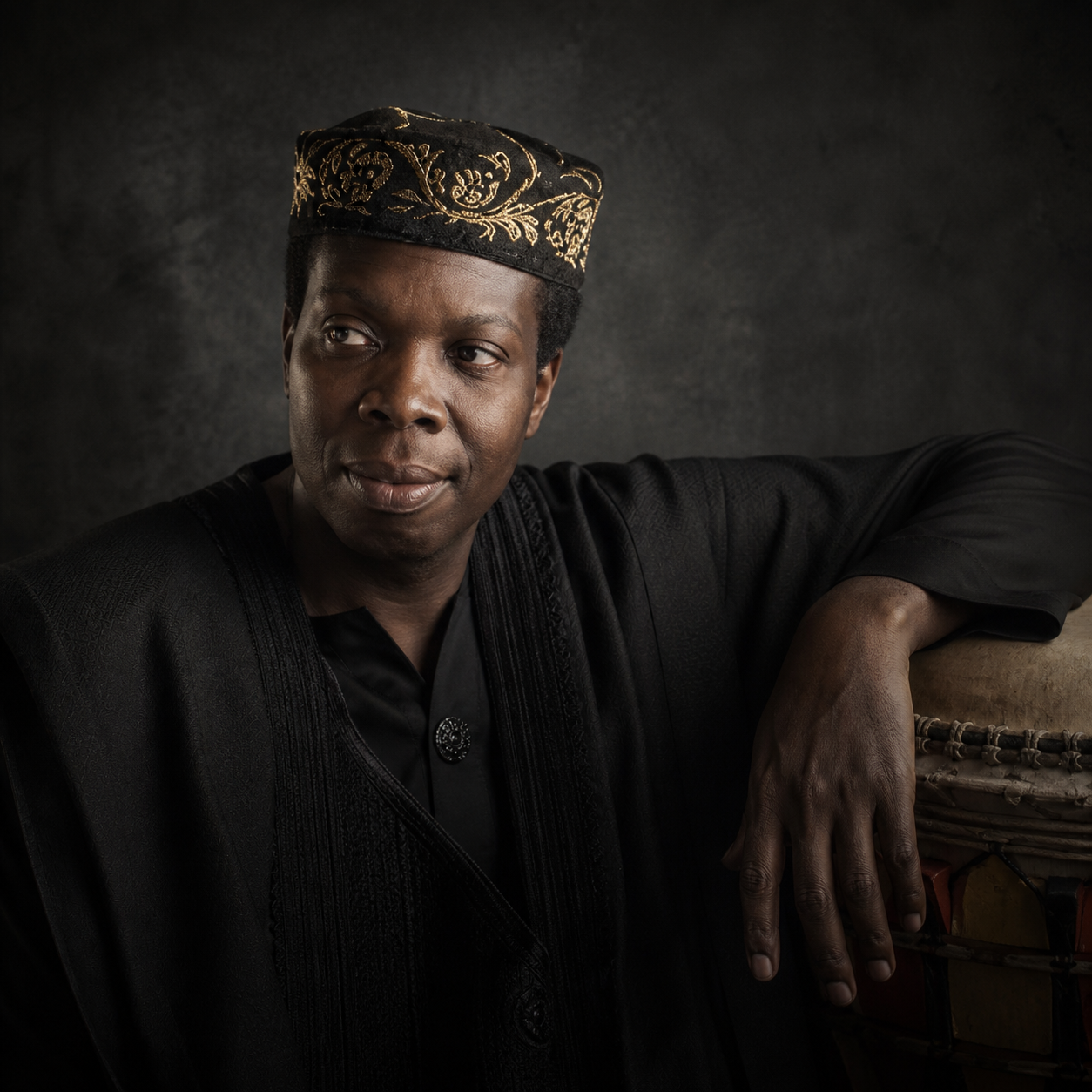
Babatunde Olatunji
Babatunde Olatunji – African Drums, Explosive Dynamics and an Audiophile Experience
Some recordings reveal the quality of an audio system through the intimacy of a human voice, while others do it with the sudden physical impact of percussion. Babatunde Olatunji belongs firmly to the second category. The Nigerian drummer and percussionist brought the rhythmic traditions of West Africa to an enormous international audience and, in the process, created music that remains fascinating for listeners interested in audiophile percussion, reference recordings, African music and high-quality hi-fi sound. His performances combine complex rhythms, powerful drums, chanting and an extraordinary sense of movement, producing recordings that can challenge a stereo system in ways that conventional instrumental music rarely does.
For audiophiles, Olatunji’s music offers much more than impressive bass. A properly reproduced drum has an initial impact, followed by the resonance of the drumhead and body, and finally the acoustic decay of the room surrounding it. When several percussion instruments are playing simultaneously, a capable audio system must reproduce not only their power but their individual positions, tonal differences and rapidly changing dynamics. This combination makes the music of Babatunde Olatunji particularly rewarding for anyone interested in testing loudspeakers, amplifiers, subwoofers and dynamic range, while the musical energy ensures that the experience never becomes a technical exercise.
From Nigeria to an International Audience
Babatunde Olatunji was born in 1927 in Ajido, in what is now Lagos State, Nigeria, and grew up surrounded by Yoruba musical traditions in which rhythm, song and community were closely connected. After moving to the United States as a young man, he increasingly found opportunities to introduce American audiences to African percussion at a time when traditional African music had relatively little mainstream exposure in the country.
His breakthrough came at the end of the 1950s with an album that would become one of the defining recordings of his career. Rather than adapting African rhythms into conventional Western popular music, Olatunji placed percussion and voices at the center of the performance. For many listeners, it was an entirely new sonic world, and its influence extended beyond world music into jazz, popular music and the growing interest in African musical traditions.
Olatunji would eventually collaborate and perform with musicians from very different backgrounds, while his work also became associated with the wider cultural exchange between African and American music. His importance therefore extends beyond his ability as a percussionist. He helped introduce generations of listeners to the complexity and expressive power of African drumming and Yoruba-inspired rhythms.
Drums of Passion – The Album That Introduced a New Sound
Released in 1960, Drums of Passion became Babatunde Olatunji’s landmark recording and one of the most influential African music albums to reach a large Western audience. The title accurately describes what the listener encounters: drums are not merely supporting instruments but the foundation of the entire musical experience. Different percussion patterns overlap and interact while voices and chants become part of the rhythmic structure.
For listeners interested in audiophile world music and percussion recordings, Drums of Passion remains fascinating because percussion exposes weaknesses in an audio system very quickly. The attack of a drum is extremely fast, and a system that cannot respond cleanly can soften the initial impact. At the same time, excessive low-frequency energy can turn individual drums into an indistinct rumble. Good reproduction requires speed and control as much as bass extension.
Listen carefully and the performance should contain many different textures rather than one generalized percussion sound. Larger drums have weight and body, while smaller percussion instruments should remain quick and clearly defined. Voices need to retain their own space within the recording instead of disappearing behind the rhythmic intensity. When these elements remain separated, the complexity of Olatunji’s arrangements becomes much easier to appreciate.
Jin-Go-Lo-Ba and the Power of Rhythm
One of the pieces most strongly associated with Olatunji is “Jin-Go-Lo-Ba,” a performance that demonstrates the hypnotic quality of layered percussion. Rhythmic patterns repeat and develop while different instruments enter the arrangement, creating momentum without requiring a conventional melody to guide the listener.
The composition would later become known to an even wider audience when Santana recorded a version titled “Jingo.” The connection illustrates how African rhythmic ideas increasingly entered rock, jazz and Latin-influenced popular music during the following decades. What might initially have sounded unfamiliar to many Western listeners eventually became part of the vocabulary of international popular music.
For the audiophile, recordings built around this kind of percussion offer an excellent opportunity to evaluate rhythmic precision, transient response and bass control. A good system should allow the listener to follow several rhythmic patterns at once without losing the fundamental pulse of the performance. The music should sound energetic and physical, but never slow or bloated.
When Percussion Tests a Hi-Fi System
Percussion is among the most demanding material a stereo system can reproduce because a drum strike contains an enormous amount of information in a very short period of time. The initial transient can be extremely fast, while the resonance that follows may extend much longer and reach considerably lower frequencies. Reproducing both correctly requires an amplifier and loudspeakers capable of moving from silence to impact almost instantaneously while maintaining control afterwards.
This is where Babatunde Olatunji recordings can become excellent audiophile reference material. Instead of listening only for how hard the drums hit, concentrate on whether they sound like different physical instruments. A large drum should have a sense of size, but the listener should also hear changes in pitch and resonance. Smaller percussion needs to remain distinct, while handclaps and voices should appear with a convincing sense of immediacy.
A well-integrated subwoofer can add another dimension by reproducing the deeper resonance of larger drums, but integration is crucial. If the subwoofer becomes separately identifiable, the rhythmic coherence can quickly disappear. Properly adjusted, it should simply make the drums seem larger and more physically believable without drawing attention to the low-frequency system itself.
Circle of Drums – An Audiophile Favorite
For listeners specifically interested in high-quality audiophile percussion recordings, Olatunji’s later work also deserves attention. Circle of Drums, recorded with Muruga Booker and Sikiru Adepoju, places the listener inside a richly layered percussion environment where the character of individual drums becomes central to the experience.
Recordings of this type are particularly useful for evaluating soundstage and spatial information. A capable stereo system should not present all percussion on one flat line between the loudspeakers. Instead, individual instruments should occupy recognizable positions with differences in width and depth. The acoustic information surrounding the drums helps create the impression of physical performers rather than sounds attached to loudspeaker cabinets.
This makes Olatunji an interesting contrast to conventional audiophile vocal recordings. With a singer, the challenge is often reproducing a stable central image and realistic tonal character. With percussion, the system must reproduce speed, scale, placement and rapidly changing energy across a much larger acoustic picture.
The Influence of Babatunde Olatunji
Olatunji’s influence extended well beyond his own albums. His music helped increase awareness of African percussion in the United States, and his career brought him into contact with musicians from jazz, rock and other musical traditions. Among the artists with whom he developed connections was Mickey Hart of the Grateful Dead, whose own fascination with percussion and global rhythmic traditions led to further musical collaboration.
This broader influence is important because Olatunji arrived during a period when African musical traditions were often poorly understood by mainstream Western audiences. By placing percussion at the center rather than treating it as an exotic addition to another style, he helped demonstrate the sophistication of rhythmic music and encouraged listeners and musicians to explore traditions outside the familiar Western framework.
His work can therefore be heard as part of the development of what would later broadly be marketed as world music, although the label hardly captures the cultural and musical complexity behind the recordings.
Why Babatunde Olatunji Belongs in an Audiophile Collection
Most audiophile collections contain recordings chosen to demonstrate particular strengths of an audio system. Female vocals reveal midrange quality and imaging, acoustic jazz can demonstrate instrumental timbre, and orchestral music challenges scale and dynamic range. Babatunde Olatunji adds percussion to that reference library, providing music capable of revealing transient speed, low-frequency control, dynamic headroom and the ability of a system to separate multiple instruments during complex passages.
His recordings can be especially useful when comparing loudspeakers or adjusting a subwoofer. Deep bass should never obscure the smaller percussion instruments, while increased volume should add physical scale without making the performance aggressive or confused. A powerful amplifier may reveal its advantages not simply by producing greater volume but by maintaining control during sudden peaks and dense rhythmic passages.
The best result, however, occurs when these technical considerations disappear. Once the system reproduces the drums convincingly, the listener no longer thinks about transient response or bass extension. The rhythms simply begin to move through the room, which is exactly what high-quality reproduction should achieve.
Discovering Babatunde Olatunji on YouTube Music
For listeners exploring his catalogue today, YouTube Music and digital music streaming provide an accessible way to discover the different periods of Babatunde Olatunji’s career. Drums of Passion remains the essential starting point, both because of its historical importance and because it immediately demonstrates the rhythmic energy that made him internationally famous. From there, later recordings reveal how his approach developed and how African percussion increasingly interacted with musicians and musical traditions from other parts of the world.
Anyone building a collection of audiophile percussion, African music, audiophile world music, reference recordings and high-quality instrumental music should give Olatunji serious attention. His recordings offer a very different experience from the polished vocal and jazz albums commonly found on audiophile playlists, yet they can be every bit as revealing.
Babatunde Olatunji died in 2003, but his musical legacy continues through the artists he influenced and the recordings he left behind. More than six decades after Drums of Passion introduced many international listeners to his music, those rhythms can still make a modern audio system work surprisingly hard. Play the album at a realistic volume through a system with good dynamics and controlled bass, and the attraction becomes immediately clear: this is not percussion sitting politely behind the music. The percussion is the music, and when it is reproduced properly, the listening room itself seems to become part of the performance.


