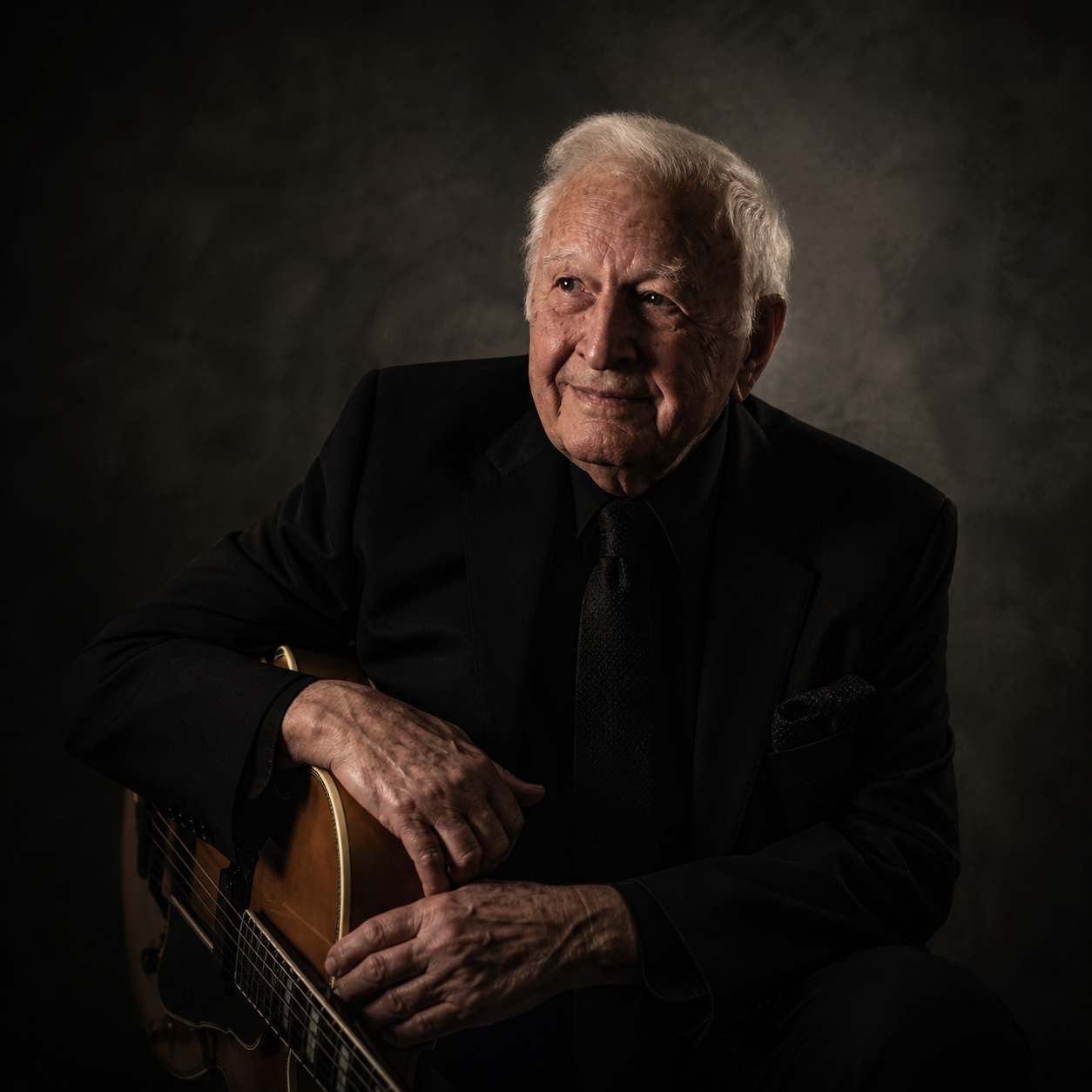
Bucky Pizzarelli
Bucky Pizzarelli – Seven-String Guitar, Timeless Swing and Audiophile Jazz
There are jazz musicians whose playing immediately draws attention to technique, and there are musicians who make difficult things sound so natural that technique almost disappears. Bucky Pizzarelli belonged to the latter group. For decades, the American guitarist represented a direct connection with the great tradition of swing guitar, combining remarkable technical control with warmth, rhythm and an instinctive understanding of the American jazz songbook. His distinctive seven-string guitar gave him an unusually rich tonal range, while his elegant playing made him equally convincing as a soloist, accompanist and ensemble musician.
For lovers of audiophile jazz guitar, acoustic guitar recordings and classic swing, Pizzarelli’s catalogue offers another attraction. Several of his recordings appeared on Chesky Records, a label closely associated with natural, spacious and high-quality audiophile recordings. Albums such as Swing Live make it easy to understand why his music works so well on a revealing hi-fi system. Rather than depending on spectacular studio effects, the pleasure comes from the physical character of the guitar: the initial attack of the strings, the resonance of the instrument and the subtle rhythmic details that turn a collection of notes into genuine swing.
From the Big Band Era to Modern Jazz
Born John Paul Pizzarelli in Paterson, New Jersey, in 1926, Bucky Pizzarelli built a career that connected several generations of American jazz. He toured with Vaughn Monroe, became an experienced studio and broadcast musician and worked with an extraordinary range of performers during a professional life stretching across many decades. His associations included musicians such as Benny Goodman, Zoot Sims, Stéphane Grappelli and George Barnes, placing him in direct contact with some of the most important figures in swing and mainstream jazz.
Pizzarelli was particularly admired for his mastery of the seven-string guitar. The additional low string extended the instrument’s bass range and allowed him to combine chordal playing, bass movement and melodic lines in ways that could make a single guitar sound remarkably complete. This approach was influenced in part by the tradition of seven-string guitarist George Van Eps, while Pizzarelli’s rhythmic playing also reflected his admiration for great swing guitarists such as Freddie Green.
What distinguished Pizzarelli, however, was not simply the unusual instrument. His playing possessed a relaxed authority that came from decades spent inside the music. Even technically demanding passages rarely sounded like demonstrations. Chords, melodies and bass lines seemed to belong naturally together, giving his performances the effortless quality that often separates a great jazz musician from a merely accomplished one.
Swing Live – Bucky Pizzarelli in Audiophile Sound
For anyone interested in Bucky Pizzarelli audiophile recordings, Swing Live is an essential album. Recorded for Chesky Records and released in 2001, it captures Pizzarelli alongside clarinetist Allan Vaché, vibraphonist Peter Appleyard, bassist Michael Moore and drummer Bernard Purdie. The combination creates a classic jazz sound built around swing, musical communication and the natural character of acoustic instruments.
The album is particularly interesting because the qualities of Pizzarelli’s playing fit perfectly with the audiophile recording philosophy. His guitar does not require exaggerated treble to reveal detail. A good system should reproduce the initial contact with the strings, followed by the body and harmonic character of the instrument, while retaining enough space around the guitar for it to exist naturally within the ensemble.
Listen carefully to the relationship between guitar and double bass. Both instruments occupy part of the lower frequency range, yet they should remain clearly distinguishable. The vibraphone introduces another challenge, combining a fast initial attack with long metallic resonance, while clarinet requires a smooth and convincing midrange. Drums add the final test of transient speed and dynamics. Together, these instruments make Swing Live an excellent recording for evaluating stereo imaging, instrumental separation, timbre and dynamic realism without ever turning the music into a sterile hi-fi demonstration.
The Chesky Records Connection
Bucky Pizzarelli’s association with Chesky Records makes him particularly interesting for audiophile listeners. The label built its reputation around creating recordings intended to preserve the impression of musicians performing within a real acoustic space, using careful microphone placement and recording techniques designed to retain spatial and tonal information.
That philosophy suits Pizzarelli exceptionally well because so much of his musical character exists in small details. The seven-string guitar has both delicacy and surprising weight, and a natural recording allows the listener to hear the transition from the higher melodic strings into the deeper register without making the instrument sound artificially enlarged. The objective is not simply to produce more detail, but to preserve the relationship between musician, instrument and recording space.
Swing Live became a notable example of that combination of performance and sound quality, receiving recognition from Stereophile as a Recording of the Month in 2002. For anyone searching for Chesky Records audiophile albums, reference jazz recordings or audiophile guitar music, it is therefore an obvious place to begin.
The Art of the Seven-String Guitar
The seven-string guitar was central to Bucky Pizzarelli’s musical identity. By adding a lower string to the conventional six-string instrument, he gained access to a deeper register that allowed bass notes to become an integrated part of chordal and melodic playing. In the hands of a lesser musician, the additional range could easily become a novelty. With Pizzarelli, it became part of a sophisticated musical vocabulary.
For audiophiles, the extended range also makes his guitar particularly interesting. A properly reproduced acoustic or amplified jazz guitar should combine clarity with body. If a system emphasizes the upper frequencies too strongly, the strings can become hard and metallic; if the lower midrange is excessive, chords lose definition and the instrument becomes unnaturally warm. Pizzarelli’s seven-string playing exposes both problems because the instrument moves so naturally between bass notes, chords and melodic phrases.
On a balanced system, the result is wonderfully convincing. Individual strings retain their character, chords have harmonic richness and the lower register provides foundation without becoming disconnected from the rest of the instrument. This makes Bucky Pizzarelli’s guitar recordings excellent reference material for evaluating tonal balance and midrange realism.
Bucky and John Pizzarelli – Two Generations of Jazz Guitar
An important part of Bucky Pizzarelli’s later career was his musical relationship with his son, John Pizzarelli, who developed into a celebrated jazz guitarist and vocalist in his own right. The two recorded together on several occasions, creating a fascinating meeting between generations that shared the same musical language while retaining individual personalities.
Recordings such as Generations, Contrasts and their other collaborations demonstrate how naturally the two guitarists communicated. Rather than turning their performances into technical competitions, they created musical conversations in which accompaniment and soloing constantly changed roles. For listeners interested in jazz guitar duets and audiophile acoustic guitar, these recordings can be particularly rewarding because two similar instruments force an audio system to reproduce subtle differences in tone, position and articulation.
The family connection adds another dimension. Bucky Pizzarelli spent much of his career preserving and developing a guitar tradition reaching back to the swing era, while John carried elements of that tradition into a younger generation. Their recordings together therefore sound not merely like collaborations between two accomplished guitarists, but like a musical language being passed from father to son.
Why Bucky Pizzarelli Belongs in an Audiophile Collection
Jazz guitar can be deceptively difficult to reproduce convincingly. The instrument occupies a frequency range where tonal balance is extremely important, and much of its identity is contained in relatively small details: the attack of a pick, the vibration of a string, the resonance following a chord and the slight variations in timing that create swing. A revealing system should make these details easier to hear without artificially emphasizing them.
This is why Bucky Pizzarelli is such an interesting artist for audiophile listening. His music does not rely on enormous bass, extreme dynamics or spectacular studio production. Instead, it asks an audio system to reproduce instruments naturally and preserve the rhythmic relationship between musicians. When the reproduction is correct, the guitar has texture and physical presence, the double bass remains controlled, cymbals retain their metallic character and the recording space becomes part of the performance.
His catalogue is therefore an excellent addition for listeners building a collection of audiophile jazz, reference guitar recordings, seven-string guitar music, swing jazz and high-quality acoustic recordings. It provides a useful contrast to the female vocal and large-scale demonstration tracks commonly found on audiophile playlists because the attraction is based primarily on timbre, timing and musical interaction.
Discovering Bucky Pizzarelli on YouTube Music
For listeners exploring Bucky Pizzarelli through YouTube Music and digital music streaming, Swing Live is an excellent starting point, particularly for those interested in sound quality. From there, albums such as Generations, Five for Freddie, Contrasts and his various guitar collaborations reveal different aspects of a remarkably long career. His recordings with John Pizzarelli are especially worthwhile for listeners who enjoy the sound of multiple jazz guitars interacting within an intimate acoustic setting.
Exploring his catalogue also opens a door into a much broader history of swing guitar and mainstream jazz. Pizzarelli’s musical world connects the traditions of Freddie Green, Django Reinhardt and George Van Eps with later generations of jazz guitarists, yet his own playing remains immediately recognizable. The seven-string instrument gave him additional possibilities, but his real signature was the relaxed rhythmic confidence behind every performance.
Bucky Pizzarelli died in 2020 at the age of 94, leaving behind a recording career that spans an extraordinary period in American jazz. For audiophile listeners, albums such as Swing Live preserve something especially valuable: not simply the sound of a beautiful guitar, but the atmosphere of experienced jazz musicians communicating naturally with one another. Through a good pair of loudspeakers or headphones, the strings have texture, the instruments occupy their own spaces and the swing feels effortless. That is ultimately what makes Bucky Pizzarelli worth returning to. The recording quality may attract the audiophile, but it is the warmth, elegance and timeless rhythm of his guitar that keeps the music playing.


