
Friend ‘n Follow
GREAT CHOICE: Friend ‘n Follow!
Great music deserves to be discovered, enjoyed and shared.
CAN YOU SPARE A CUP OF COFFEE?
Audiophile-Streaming is a personal passion project, built with countless hours of discovering, selecting and sharing exceptional music.
I personally cover, without sponsors, the ongoing costs of hosting, software and subscriptions to keep the music discoveries coming. If you enjoy my work, your support is always appreciated.
A LITTLE THANK YOU IN RETURN
Just one coffee gives you lifetime access to the Coffee Club and all its playlists.
No subscriptions. No recurring fees.
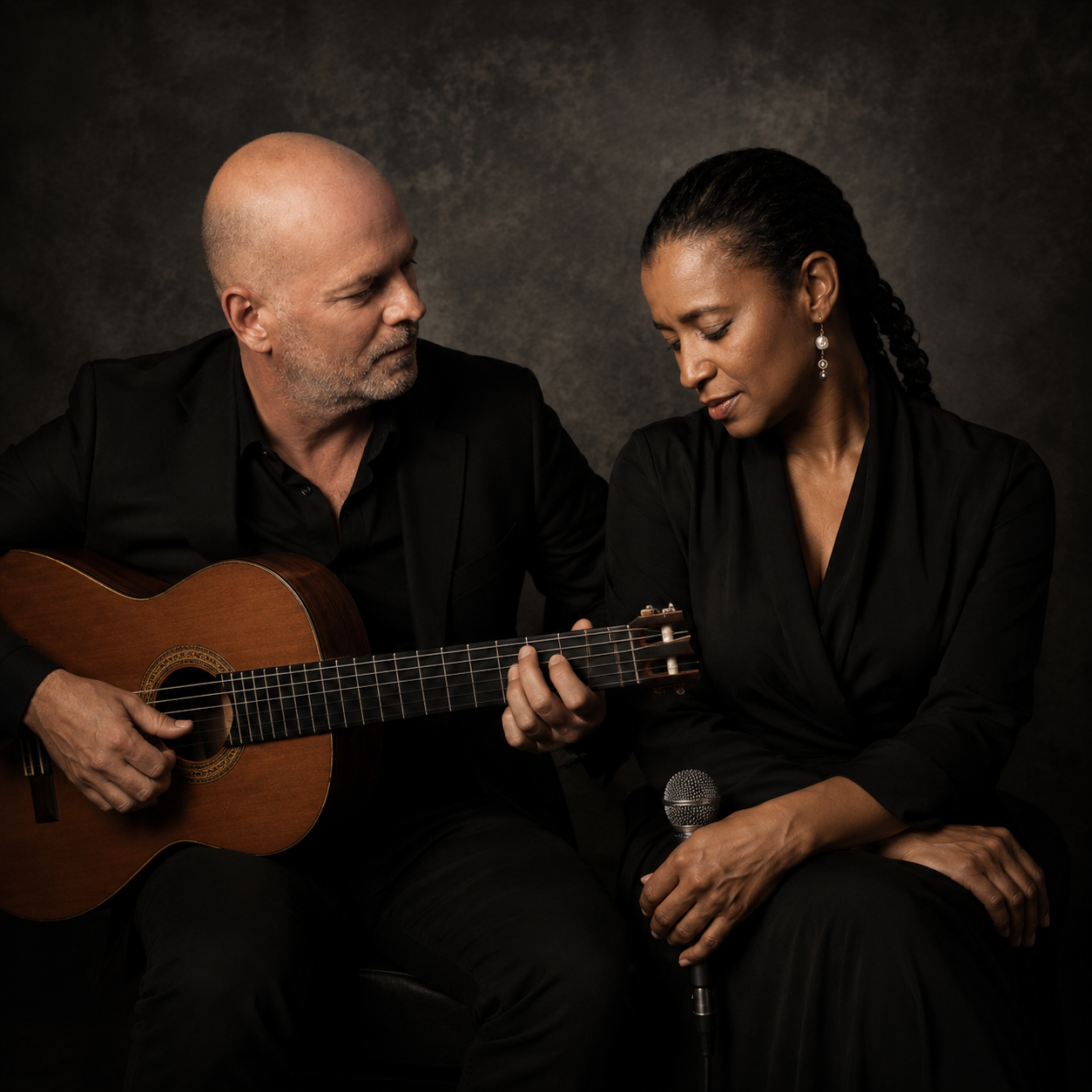
There are only two musicians in Friend ‘n Follow, but the sound they create is remarkably complete. A deep, soulful female voice and an acoustic guitar are all that German duo Friend ‘n Fellow need to make music that can be intimate, powerful and surprisingly rhythmic. Singer Constanze Friend and guitarist Thomas Fellow have spent decades developing a musical partnership that crosses the boundaries between soul, blues, jazz and acoustic pop. For me, their greatest strength is the way they make familiar songs sound fresh without losing what made those songs special in the first place. They are also particularly interesting from an audiophile perspective, because their stripped-down arrangements leave very little room for either the musicians or the recording to hide.
The duo’s story began in 1991 with a concert in Leipzig, Germany. Constanze had studied modern singing in Weimar and previously performed with the R&B band Mr. Adapoe, appearing at European festivals and supporting musicians including James Brown and Alvin Lee. Thomas came from a different musical background, having studied classical guitar for seven years in Weimar, won prizes at international competitions and performed internationally. Combining these experiences gave Friend ‘n Fellow a musical identity that was neither traditional acoustic folk nor conventional jazz. Constanze brought the emotional directness of soul and blues, while Thomas contributed the technique and arranging ability of a classically trained guitarist. I find that contrast fascinating, especially when his intricate playing provides a surprisingly strong rhythmic foundation beneath her relaxed vocal delivery.
Their early career gradually developed into an international success story. The duo released Fairy Godmother independently in 1995, followed by Home in 1997 and Purple Rose in 1998, both through Ruf Records. Their performances took them across Europe and eventually to audiences in Asia and the United States, including appearances alongside Ray Charles, Al Jarreau and Luther Allison. What interests me most about this period is how they established themselves without abandoning their simple musical format. Instead of adding more instruments to create a bigger sound, they concentrated on making the interaction between voice and guitar more expressive. That decision became the foundation of their musical personality and an important reason their recordings appeal to serious listeners.
Two Musicians, One Complete Sound
I consider Covered, released by Ruf Records in 2005, one of the most useful introductions to Friend ‘n Fellow. The album demonstrates their ability to reinterpret well-known songs without treating the originals as untouchable classics. Their versions of “What a Wonderful World”, “Light My Fire” and “Fly Like an Eagle” reveal how much can be accomplished through changes in phrasing, rhythm and guitar arrangement. On “What a Wonderful World”, I particularly appreciate the contrast between Constanze’s low, expressive voice and the clarity of Thomas’s acoustic guitar. Her singing has a natural warmth, while his playing supplies the harmony, rhythmic movement and instrumental detail without overwhelming the melody.
“Light My Fire” is another interesting example because a song associated with a completely different instrumental sound becomes a showcase for acoustic interpretation. Thomas manages to give the music movement and rhythmic energy while leaving Constanze enough space to shape the vocal phrases. I enjoy listening to the way the guitar alternates between supporting the voice and briefly taking over the musical conversation. With good speakers or headphones, the different elements of his playing are easy to follow, particularly the relationship between the bass notes and the higher strings. It is an excellent reminder that a convincing sense of rhythm does not necessarily require a drummer or a separate bass player.
The duo continued exploring their own material with Crystal in 2006 and Lady in 2009. These recordings also demonstrate that Friend ‘n Fellow are more than accomplished interpreters of other people’s songs. Lady is particularly interesting because the musicians approached it with a warmer, earthier sound, drawing inspiration from Tenerife, where almost all its songs were written. The album was recorded with Jannique and Thomas Adapoe, bringing Constanze’s earlier musical connections into another phase of the duo’s career. For me, this development shows their willingness to explore different moods and arrangements without losing the direct musical communication that defines their work.
Discovered, released in 2010, marked another important step by bringing the duo back to reinterpretations of established songs. Their version of Eurythmics’ “Here Comes the Rain Again” is a particularly good example of their approach, alongside their interpretation of Coldplay’s “Clocks”. Both songs originally depend on instrumental arrangements that are quite different from the duo’s acoustic format. Friend ‘n Fellow concentrate instead on the melody, rhythmic structure and emotional character of each composition. I appreciate that they are not simply producing quieter copies of familiar recordings. They find different ways to express the songs, although listeners strongly attached to the original arrangements may need a little time to appreciate the change.
For anyone interested in audiophile recordings, “Here Comes the Rain Again” is an especially worthwhile listening choice. Constanze’s lower register gives the melody a different character, and I like how the guitar maintains the song’s forward movement without relying on the original electronic production. A revealing audio system allows me to concentrate on the vocal texture, the individual guitar notes and the way the two musicians coordinate their timing. The relatively uncomplicated arrangement also makes it easier to notice whether the midrange sounds natural and whether the guitar retains its distinctive string character. What matters most to me, however, is that the performance remains musical rather than becoming merely an exercise in sound quality.
The Energy of a Live Performance
The 2016 album Silver Live offers another perspective on their musical partnership. Recorded during their 2015 About April tour, it celebrated 25 years of Friend ‘n Fellow and captured the qualities that had made their concerts so popular. I particularly like their live interpretation of U2’s “With or Without You”, which demonstrates how effectively they can build musical intensity with just two performers. Thomas’s guitar provides the rhythmic structure and harmonic foundation, while Constanze has the freedom to vary her phrasing and gradually increase the emotional intensity. The live setting adds another dimension because the performance feels spontaneous rather than carefully constructed from separate studio parts. For listeners interested in dynamics, guitar articulation and the atmosphere of a concert recording, Silver Live is well worth exploring.
Another development came with Characters, released by Doctor Heart Music in 2019. Rather than concentrating on familiar material, the duo presented twelve individual stories connected by the personalities of their characters. Songs including “Postman”, “Stranger” and “King” reflect their growing interest in acoustic blues and storytelling. I find this direction interesting because it demonstrates that their musical relationship has continued to evolve rather than depending entirely on the popularity of their earlier interpretations. Their songwriting gives Constanze different opportunities to explore the meaning of the lyrics, while Thomas can develop arrangements around the particular mood and rhythm of each story. The album is also an indication of how comfortable they have become with the musical freedom offered by their unusual instrumental combination.
Thomas’s work outside the duo is another important part of their story. As a professor at the Hochschule für Musik Carl Maria von Weber in Dresden, he has been involved in developing acoustic guitar education and sharing his experience with younger musicians. He also established the European Guitar Award and wrote The Fellow Guitar Book, published by Schott Music. His approach to guitar accompaniment is particularly relevant to the music he creates with Constanze. Rather than treating the guitar as an instrument that simply provides chords beneath a singer, he approaches it as a complete musical partner, capable of handling several musical functions simultaneously. Hearing that philosophy expressed so naturally in Friend ‘n Fellow’s recordings is one of the things I admire most about his playing.
For someone discovering Friend ‘n Fellow, I would begin with Covered, continue with Discovered and then explore Silver Live to hear how their music develops on stage. Their recordings are especially rewarding on a balanced audio system that reproduces acoustic instruments and the human voice convincingly, without exaggerated bass or excessive brightness. But their importance extends beyond sound quality. From their first concert in Leipzig to their original compositions on Characters, Constanze Friend and Thomas Fellow have demonstrated how much musical variety two experienced performers can create together. Some interpretations may be quite different from what listeners expect, but that willingness to reconsider familiar music is an essential part of their identity. Ultimately, what makes Friend ‘n Fellow special to me is the natural musical communication between Constanze’s expressive voice and Thomas’s exceptionally versatile acoustic guitar.
HiFi’ve, Ronald – Your EarFluencer
