
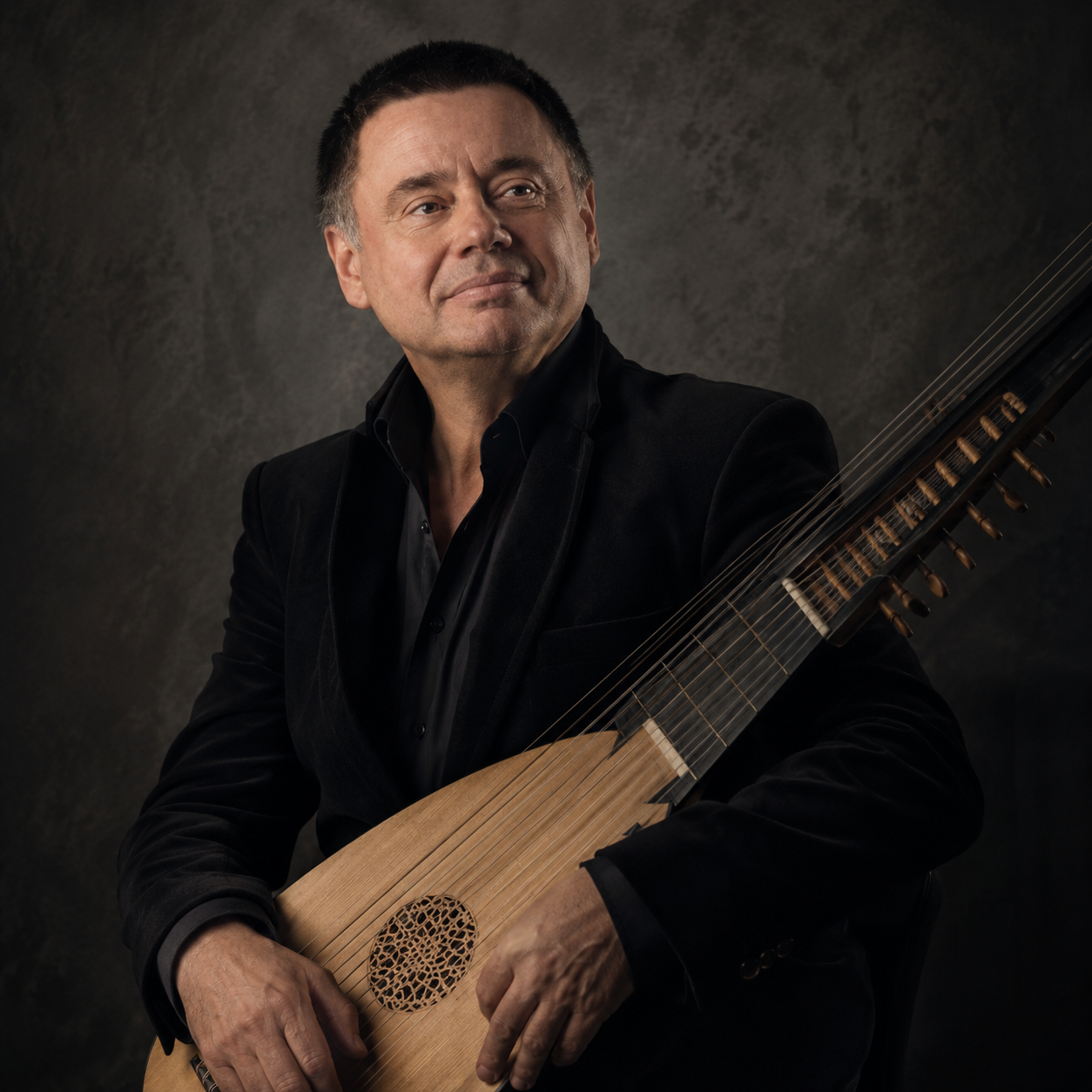
Edin Karamazov
GREAT CHOICE: Edin Karamazov!
Great music deserves to be discovered, enjoyed and shared.
CAN YOU SPARE A CUP OF COFFEE?
Audiophile-Streaming is a personal passion project, built with countless hours of discovering, selecting and sharing exceptional music.
I personally cover, without sponsors, the ongoing costs of hosting, software and subscriptions to keep the music discoveries coming. If you enjoy my work, your support is always appreciated.
A LITTLE THANK YOU IN RETURN
Just one coffee gives you lifetime access to the Coffee Club and all its playlists.
No subscriptions. No recurring fees.
Edin Karamazov is the kind of musician every serious hi-fi listener should experience at least once, because his playing brings the listener frighteningly close to the physical reality of plucked strings, resonating wood, room air and silence. He is not simply a lute player or classical guitarist; he is a sound sculptor with historical depth, technical brilliance and a rare sense of drama. In an age where so much music is polished, compressed and flattened for convenience, Karamazov reminds us what acoustic music can do when it is allowed to breathe.
His genre world is mainly classical music, early music, Renaissance and Baroque repertoire, with strong connections to folk traditions and contemporary crossover projects. Born in 1965 in Zenica, Bosnia and Herzegovina, Edin Karamazov began his musical path as a classical guitarist and later became one of the most distinctive modern masters of the Baroque lute. He studied with Hopkinson Smith at the Schola Cantorum Basiliensis in Switzerland, one of the great centres for historically informed performance, and he was also connected with the influence of conductor Sergiu Celibidache. His career has taken him from major early music ensembles to collaborations with some of the world’s most admired singers and instrumentalists.
For audiophiles, the attraction is immediate. Karamazov’s instrument lives in the small details: the attack of a fingertip on a string, the bloom of a chord, the faint decay of a note into the acoustic space. A good system reveals the architecture of his playing. You hear not only melody, but pressure, wood, string tension, timing and breath. His music is perfect for testing natural timbre, micro-dynamics and stereo realism. Unlike large orchestral recordings, where scale can sometimes hide detail, lute and guitar recordings expose everything. If the recording is honest and the system is capable, Karamazov’s playing can sound almost present in the room.
His most famous international recording is undoubtedly Songs from the Labyrinth, the 2006 Deutsche Grammophon album with Sting, built around the music of Renaissance composer John Dowland. It was an unusual project: a global pop figure entering the world of Elizabethan lute songs with a serious classical musician at his side. The result introduced many listeners to Dowland’s melancholy world and to Karamazov’s refined, atmospheric lute playing. The album reached a broad audience and became one of the best-known modern crossover projects connected to Renaissance music.
Another essential recording is The Lute Is a Song, Karamazov’s solo-centred Decca project, which features guests including Sting, Renée Fleming and Kaliopi. This album is especially interesting because it shows his artistic personality beyond accompaniment: poetic, daring, elegant and open to dialogue between old and new musical languages. He is also important for his work with countertenor Andreas Scholl, including Wayfaring Stranger, where his lute and guitar work supports one of the great voices in early and folk-inspired classical repertoire.
The positives are clear. First, Karamazov has exceptional tonal control: every note feels placed, shaped and emotionally weighted. Second, his recordings reward serious listening because they are rich in space and transient detail. Third, he connects the old world and the modern listener without turning early music into museum music. Fourth, he brings a sense of risk and personality to repertoire that can sometimes sound academically correct but emotionally distant. With Karamazov, Dowland, Bach or folk-inspired material becomes intimate, human and alive.
In audiophile terms, the best starting point is Songs from the Labyrinth with Sting for accessibility and atmosphere, especially if you want voice and lute in a beautifully sparse soundstage. For a more direct view of Karamazov himself, The Lute Is a Song is the stronger artistic portrait, with more variety and more focus on his instrumental colour. Wayfaring Stranger with Andreas Scholl is also highly recommended for lovers of voice, lute and chamber-scale realism. There is no reliable evidence that his key albums are native DSD recordings, so I would not market them as true DSD audiophile releases. The best hi-fi approach is to look for lossless or hi-res versions on platforms such as Qobuz, Apple Music Classical, Tidal or Decca/Deutsche Grammophon-related services, where available.
A practical audiophile ranking would place The Lute Is a Song at the top for instrumental beauty, intimacy and tonal nuance; Songs from the Labyrinth very close behind for atmosphere, cultural importance and the magical contrast between Sting’s voice and Karamazov’s lute; and Wayfaring Stranger as an essential vocal-instrumental recording with excellent chamber-music refinement. These are not “spectacular” hi-fi albums in the loud, show-off sense. They are better than that: they are quiet truth-tellers. They reveal whether a system can reproduce subtlety, not just power.
