
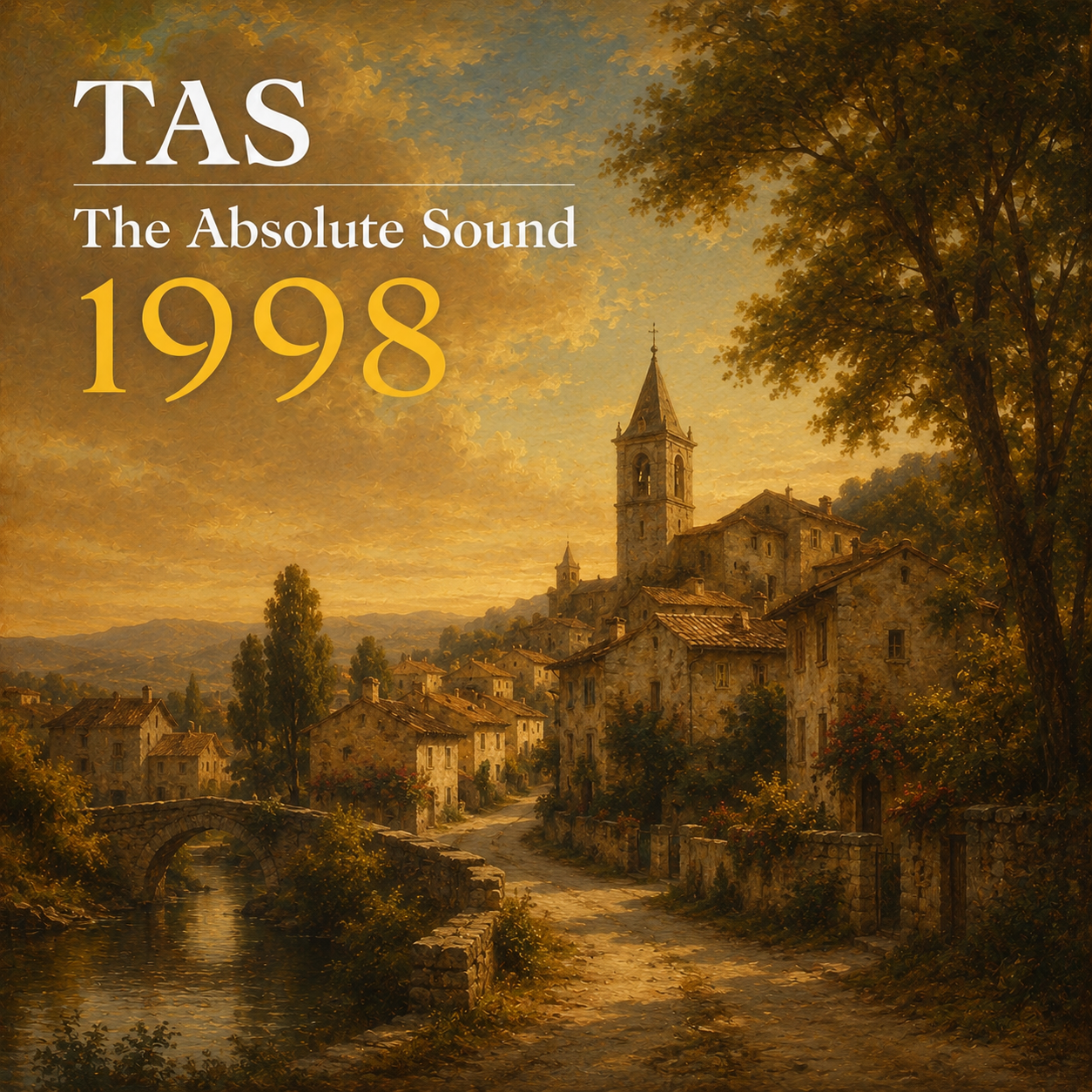
The Absolute Sound
1998
The Absolute Sound 1998, A Glorious Audiophile Journey Around the Musical World
By the time The Absolute Sound 1998 appeared as the third chapter in the celebrated TAS audiophile series, the collection had already begun to develop a recognisable character. The previous editions had demonstrated that an audiophile compilation could be technically revealing without becoming cold or predictable, but the 1998 album carried that philosophy further by creating a musical journey of unusual variety, colour and emotional depth. Released under the Aurora Music International label, The Absolute Sound 1998 brought together vocal jazz, classical music, traditional folk, atmospheric world music and beautifully recorded instrumental performances, allowing each track to open a different window onto the possibilities of high fidelity sound.
The attraction of this album begins with its sense of discovery. It does not behave like a conventional collection of popular songs assembled simply to fill a compact disc, nor does it feel like a clinical test recording designed only for audio demonstrations. Instead, The Absolute Sound 1998 unfolds like a carefully written travel story in which every new chapter introduces another musical landscape. One moment the listener is surrounded by spacious percussion and mysterious atmosphere, while the next brings the warmth of an intimate vocal, the elegance of a familiar melody or the thrilling precision of a virtuoso classical performance. This broad musical vision is exactly what makes the album such a valuable audiophile reference recording, because a truly outstanding hi fi system must be able to reproduce far more than one genre or one type of sound.
The journey begins with Earth Dancer: Genesis, an evocative opening that immediately establishes the album’s sense of scale and atmosphere. It is the kind of recording that encourages the listener to sit back and notice how the sound develops within the room, with small details appearing from a deep and carefully layered background. On a transparent high end audio system, the presentation feels expansive rather than artificially enlarged, revealing ambience, tonal texture and subtle spatial information without losing the emotional flow of the music. As an opening track, it acts as both an invitation and a challenge, asking the loudspeakers to disappear while the recording itself takes command of the listening space.
That atmospheric beginning leads naturally into This Piece of Earth by West of Eden and Motherland by Tian Jiang, recordings that give The Absolute Sound 1998 a strong international character. The album’s world music selections are not included merely to create variety, because they play an important role in testing tonal colour, rhythm and instrumental realism. Traditional instruments can be especially revealing through a serious stereo system, since their complex harmonics quickly expose an unnatural treble, a coloured midrange or a lack of rhythmic precision. When reproduced correctly, these performances possess texture and life, allowing strings, percussion and voices to retain their individual identity while remaining connected within the wider musical arrangement.
Tian Jiang returns with Shanghai Dream, and the track deepens the album’s sense of travel by introducing another delicately drawn musical scene. The piano becomes an important instrument for evaluating audio equipment because it combines percussive attack, harmonic richness and a long natural decay. An average loudspeaker may reproduce the notes clearly enough, but the best audiophile speakers allow the listener to hear the body of the instrument, the weight of each key and the fading resonance that follows. Shanghai Dream can therefore serve as excellent piano test music, yet its real achievement lies in the beauty and calm of the performance. Like the finest audiophile recordings, it remains rewarding even after the listener has stopped thinking about sound quality.
The vocal selections give the album its human centre, particularly Carol Kidd’s That’s Me, which brings intimacy and personality into the listening room. Carol Kidd has long been admired by lovers of female vocal audiophile music, and this performance shows why her voice can be so effective for testing midrange clarity and emotional realism. Through well balanced loudspeakers or reference headphones, the vocal should sound focused but never trapped between the speakers, warm but never heavy, and detailed without becoming unnaturally sharp. The finest audio systems reveal the small changes in phrasing and tone that make the performance personal, while poorer equipment may flatten those differences and reduce the singer to a generic central image.
Ulla Neumann’s Feelings and Jack Jones’s Color of the Wind continue this vocal thread while offering different shades of expression. Their inclusion demonstrates that The Absolute Sound 1998 is not interested in one narrow definition of audiophile perfection. Some recordings impress with scale, others with transparency, and others with the ability to communicate a lyric directly and naturally. Together, these tracks make the album useful for evaluating vocal presence, sibilance control, tonal balance and the smoothness of the upper midrange. More importantly, they ensure that the technical qualities of the recording are always tied to a recognisable human emotion.
As the album moves through Émile Carrara’s In the Mood and Michiko’s After 9, its rhythm becomes lighter and more playful. These performances reveal another important quality of a good hi fi system, namely its ability to preserve musical timing. Audiophile sound is often discussed in terms of detail, bass extension and soundstage width, but music can lose its excitement when an audio system sounds slow or disconnected. The Absolute Sound 1998 provides several opportunities to judge whether a system can keep instruments moving together with energy and precision. Bass notes must remain controlled, melodic lines should flow naturally and the entire performance should maintain a sense of momentum rather than becoming a collection of isolated sounds.
One of the most striking moments arrives with Ar Galon Digorr by Annie Ebrel and Gilles Le Bigot, featuring a richly textured combination of voice and traditional instrumentation. This is precisely the kind of audiophile folk recording that can transform a listening room. The voice carries both strength and vulnerability, while the instrumental accompaniment creates a broad acoustic environment around it. When the stereo imaging is correct, the performance feels open and believable, with each element occupying its own space without losing the unity of the music. The track is especially effective for testing speaker placement, because even a small adjustment in toe in or listening position can change the focus of the voice and the perceived depth of the surrounding instruments.
Jeff Leyton’s Music of the Night adds theatrical scale to the collection, while the Paganini selection In cuor più non mi sento, performed by Stefan Milenković with Riccardo Agosti and Pier Domenico Sommati, brings classical virtuosity and dynamic contrast. The violin can be one of the most demanding instruments for any loudspeaker or headphone, because an overly bright system can make its upper register sound aggressive, while a dull system can remove its brilliance and energy. A properly balanced high end stereo system should preserve the speed, texture and intensity of the bow without turning the instrument into a hard or metallic sound. The performance also tests transient response, instrumental separation and amplifier control, making it one of the most valuable classical reference tracks on the album.
The closing part of The Absolute Sound 1998 continues the international journey with Vänner och fränder by Folk & Rackare and Flower of Scotland, associated with the Celtic tradition. These final selections bring the album back to the qualities that have defined it from the beginning, namely atmosphere, cultural variety and a strong sense of place. Folk music can sound deceptively simple, yet its natural instruments and exposed voices are often extremely demanding to reproduce convincingly. The listener should hear wood, string, breath and room ambience rather than an artificially polished studio image, and the best audio systems allow these details to emerge without disrupting the emotional continuity of the performance.
For listeners searching for the best audiophile album to test speakers, The Absolute Sound 1998 remains a remarkably complete choice. Its fourteen tracks examine many of the qualities that determine whether a hi fi system is genuinely musical, including stereo imaging, soundstage depth, vocal realism, bass definition, treble smoothness, dynamic range and instrumental texture. The album can expose loudspeakers that sound impressive but unnatural, amplifiers that lose control during demanding passages and headphones that exaggerate detail at the expense of tonal balance. At the same time, it never reduces the listening experience to a technical examination, because every test is hidden within music that deserves attention in its own right.
This balance also makes the album ideal for comparing a DAC, CD player, network streamer or amplifier. A better source may reveal more ambience around a voice, while a more capable amplifier can produce greater stability, stronger bass control and a more effortless sense of scale. The most meaningful improvement, however, is not simply the appearance of extra detail. It is the moment when the performance sounds more coherent, when the musicians appear more present and when the listener becomes less aware of the equipment standing between the recording and the room.
The Absolute Sound 1998 should therefore be regarded not merely as the third volume of a collectable audiophile CD series, but as a beautifully conceived musical document from an era when carefully selected reference recordings played an essential role in high end audio culture. Its combination of world music, female vocals, classical performances, folk traditions and instrumental colour gives the album an identity that still feels fresh and adventurous. Although playback technology has moved from compact disc toward lossless streaming and high resolution audio, the fundamental qualities of a great recording have not changed, and this collection continues to demonstrate that realism, emotion and musical atmosphere remain more important than format alone.
The final verdict is unreservedly positive, because The Absolute Sound 1998 succeeds both as a serious audiophile test album and as a deeply enjoyable listening experience. It can help optimise speaker placement, compare audio components and reveal the full potential of a high end sound system, yet it is just as satisfying when played simply for pleasure. Its carefully chosen performances create a coherent journey across musical cultures, and its recording quality allows every voice and instrument to communicate with clarity and warmth.
For collectors of the TAS series, The Absolute Sound 1998 is an essential chapter. For music lovers discovering audiophile recordings for the first time, it is an inviting introduction to the pleasures of high fidelity sound. For experienced listeners searching for the best reference music for testing speakers and headphones, it remains a valuable and rewarding companion. Above all, it is an album that proves the finest audio equipment achieves its purpose only when it disappears, leaving the listener alone with the music

