
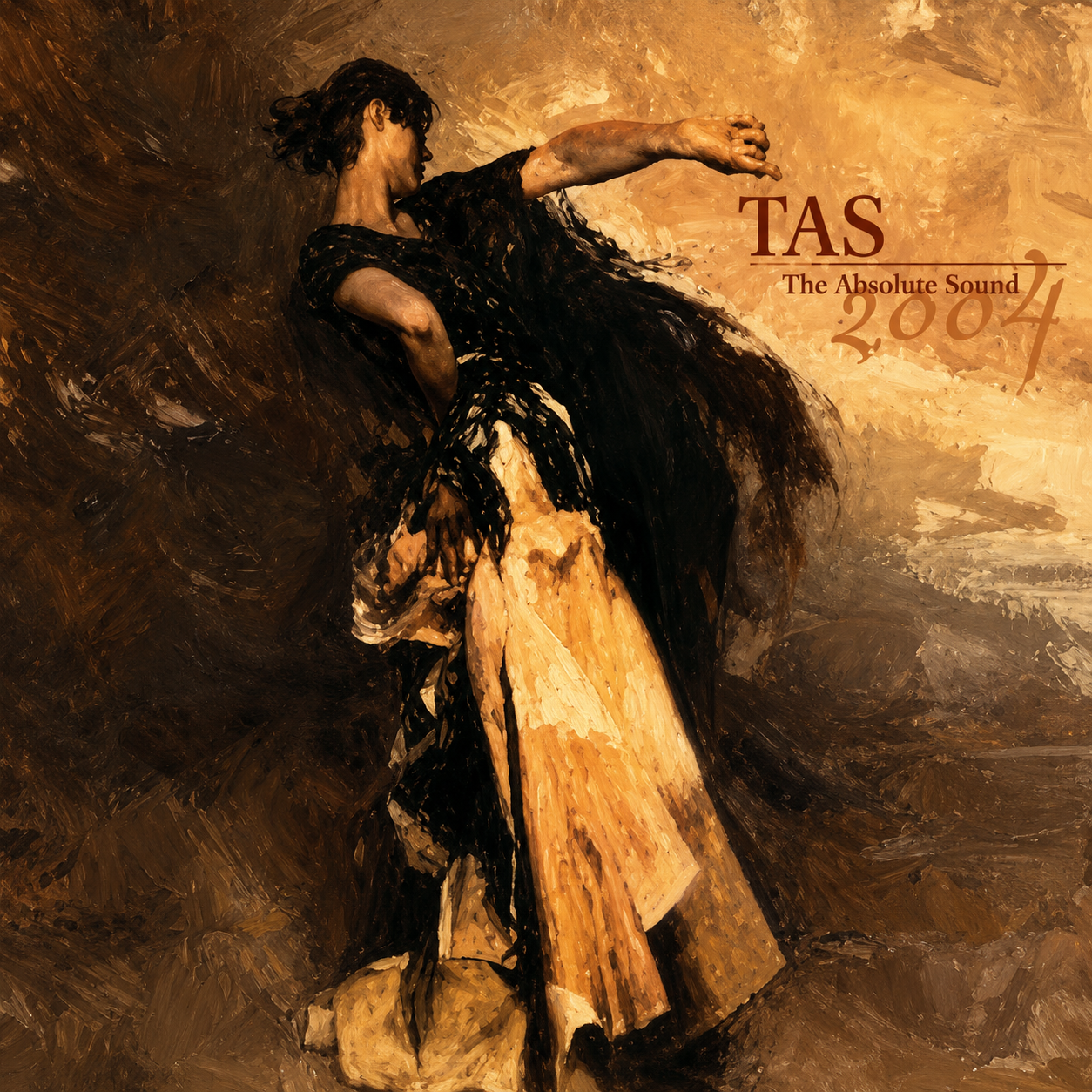
The Absolute Sound
2004
GREAT CHOICE: The Absolute Sound 2004!
Great music deserves to be discovered, enjoyed and shared.
CAN YOU SPARE A CUP OF COFFEE?
Audiophile-Streaming is a personal passion project, built with countless hours of discovering, selecting and sharing exceptional music.
I personally cover, without sponsors, the ongoing costs of hosting, software and subscriptions to keep the music discoveries coming. If you enjoy my work, your support is always appreciated.
A LITTLE THANK YOU IN RETURN
Just one coffee gives you lifetime access to the Coffee Club and all its playlists.
No subscriptions. No recurring fees.
The Absolute Sound 2004, An Audiophile Masterpiece Filled with Voices, Atmosphere and Musical Beauty
Some albums impress by making an immediate display of power, while others earn their place in a music collection more quietly, revealing their character little by little until the listener realises that an entire evening has passed. The Absolute Sound 2004 belongs to this second and more enduring kind of recording. It does not behave like a collection of disconnected demonstration tracks, nor does it present sound quality as an empty spectacle. Instead, it unfolds like a carefully written book in which every performance becomes a new chapter, every voice introduces another emotional colour and every instrument leads the listener deeper into the rich world of high fidelity music.
Released as part of the celebrated TAS audiophile series, The Absolute Sound 2004 is a beautifully assembled journey through classical music, jazz, folk, vocal recordings, piano music and timeless popular melodies. Its sixteen tracks move naturally between intimacy and grandeur, allowing the album to test the precision of a high end audio system while remaining deeply enjoyable as music. This combination of technical excellence and emotional warmth is what makes the collection so valuable, because the best audiophile albums do more than reveal equipment. They create the sensation that the equipment has disappeared.
From the first track onward, The Absolute Sound 2004 invites the listener into a spacious and carefully balanced world. Depart in Peace by the Scottish Ensemble begins the journey with grace, texture and an atmosphere of quiet concentration. The strings appear with delicacy but never fragility, carrying enough body to sound like real instruments rather than thin lines of treble suspended between the speakers. On a well matched stereo system, the ensemble gains width and depth, while the natural reverberation surrounding the players creates the impression of a real acoustic space extending beyond the walls of the listening room.
This opening makes the album immediately valuable as classical reference music for testing speakers and headphones. String recordings can expose an unbalanced system within seconds, because excessive high frequency energy turns the instruments sharp and metallic, while insufficient resolution removes the fine texture of the bow and the resonance of the wooden bodies. The best audiophile speakers allow the Scottish Ensemble to sound smooth, expressive and alive, preserving the energy of the performance without sacrificing refinement.
The mood changes with Eriskay Love Lilt, performed by Willard White, whose magnificent voice brings weight, dignity and humanity to the album. A deep male voice is an exceptional test of midrange realism because it asks an audio system to reproduce richness without muddiness and power without exaggeration. Through a transparent amplifier and carefully positioned loudspeakers, White’s voice should appear stable and substantial, with every phrase supported by natural resonance rather than artificial bass emphasis.
This is one of those moments when The Absolute Sound 2004 demonstrates the true meaning of audiophile vocal music. The value of the recording is not merely that the voice sounds impressive, but that it sounds recognisably human. Breath, tone and emotion remain connected, allowing the performance to communicate directly rather than becoming a technical showcase. A good system reproduces the notes, but an exceptional high end audio system reveals the presence behind them.
The familiar melody of Vincent, also known as Starry, Starry Night, arrives through Chloë with an atmosphere of tenderness and reflection. The song is ideally suited to close listening because its emotional strength depends upon nuance rather than volume. The voice must remain clear and intimate, while the accompaniment needs enough space to support the singer without surrounding her in an artificial cloud of sound.
As a female vocal reference track, Vincent can reveal whether a system handles the upper midrange with balance and control. Sibilants should sound natural rather than exaggerated, while the central image should remain focused without making the singer appear unnaturally large. Through high quality audiophile headphones, the track becomes equally revealing, exposing subtle details in the voice and the quiet ambience around the performance. Yet the music never feels clinical. Its beauty lies in the way the recording encourages the listener to stop analysing and simply follow the story.
That sense of storytelling becomes even stronger with Allan Taylor’s The Beat Hotel, one of the defining performances on The Absolute Sound 2004. Taylor’s voice possesses the lived-in character that has made his recordings so highly regarded among audiophiles, while the arrangement combines clarity, atmosphere and an unhurried sense of movement. Every phrase feels considered, and every instrumental contribution supports the narrative rather than competing for attention.
The Beat Hotel is outstanding music for testing speakers because it brings together several important elements within a single recording. The voice tests midrange warmth and focus, the instruments reveal tonal balance and texture, and the surrounding acoustic information challenges the soundstage capabilities of the system. On an ordinary setup, the track may remain enjoyable, but on a carefully assembled audiophile system, it acquires extraordinary depth. The performer appears to stand within a believable space, while the instruments develop around him with natural scale and separation.
This is also where the quality of a DAC, CD player or network streamer becomes easier to recognise. A refined digital source does not simply make the recording brighter or more detailed. It reveals more of the quiet space around the voice, gives each instrument a more realistic tonal character and allows the performance to flow with greater coherence. The improvement is not about collecting additional sounds, but about making the complete musical picture more convincing.
La Vie en Rose, performed by Cyntia M, brings warmth and romance into the sequence, transforming the listening room into a place of softer light and elegant melody. The song has been recorded countless times, yet its appearance on The Absolute Sound 2004 feels entirely natural because the arrangement emphasises intimacy and expression. The performance is polished without losing humanity, making it ideal for testing vocal presence, stereo imaging and the smoothness of the treble.
The best audio equipment allows the song to unfold without effort. The voice should float naturally in the centre while the accompaniment remains clearly organised around it. Nothing should sound crowded, and nothing should demand attention through excessive brightness. When reproduced correctly, La Vie en Rose becomes a reminder that superior sound quality is often most impressive when it feels relaxed.
Méav’s Youkali Tango introduces another shade of elegance, combining a haunting vocal performance with the distinctive atmosphere of tango. Her voice carries purity and mystery, while the arrangement creates a sense of movement beneath the melody. This contrast between delicacy and rhythm makes the track especially useful for evaluating whether a system can preserve small vocal details while maintaining a stable musical foundation.
The soundstage should remain open and dimensional, with the singer placed clearly within the recording space rather than attached to the loudspeakers. The accompaniment must possess enough weight to create momentum, but it should never obscure the voice. Through the best audiophile speakers, Youkali Tango acquires an almost visual quality, as though the listener can sense the distance between the performers and the room surrounding them.
Ivan Rebroff’s Wenn Ich Einmal Reich War changes the scale once again, bringing theatrical power and vocal authority into the collection. Rebroff’s extraordinary range and dramatic style provide an excellent test of dynamics, tonal richness and amplifier control. A system lacking headroom may compress the stronger passages, while a poorly balanced speaker can make the voice sound heavy or overly dominant.
A capable high end stereo system, however, allows the performance to expand freely. The voice retains its power without losing texture, and the musical peaks arrive with confidence rather than hardness. This is dynamic test music in the most enjoyable sense, because the challenge is embedded within a performance of enormous personality.
The jazz heart of The Absolute Sound 2004 emerges beautifully through the Eddie Higgins Trio’s What a Difference a Day Made. The piano possesses warmth and elegance, while the rhythm section creates a relaxed but perfectly controlled sense of swing. Jazz of this quality can reveal whether an audio system understands timing, because the music must breathe and move as a unified performance rather than as a collection of individually reproduced instruments.
The piano is especially demanding. Its notes require a clear initial attack, a resonant body and a natural decay, all of which must remain connected. A lesser system may reproduce the keyboard accurately enough but fail to convey the physical size and harmonic richness of the instrument. Through refined audiophile equipment, the piano gains weight and presence, while the bass and percussion remain distinct without becoming detached from the performance.
Silvia Droste’s Besame Mucho continues the album’s jazz and vocal atmosphere with sensuality and control. Her phrasing brings freshness to a familiar standard, while the recording allows the voice to remain close and expressive. The arrangement provides enough detail for careful listening, but the performance never sounds designed solely for demonstration.
This is one of the great strengths of The Absolute Sound 2004. Familiar songs are presented with enough personality to feel newly discovered, and the recording quality serves the interpretation rather than overwhelming it. Besame Mucho can be used to test vocal realism, bass definition and room ambience, yet its true appeal is emotional. The listener is drawn into the performance not because a particular frequency sounds spectacular, but because everything sounds connected.
My Foolish Heart, performed by the Eddie Higgins Quartet with Scott Hamilton, deepens the late-night jazz atmosphere. Hamilton’s saxophone brings warmth, breath and lyrical expression, while the ensemble surrounds him with understated elegance. A saxophone can be a difficult instrument for loudspeakers to reproduce because its sound combines soft breath, rich body and powerful upper harmonics. An overly bright system may turn it aggressive, while a dull system can remove its character.
The best speaker test music reveals these differences without requiring effort, and My Foolish Heart does exactly that. On a balanced system, the saxophone appears full and natural, the piano remains articulate and the rhythm section retains its quiet momentum. The musicians occupy individual positions within the stereo soundstage, yet the ensemble sounds like a single living performance.
Lisa Kelly’s Dubhdarra carries the album toward a Celtic atmosphere, where voice, melody and acoustic space become inseparable. The recording possesses a wide, open quality that can make the loudspeakers disappear when the system and room are working together correctly. Her voice rises with purity and strength, while the arrangement creates a broad background that extends beyond the physical boundaries of the stereo setup.
This makes Dubhdarra an excellent track for evaluating soundstage width, depth and centre-image stability. The voice should remain focused even as the surrounding music expands, and the reverberation should fade naturally rather than ending abruptly. Through reference headphones, the same recording reveals layers of ambience and instrumental texture, demonstrating why The Absolute Sound 2004 remains such useful headphone test music.
David Roth’s John and Josie brings the listener back to the intimacy of a storyteller with a guitar and a carefully observed lyric. Roth’s recordings have long appealed to audiophiles because his voice and acoustic instruments are captured with clarity, warmth and a strong sense of presence. Here, the song feels personal and immediate, creating the impression that the performer is sharing the story with a small audience rather than addressing a distant concert hall.
Acoustic guitar is one of the most revealing instruments in high fidelity audio. The initial pluck of the string must be precise, but the body of the guitar should add warmth and resonance. If the system emphasises attack without body, the instrument sounds artificial. If it produces too much warmth, individual notes lose definition. John and Josie finds an ideal balance, making it excellent acoustic reference music for comparing speakers, amplifiers and digital sources.
Robin Spielberg’s The Promise offers a moment of instrumental stillness, allowing the piano to become the emotional voice of the album. Her playing is gentle but purposeful, with each note given room to develop. The recording rewards systems capable of reproducing quiet dynamic changes, long decays and a low noise floor.
A fine piano recording can make a listening room feel larger, because the natural resonance of the instrument appears to continue after the keys have been struck. The Promise demonstrates this beautifully. On a transparent stereo system, the notes do not merely stop. They fade into the surrounding silence, and that silence becomes part of the music.
Méav returns with I Dreamt I Dwelt in Marble Halls, a performance filled with classical grace and luminous vocal beauty. Her voice requires a system capable of reproducing openness without sharpness, because its purity can quickly expose excessive treble or unnatural sibilance. When the tonal balance is correct, the performance feels effortless, floating above the accompaniment with elegance and emotional restraint.
The album then turns toward instrumental virtuosity with Sonata No 2 in C Major, performed by Luigi Alberto Bianchi and Maurizio Preda. The dialogue between instruments tests speed, separation and tonal accuracy, but the recording never loses its sense of musical partnership. Rapid passages should remain clear without becoming fragmented, while quieter moments must retain texture and focus.
The journey reaches its majestic conclusion with Maria Callas singing Casta Diva. Few voices possess such a combination of dramatic authority, vulnerability and unmistakable identity, and her appearance gives The Absolute Sound 2004 a finale of genuine grandeur. The recording demands control from the entire audio system, because the voice can move from delicate phrasing to commanding peaks while the orchestral background continues to develop around it.
A high quality amplifier must provide enough headroom for the performance to expand without strain, while the loudspeakers must preserve the unique texture of Callas’s voice. The soundstage needs scale and depth, but the singer must remain the emotional centre. When all these elements come together, Casta Diva provides a conclusion worthy of the journey, leaving the listener not with the memory of equipment, but with the presence of a legendary artist.
The Absolute Sound 2004 is therefore far more than a useful collection of audiophile test tracks. It is a complete musical experience that can reveal bass control, treble smoothness, vocal realism, stereo imaging, dynamic range and instrumental texture while preserving a natural sense of continuity. Every track introduces a different musical world, yet the album flows with the confidence and elegance of a single carefully planned work.
For listeners searching for the best audiophile album to test speakers, headphones, amplifiers, DACs and complete high end audio systems, The Absolute Sound 2004 is enthusiastically recommended. It offers enough detail and variety to challenge serious equipment, but its lasting value lies in its warmth, humanity and exceptional musical selection.
The finest audiophile recordings do not exist merely to prove that a system can produce deeper bass or a wider soundstage. They remind the listener that better sound can create a stronger connection with music. The Absolute Sound 2004 achieves that goal magnificently, transforming a series of beautifully recorded performances into an absorbing journey that deserves to be heard slowly, repeatedly and with complete attention
Release information, label details and the complete track programme were checked against Aurora Music International and the published TAS 2004 track listing (Audiophile Music)
