
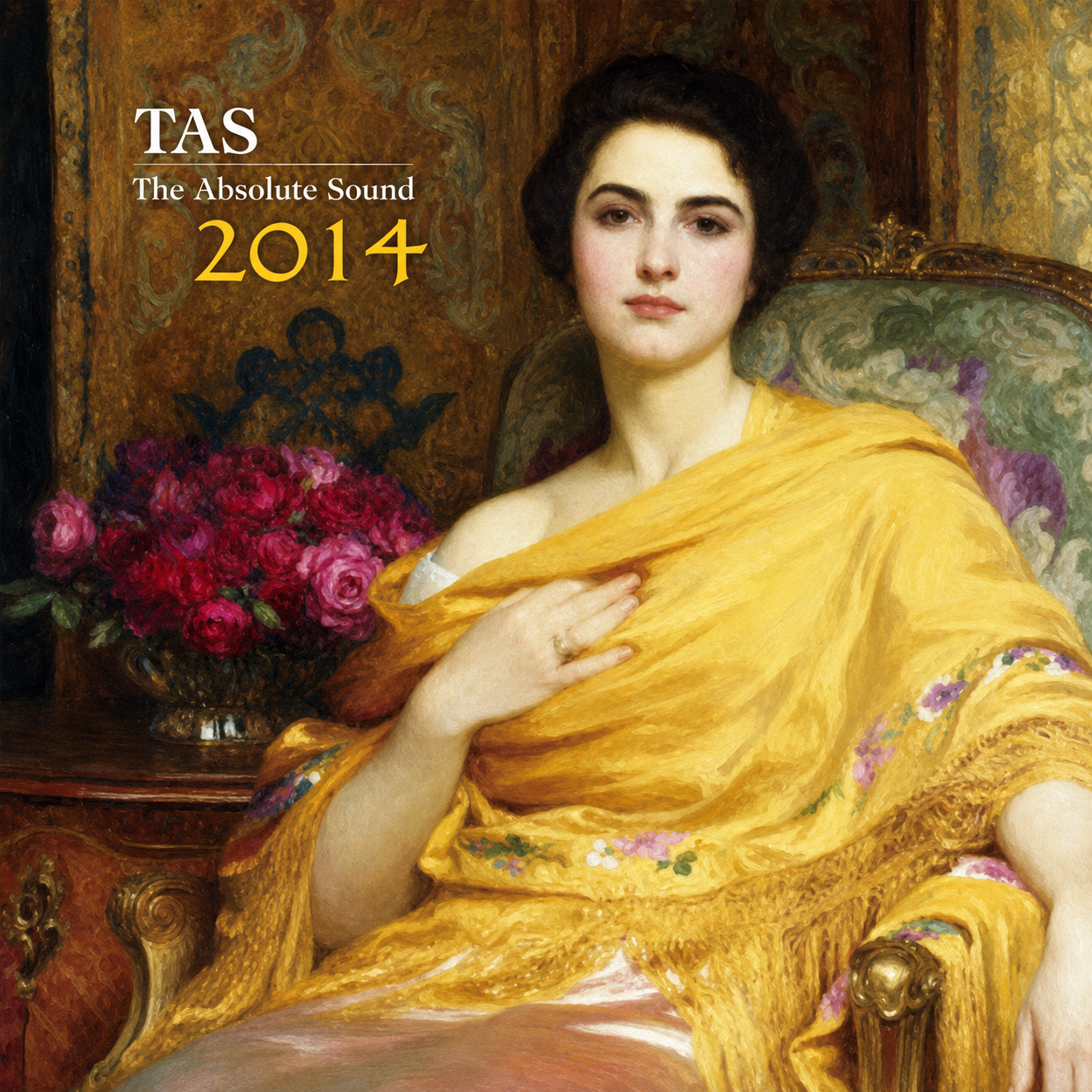
The Absolute Sound
2014
GREAT CHOICE: The Absolute Sound 2014!
Great music deserves to be discovered, enjoyed and shared.
CAN YOU SPARE A CUP OF COFFEE?
Audiophile-Streaming is a personal passion project, built with countless hours of discovering, selecting and sharing exceptional music.
I personally cover, without sponsors, the ongoing costs of hosting, software and subscriptions to keep the music discoveries coming. If you enjoy my work, your support is always appreciated.
A LITTLE THANK YOU IN RETURN
Just one coffee gives you lifetime access to the Coffee Club and all its playlists.
No subscriptions. No recurring fees.
The Absolute Sound 2014, An Audiophile Masterpiece of Voices, Atmosphere and Musical Adventure
Some albums are designed to fill a room with music, while others appear to transform the room itself. The Absolute Sound 2014 belongs to that rare second category, because this beautifully curated audiophile compilation does not merely offer fourteen impressive recordings. It creates a succession of living musical spaces, each with its own light, temperature and emotional character. Classical instruments emerge from deep acoustic surroundings, intimate voices appear with remarkable physical presence, jazz performances breathe with late-night warmth and familiar melodies return in forms that feel newly discovered.
As part of the celebrated TAS audiophile series from Aurora Music International, The Absolute Sound 2014 continues a tradition built upon careful musical selection and exceptional recording quality. The album moves confidently through classical music, folk, jazz, chanson and singer-songwriter material, yet it never feels like a random collection. Its sequencing has the flow of a well-written book, beginning with instrumental refinement, travelling through cultures and emotions, and gradually arriving at a finale of orchestral beauty.
For listeners searching for the best audiophile music for testing speakers, headphones, amplifiers, DACs and complete high-end audio systems, The Absolute Sound 2014 is a remarkably complete reference album. It reveals stereo imaging, soundstage depth, vocal realism, bass definition, treble smoothness, instrumental texture and dynamic range, but it does so without reducing the music to a technical demonstration. The album’s greatest achievement is not that it makes expensive equipment sound impressive. It makes the equipment disappear.
An Elegant Classical Beginning
The journey opens with Paganini’s Sonata with Variations, performed by S D Donne, Marco Scicli, A Sebastiani and D Puliti. It is a graceful and technically demanding entrance, filled with the speed, delicacy and tonal contrast that make classical chamber music such valuable reference material for serious hi-fi listening.
The violin and accompanying instruments require an audio system capable of reproducing brilliance without hardness. An excessively bright loudspeaker can make the violin sound thin or metallic, while a system lacking resolution may soften the instrument until its energy and texture disappear. Through a well-balanced pair of audiophile speakers, the bow possesses speed and attack, yet the wooden resonance of the instrument remains clearly audible beneath the upper harmonics.
The recording also examines stereo focus and acoustic depth. The musicians should occupy individual positions within a believable performance space, but they must continue to sound connected through natural reverberation. When speaker placement and room acoustics are correctly adjusted, the instruments no longer seem attached to the loudspeaker cabinets. They appear to stand freely within the room, beginning The Absolute Sound 2014 with elegance and anticipation.
Aheyla and the Warmth of Human Celebration
Aheyla, I Rejoice by Carl Cleves and Parissa Bouas changes the emotional landscape immediately. The classical refinement of the opening gives way to warmth, rhythm and a strong sense of human connection. The voices carry individuality and natural texture, while the acoustic arrangement creates an inviting musical atmosphere.
Duet recordings are excellent for evaluating midrange transparency because the playback system must preserve two different vocal identities without separating them unnaturally. Carl Cleves and Parissa Bouas should remain recognisably distinct, with their individual tones, weights and phrasing intact. A coloured system may make both voices sound too similar, while a transparent high-end audio setup allows their differences to become part of the emotional dialogue.
The acoustic instruments provide a second challenge. Guitar strings should begin with a clean attack, but the wooden body must add warmth and natural resonance. Bass notes require definition rather than exaggerated power, supporting the rhythm without obscuring the voices. Through a balanced amplifier and loudspeaker combination, Aheyla, I Rejoice sounds open, organic and effortlessly musical.
This track demonstrates one of the defining strengths of TAS 2014. Audiophile sound quality is never presented as a separate attraction. Every additional detail strengthens the performance, bringing the listener closer to the personalities behind the music.
Caledonia and the Call of Home
Caledonia, performed by Dougie MacLean with the Royal Scottish National Orchestra, brings scale, nostalgia and emotional grandeur into the album. The song has long carried associations with homeland, distance and belonging, but the orchestral setting gives it an even broader emotional horizon.
MacLean’s voice must remain natural and clearly focused while the orchestra develops around him. This balance can be difficult for an audio system to achieve. If the vocal is pushed too far forward, the orchestral depth collapses, but if the system lacks midrange presence, the singer may disappear into the larger arrangement. The finest high-end stereo systems maintain both intimacy and scale, placing the voice firmly at the centre while allowing the orchestra to extend far behind and beyond it.
Caledonia is outstanding music for testing soundstage width and depth. Strings, winds and lower orchestral instruments should occupy organised layers rather than forming a flat wall of sound. Dynamic passages need enough amplifier headroom to expand without becoming compressed, while quiet sections require low-level resolution and a silent background.
When everything is reproduced correctly, the performance becomes deeply moving. The listening room seems to grow, the orchestra acquires physical dimensions and MacLean’s voice carries the emotional weight of someone looking back toward a place that remains part of him. It is high-resolution audio in service of memory.
Kira Skov and Ned Ferm Enter the Night
Can’t Believe You Just Did It Again by Ned Ferm and Kira Skov introduces a darker and more contemporary jazz atmosphere. The track feels spontaneous, intimate and slightly dangerous, as though the listener has entered a small club after midnight and discovered two musicians performing without concern for the outside world.
Kira Skov’s voice has depth and character, while Ned Ferm’s instrumental contribution provides movement and tension. The recording is especially useful for testing tonal differentiation and stereo imaging. The voice and instrument should remain clearly separated, yet they must occupy the same acoustic environment. A system that exaggerates separation may make the performers sound disconnected, while poor resolution can cause them to merge into an indistinct centre image.
The track also reveals the quality of a system’s timing. Jazz depends upon small changes in emphasis, pause and rhythmic placement, and equipment that sounds slow can remove the urgency from the performance. Through a responsive amplifier and transparent loudspeakers, the music moves freely, preserving both the structure and the feeling of improvisation.
This is audiophile jazz at its most compelling. It provides abundant information about the recording and playback chain, but its smoky atmosphere and emotional tension make analysis difficult to maintain for long.
Claire Martin Reimagines The Man Who Sold the World
Claire Martin’s interpretation of The Man Who Sold the World is one of the great centrepieces of The Absolute Sound 2014. The familiar composition is transformed into a sophisticated vocal performance, retaining the mystery of the original while introducing a more intimate and reflective character.
Martin’s voice is captured with clarity, warmth and remarkable control, making the track exceptional female vocal reference music. The central image should remain stable and dimensional, with the singer appearing at a believable height and distance. Sibilants must sound natural rather than exaggerated, while subtle breathing and phrasing need enough resolution to remain audible.
The arrangement surrounds her without becoming crowded. Every instrument has a defined role, yet the performance remains cohesive. A refined DAC or SACD player may reveal greater ambience and smoother decay, but the improvement should never make the recording feel analytical. The ideal result is greater emotional continuity, with the voice and accompaniment forming one complete dramatic scene.
The Man Who Sold the World demonstrates why familiar songs can become especially valuable audiophile test tracks. The listener already knows the melody, making the new arrangement and recording perspective easier to recognise. Claire Martin does not simply cover the composition. She enters its world and makes it her own.
Serge Gainsbourg and the Seduction of L’eau à la bouche
L’eau à la bouche by Serge Gainsbourg introduces unmistakable French elegance and sensuality. Gainsbourg’s voice possesses an intimate, conversational quality, while the arrangement creates an atmosphere of sophistication and suggestion.
This kind of recording places enormous importance on the lower midrange. The voice needs warmth and presence, but too much energy in this area can make the performance sound thick or excessively close. A lean system, on the other hand, may remove the relaxed physicality that gives Gainsbourg his distinctive character.
Through a well-balanced high-end audio system, the vocal appears textured and tangible, surrounded by an arrangement that retains softness without losing detail. Small instrumental touches emerge naturally rather than being pushed forward, and the recording maintains a sense of intimacy without collapsing into a narrow soundstage.
L’eau à la bouche is a superb example of how audiophile music can communicate atmosphere through restraint. Nothing needs to be exaggerated because the appeal lies in tone, pacing and personality. The track does not demand attention. It draws the listener closer.
Dinah Shore Brings Golden-Era Charm
Buttons and Bows by Dinah Shore introduces the warm familiarity of classic American popular music. Her voice carries elegance, confidence and an unmistakable period character, while the arrangement provides brightness and rhythm without overwhelming the vocal.
Older recordings can reveal a great deal about the quality and maturity of an audio system. Equipment that is too analytical may emphasise age, noise or limitations in the source, while an overly soft system can remove the vitality and detail that remain within the recording. The finest systems preserve the historical character without treating it as a flaw.
Dinah Shore should sound natural and charming, with her voice clearly placed within the original production. The accompaniment needs rhythmic life, but it should never become sharp or brittle. Through refined equipment, Buttons and Bows demonstrates that audiophile listening is not limited to modern high-resolution recordings. Musical character, careful mastering and a convincing performance remain timeless.
Schumann Opens the Orchestral Stage
The Schumann Symphony No 3 selection, conducted by Robin Ticciati with the Scottish Chamber Orchestra, expands the album into full orchestral scale. After the intimacy of the preceding vocal recordings, the change feels dramatic, opening the stereo soundstage and challenging the entire audio system.
Orchestral music demands clarity within complexity. Strings, winds, brass and percussion must remain individually recognisable while contributing to a unified musical structure. A system lacking resolution may turn the orchestra into a dense mass, while poor amplifier control can make dynamic passages sound strained.
A capable high-end system allows the performance to grow naturally. The orchestra extends in width and depth, individual sections occupy believable positions and the acoustic surrounding the ensemble becomes part of the experience. The music should gain power without becoming hard, and quieter passages must remain detailed even when the overall level falls.
This Schumann recording is excellent classical music for testing speakers, amplifier headroom and room acoustics. It reveals whether the system can move beyond small-scale intimacy and create the scale of a real concert hall.
Emily Barker and the Dreamlike World of Sleeping Horses
Sleeping Horses by Emily Barker and the Red Clay Halo brings the album gently back toward acoustic folk. Barker’s voice appears with vulnerability and calm, while the arrangement creates a dreamlike atmosphere filled with natural instrumental colours.
The recording is particularly effective for testing acoustic guitar texture and vocal presence. The strings require speed and definition, but their tone must include enough body to sound physical. Barker’s voice should remain open and intimate without becoming unnaturally large or forward.
The best reproduction allows silence to surround the performance. Small reverberations and instrumental decays remain audible, creating the impression of a quiet space in which every sound has room to develop. Through reference headphones, these low-level details become easy to examine, while a carefully configured stereo system creates the more convincing physical environment.
Sleeping Horses is not spectacular in the conventional sense. Its beauty lies in subtlety, atmosphere and emotional honesty. It rewards equipment capable of preserving quiet details without turning them into technical attractions.
Christian Willisohn Transforms Caruso
Christian Willisohn’s interpretation of Caruso brings blues weight, vocal authority and instrumental richness into the collection. His deep, textured voice gives the familiar composition a character very different from the grand operatic versions often associated with it.
Willisohn’s vocal is a powerful test of lower-midrange accuracy and bass control. His voice should possess depth without boom and texture without harshness. An amplifier lacking control may allow the lower frequencies to become heavy, while a lean system can remove the warmth and physical presence that define the performance.
The accompanying instruments must retain clarity and scale. Piano notes require weight, attack and natural decay, while the arrangement needs enough space to prevent the vocal from dominating everything around it. Through a balanced high-end audio system, Caruso becomes dramatic without sounding exaggerated.
This performance demonstrates the value of interpretation. A famous melody is placed within another musical language, revealing emotional possibilities that may not have been obvious before. TAS 2014 repeatedly celebrates this kind of transformation, using exceptional recording quality to illuminate the individual character of each artist.
Inger Marie Gundersen and the Intimacy of Always on My Mind
Always on My Mind by Inger Marie Gundersen is one of the album’s most captivating female vocal performances. Her delivery is restrained, warm and emotionally controlled, allowing the familiar song to feel personal rather than sentimental.
Gundersen’s voice should appear focused and naturally proportioned, with every breath and subtle change in tone preserved. A bright system may exaggerate sibilance, while an overly warm presentation can hide the delicacy of her phrasing. The finest loudspeakers and headphones reproduce the vocal with clarity while retaining its softness.
The arrangement creates a broad but intimate soundstage, with instruments surrounding the singer without reducing her importance. Bass should remain controlled and tuneful, supporting the performance with quiet authority. Through a refined digital source, reverberation and low-level ambience become easier to hear, deepening the sense of space.
Always on My Mind is ideal audiophile music for testing vocal realism, stereo imaging and long-term listening comfort. More importantly, it is a genuinely moving interpretation that becomes more affecting as the playback system grows more transparent.
Respighi and Chopin Bring Classical Refinement
The second movement from Respighi’s Sonata in B Minor for violin and piano, performed by Franco Gulli and Enrica Cavallo, returns the album to chamber music with lyrical beauty. The violin and piano form a demanding partnership, requiring tonal balance, speed and precise stereo focus.
The violin must remain expressive without becoming metallic, while the piano needs weight, scale and harmonic complexity. Both instruments should occupy distinct positions, yet their natural reverberation must connect them within the same acoustic space. A transparent system reveals the dialogue between the musicians rather than presenting two unrelated sound sources.
Chopin’s Piano Concerto No 2, performed by Ingrid Fliter with the Scottish Chamber Orchestra, then expands the scale again. The piano must remain clear and focused within the orchestral background, while the ensemble provides depth, colour and dynamic support.
This recording challenges amplifier power, bass control and instrumental separation. The piano’s lower register requires authority, the upper notes need brilliance without hardness and the orchestra must retain organisation as the music grows more complex. Through a world-class high-end audio system, the performance becomes majestic, spacious and emotionally uplifting.
Dvořák Brings the Journey Home
The Absolute Sound 2014 closes with Dvořák’s Serenade for Strings, performed by Boris Monoszon and the Solisti di Praga. It is an inspired conclusion, combining warmth, elegance and a gentle sense of arrival.
The strings should sound smooth but alive, with the texture of the bows clearly preserved. The ensemble needs width and depth, yet the presentation must remain coherent. A system with an aggressive treble can make the performance tiring, while a dull system removes the brilliance and movement that give the music its life.
When reproduced correctly, the orchestra seems to float freely behind the loudspeakers. Natural hall ambience surrounds the players, and the final passages create a feeling of peace rather than spectacle. The journey that began with Paganini’s intimate chamber music ends with a larger but equally graceful string performance, giving the album a satisfying sense of symmetry.
Final Verdict
The Absolute Sound 2014 is an outstanding audiophile compilation and one of the most varied, sophisticated and emotionally rewarding albums in the TAS series. Its combination of classical music, jazz, folk, chanson and high-quality vocal recordings creates a musical journey that feels carefully written rather than simply assembled.
It is enthusiastically recommended for listeners searching for the best audiophile album for testing speakers, SACD reference music, female vocal test tracks, acoustic guitar recordings, jazz with a deep stereo soundstage and classical performances capable of revealing the full potential of a high-end audio system.
Claire Martin transforms The Man Who Sold the World with intelligence and atmosphere, Serge Gainsbourg brings French sophistication, Emily Barker creates intimate folk beauty and Christian Willisohn gives Caruso a rich blues character. Inger Marie Gundersen offers one of the album’s most elegant vocal performances, while Schumann, Respighi, Chopin and Dvořák provide orchestral and chamber-music scale.
When The Absolute Sound 2014 is played through a carefully balanced hi-fi system, the album does more than sound detailed or spacious. Voices become human, instruments acquire physical shape and every recording creates its own believable environment. The loudspeakers begin to disappear, the room seems to expand and fourteen individual tracks become one flowing musical story.
For audiophiles, collectors of the Aurora Music International TAS series and music lovers who believe that better sound should always lead toward a deeper emotional experience, The Absolute Sound 2014 is not merely recommended. It is an essential audiophile reference album, a beautifully curated musical adventure and a release that deserves to be heard slowly, repeatedly and with complete attention.
