
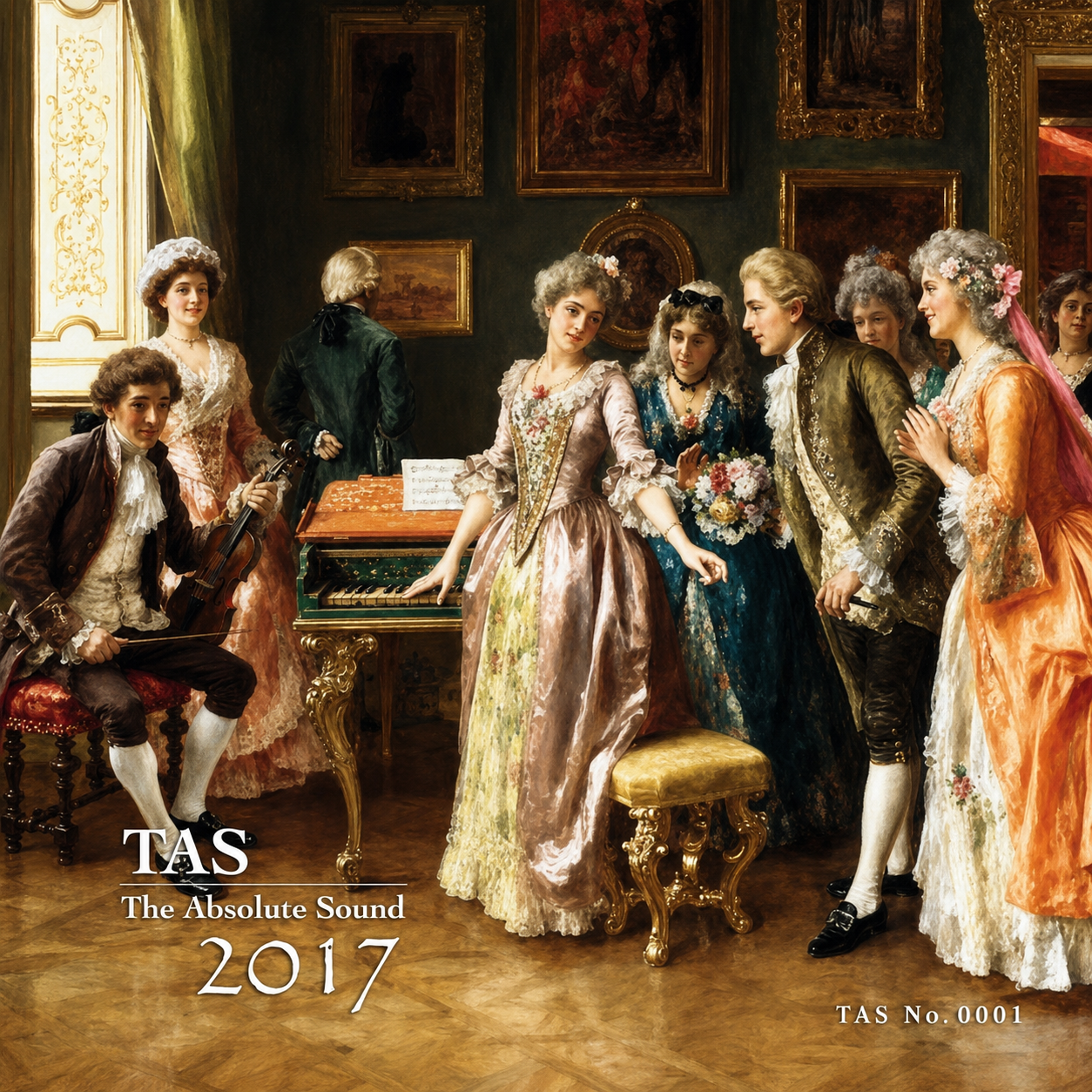
The Absolute Sound
2017
GREAT CHOICE: The Absolute Sound 2017!
Great music deserves to be discovered, enjoyed and shared.
CAN YOU SPARE A CUP OF COFFEE?
Audiophile-Streaming is a personal passion project, built with countless hours of discovering, selecting and sharing exceptional music.
I personally cover, without sponsors, the ongoing costs of hosting, software and subscriptions to keep the music discoveries coming. If you enjoy my work, your support is always appreciated.
A LITTLE THANK YOU IN RETURN
Just one coffee gives you lifetime access to the Coffee Club and all its playlists.
No subscriptions. No recurring fees.
The Absolute Sound 2017, A Magnificent Audiophile Journey Through Tango, Jazz, Vocals and Classical Music
Some audiophile albums are built to impress within seconds, using enormous drums, spectacular bass and dazzling stereo effects to demonstrate the power of an expensive audio system. The Absolute Sound 2017 follows a more rewarding path. It does not behave like a collection of disconnected speaker test tracks, but unfolds as a carefully composed musical journey in which tango, opera, acoustic songwriting, vocal jazz and orchestral music become chapters in one beautifully balanced story.
The Absolute Sound 2017 continues the celebrated TAS tradition with fourteen carefully selected recordings that combine exceptional musical performances with outstanding sound quality. The collection travels from the dramatic violin of Por Una Cabeza to the timeless voice of Elisabeth Schwarzkopf, from the acoustic storytelling of Charlie McGettigan to the jazz elegance of Nicki Parrott and Massimo Farao’, before concluding with the expansive beauty of the Royal Philharmonic Orchestra.
This variety makes TAS 2017 an outstanding audiophile reference album for testing speakers, headphones, amplifiers, DACs, CD players and SACD systems. Its recordings reveal vocal realism, stereo imaging, soundstage depth, bass definition, instrumental texture and dynamic range, yet the album never feels like a technical exercise. The sound quality serves the music so naturally that the equipment gradually disappears, leaving the listener inside a succession of intimate, dramatic and beautifully recorded performances.
Por Una Cabeza Opens the Album with Passion
The journey begins with Semmy Stahlhammer’s interpretation of Por Una Cabeza, and it is difficult to imagine a more dramatic entrance. The famous tango melody carries elegance, desire and a sense of danger, while Stahlhammer’s violin moves with extraordinary energy and expressive control. Every phrase seems to lean forward, hesitate and then accelerate again, creating the tension that gives great tango its unmistakable emotional power.
The violin is one of the most demanding instruments for any high-end audio system. Its upper harmonics can quickly become sharp or metallic through an aggressive loudspeaker, while a system lacking resolution can remove the texture and excitement of the bow. A carefully balanced hi-fi system preserves the brilliance of the instrument without adding hardness, allowing the listener to hear both the speed of the performance and the resonance of the violin’s wooden body.
Por Una Cabeza is therefore excellent classical and tango music for testing speakers, but its real success lies in the physical movement it creates. The stereo soundstage feels alive, the rhythm possesses momentum and the violin appears to dance freely beyond the loudspeakers. The recording does not simply introduce TAS 2017. It opens the curtain with confidence and immediately invites the listener into its world.
Elisabeth Schwarzkopf and the Timeless Beauty of Mozart
The transition from tango to Mozart is inspired. Elisabeth Schwarzkopf’s performance of Voi Che Sapete from Le Nozze di Figaro brings one of the great operatic voices into the collection, adding historical importance, vocal elegance and classical refinement.
Schwarzkopf’s voice carries an unmistakable combination of control, intelligence and expressive beauty. Through a transparent audio system, the singer should appear naturally focused within the soundstage, supported by the accompaniment without becoming overwhelmed by it. Her voice needs sufficient body to sound human, yet enough openness to preserve phrasing, vibrato and the subtle emotional changes within Mozart’s melody.
Vintage classical recordings require sensitive playback. Equipment that is excessively analytical can emphasise the age of the source, while an overly warm system may remove its vitality and detail. The best audiophile speakers find the correct balance, allowing the historical character of the recording to remain intact while revealing the artistry within it.
Voi Che Sapete reminds the listener that high-fidelity sound is not limited to contemporary productions. A great performance can cross generations when it is reproduced with respect, tonal balance and musical sensitivity. Within The Absolute Sound 2017, Schwarzkopf’s appearance feels like a meeting with history rather than a simple change of genre.
Charlie McGettigan Tells the Story of Feet of a Dancer
Feet of a Dancer by Charlie McGettigan brings the album into the intimate world of acoustic storytelling. After the theatrical scale of Mozart, the sound moves closer, as though the listener has left the opera house and entered a quiet room where a singer has begun sharing a personal memory.
McGettigan’s voice is warm, direct and naturally expressive, while the acoustic arrangement allows every phrase to breathe. This simplicity makes the recording exceptionally revealing. There are no heavy production effects to hide an unnatural midrange, an unstable central image or poorly controlled guitar tones.
The voice should possess realistic weight without becoming too thick, and the acoustic guitar must combine a clean string attack with the warm resonance of the instrument’s wooden body. A system that emphasises only detail can make the guitar sound dry, while excessive warmth may blur the notes and weaken the rhythm. Through a carefully matched amplifier and loudspeakers, Feet of a Dancer achieves an ideal balance between clarity and humanity.
This is outstanding acoustic music for testing speakers, but the song’s emotional character soon becomes more important than its technical value. McGettigan tells his story with calm authority, and the listener is drawn toward the words rather than the equipment reproducing them.
Sara Indrio and Paal Flaata Bring Intimacy and Atmosphere
Sara Indrio’s Amico Mio continues the album’s movement through personal voices and atmospheric arrangements. Her performance introduces warmth and emotional openness, while the recording creates enough space around the vocal to make the listening room feel larger.
A well-recorded female voice remains one of the most reliable tests of midrange quality. The human ear immediately recognises when a singer sounds too thin, too bright or unnaturally distant. On Amico Mio, Indrio should appear focused and expressive without becoming artificially enlarged. Her voice needs clarity, but the upper frequencies must remain smooth enough to preserve tenderness.
Paal Flaata’s Quicksilver Daydreams of Maria then darkens the atmosphere. His deep and distinctive voice brings gravity, mystery and a cinematic sense of space. The performance feels like a landscape observed at night, filled with distant light and half-remembered emotion.
Flaata’s vocal is especially useful for testing lower-midrange accuracy. A poorly controlled system can make a deep male voice sound swollen or heavy, while a lean presentation removes its authority. The best high-end audio systems reproduce the voice with body, texture and natural scale, keeping every word clear while preserving the darkness that gives the recording its character.
Together, Amico Mio and Quicksilver Daydreams of Maria form an absorbing central passage. One performance offers warmth and closeness, while the other creates distance and nocturnal atmosphere. Their contrast demonstrates how intelligently The Absolute Sound 2017 moves between emotional worlds without losing continuity.
Nicki Parrott Turns Que Sera, Sera into Audiophile Jazz
Nicki Parrott’s interpretation of Que Sera, Sera brings lightness, charm and effortless jazz sophistication to the album. The familiar melody could easily have become sentimental, but Parrott approaches it with warmth and rhythmic grace, allowing the song to feel fresh without losing its comforting familiarity.
Her voice is intimate and naturally engaging, while the bass provides a beautifully controlled foundation. The recording is ideal for evaluating vocal focus, low-frequency articulation and musical timing. Parrott should remain stable in the centre of the stereo image, surrounded by instruments that retain their individual positions without sounding disconnected.
The bass deserves particular attention. True audiophile bass is not simply deep or powerful. It must also possess pitch, texture and speed. Every note should begin and stop cleanly, allowing the listener to follow the melodic movement rather than hearing an indistinct area of low-frequency energy.
Que Sera, Sera is one of the album’s most immediately enjoyable tracks. It demonstrates that reference-quality sound does not need to feel serious or intimidating. High-end audio can also communicate charm, optimism and the pleasure of musicians performing with complete ease.
Canadian Sunset and the Colour of Afro-Cuban Jazz
Canadian Sunset by the Massimo Farao’ Afro Cuban Piano Quartet brings rhythmic colour and instrumental sophistication into the collection. The familiar melody is transformed through jazz harmony and Afro-Cuban movement, creating a performance that is both elegant and full of life.
Piano recordings place considerable demands on a stereo system because every note contains a sharp initial strike, a complex harmonic body and a gradual decay. A lesser setup may reproduce the melody clearly but fail to communicate the physical size and resonance of the instrument. Through high-quality audiophile speakers, the piano gains weight, brilliance and believable scale.
The rhythm section is equally important. Bass notes must remain controlled and tuneful, while percussion needs speed and texture. A system with poor timing can make the musicians sound like separate performers following the same score, but a responsive amplifier and pair of well-integrated speakers reveal the communication between them.
Canadian Sunset is exceptional jazz music for testing speakers because it examines piano tone, stereo imaging, bass response and transient speed at the same time. More importantly, the quartet swings naturally. The recording encourages movement and enjoyment rather than analysis, proving once again that the finest audiophile test music is also music worth hearing repeatedly.
Trio Neumann and the Energy of Take It Easy Boy, Boy
Take It Easy Boy, Boy by Trio Neumann adds another burst of rhythmic personality. The performance moves with confidence and playfulness, bringing a lively contrast to the more reflective tracks elsewhere on TAS 2017.
This is music that reveals whether an audio system can preserve momentum. The instruments need clarity, but their relationship is even more important. Rhythm depends upon timing, and timing can disappear when bass becomes slow, transients lose definition or different parts of the frequency range feel disconnected.
Through a well-balanced high-end system, Trio Neumann sounds immediate and unified. Individual instruments remain easy to follow, yet the performance never becomes a clinical display of separation. Everything moves together, creating energy without confusion.
Take It Easy Boy, Boy is an excellent reference track for evaluating amplifier control and speaker responsiveness. It can reveal whether a system is merely detailed or genuinely musical, because the true test is not how many sounds can be identified, but whether those sounds create a convincing rhythm.
Hanne Sørvaag and the Emotional Pull of June
Anything ’Bout June Again by Hanne Sørvaag returns the listener to singer-songwriter intimacy. Her voice carries warmth and a gentle emotional directness, while the arrangement gives the performance enough room to develop naturally.
The recording works beautifully as female vocal test music because Sørvaag’s voice should remain open and detailed without becoming sharp. Subtle breathing and changes in phrasing need to remain audible, but they should never be exaggerated by the playback system.
The central image should appear stable and dimensional, with instruments extending behind and around the singer. A refined DAC or SACD player may reveal additional ambience and smoother instrumental decay, but the improvement should strengthen the emotional continuity rather than drawing attention toward individual recording details.
Anything ’Bout June Again is a quietly persuasive performance. It does not need dramatic production or powerful dynamics to make an impression. Its strength lies in the natural closeness of the voice and the sense that the song is being shared with the listener rather than performed for a distant audience.
Tango for 3 Checks into Hotel Victoria
Hotel Victoria by Tango for 3 returns the album to the passion and movement introduced by Por Una Cabeza. The mood, however, is different. Where the opening track presents tango through the expressive brilliance of a solo violin, Hotel Victoria creates a wider and more rhythmic dramatic scene.
The performance tests bass control, transient response and instrumental separation. Tango depends upon sudden accents, pauses and changes in tension, and a slow audio system can remove much of its emotional impact. Responsive loudspeakers allow each attack to arrive with precision, while a capable amplifier provides the control needed to keep the low frequencies firm.
The stereo soundstage should feel layered and active, with instruments occupying clear positions while remaining connected by rhythm. When reproduced correctly, Hotel Victoria has an almost visual quality. The listener can imagine the movement of dancers and the shifting energy of the room.
This is one of the album’s strongest demonstration tracks, but it never sounds as though it was selected solely to impress audiophiles. The music has character, drama and a powerful sense of place.
The Northern Light of Skjærgårdsø
Tove Karoline Knutsen’s Skjærgårdsø changes the temperature of the album once again. The recording has a distinctly Nordic atmosphere, filled with space, quiet light and restrained emotion. After the passion of tango, its calm arrives like fresh air.
Knutsen’s voice should appear pure and naturally focused, surrounded by an arrangement that preserves openness without becoming empty. This is an excellent recording for testing soundstage depth and treble smoothness. Higher frequencies need enough air to reveal atmosphere, but any harshness can quickly damage the fragile beauty of the performance.
The finest stereo systems allow Skjærgårdsø to extend well beyond the physical loudspeakers. The voice remains stable while reverberation and instruments create a broader landscape around it. The result feels spacious but never artificial.
This ability to suggest environment is one of the great pleasures of high-fidelity sound. Stereo imaging becomes more than the placement of instruments. It creates weather, distance and emotional space.
Barb Jungr Reimagines the Beatles
Barb Jungr’s performance of Golden Slumbers, Carry That Weight and The End is one of the major highlights of The Absolute Sound 2017. Jungr approaches familiar Beatles material with the interpretive intelligence of a dramatic singer and the timing of an experienced jazz performer.
Rather than imitating the original versions, she reshapes the sequence into a personal emotional statement. Her voice moves from intimacy to strength, while the arrangement grows naturally around her. The extended medley gives the performance enough time to create a complete narrative arc.
As audiophile female vocal music, the recording is extremely demanding. Jungr’s voice must remain centred and dimensional throughout changing levels of intensity. Quiet phrases require low-level resolution, while stronger passages need amplifier headroom and loudspeaker stability. Excessive brightness can make the vocal hard, but a system lacking openness may hide the expressive details that make her interpretation so compelling.
The arrangement also tests dynamics and soundstage organisation. As the music grows, instruments should retain their positions and tonal character. A high-end audio system allows the performance to expand without becoming crowded or compressed.
Jungr’s medley captures everything that makes the TAS series attractive. It offers reference-quality sound, a famous composition and an artist with enough personality to make the music feel newly discovered.
Ketil Bjørnstad Creates a World of Shimmering Light
Shimmering by Ketil Bjørnstad introduces a contemplative instrumental atmosphere near the end of the album. Bjørnstad’s music often seems to exist between jazz, classical composition and Nordic landscape, and this performance possesses the quiet clarity suggested by its title.
The piano should sound full and resonant, with notes that emerge naturally and fade gradually into silence. A high-quality digital source can reveal the harmonic complexity and acoustic decay, while a quiet amplifier allows the smallest details to remain audible.
Shimmering is excellent piano test music because it exposes systems that reproduce attack without body or detail without atmosphere. The finest playback gives the instrument realistic dimensions and allows silence to become part of the composition.
The track prepares the listener for the orchestral finale by creating a moment of stillness. It feels like the final quiet page before the story opens into its largest and most dramatic landscape.
The Royal Philharmonic Orchestra Brings a Majestic Finale
The Absolute Sound 2017 closes with the Intermezzo from Mascagni’s Cavalleria Rusticana, performed by Andrea Licata and the Royal Philharmonic Orchestra. It is an inspired conclusion, combining lyrical beauty, orchestral scale and one of classical music’s most deeply emotional melodies.
The performance begins with restraint, allowing the strings to rise gently from the silence. As the orchestra develops, the soundstage expands in width and depth. A capable high-end system should preserve the softness of the opening while providing enough dynamic freedom for the larger passages to grow without strain.
Strings must sound smooth but alive, with the texture of the bows clearly audible. The orchestra should not become a flat wall of sound. Individual sections need organisation and depth, while the natural acoustic of the performance space connects them into a unified whole.
The Cavalleria Rusticana Intermezzo is outstanding classical music for testing speakers, amplifier headroom and room acoustics, but its emotional effect is even more important. The melody carries tenderness, dignity and an almost spiritual feeling of resolution.
As the final notes fade, the journey feels complete. The album has travelled from tango and Mozart through folk, jazz and intimate vocals before arriving at orchestral beauty. The conclusion does not merely end the programme. It gathers the emotional threads and brings them gently home.
Final Verdict
The Absolute Sound 2017 is a magnificent audiophile compilation and one of the most varied, elegant and emotionally rewarding releases in the TAS series. Its fourteen tracks move naturally through tango, opera, singer-songwriter music, female vocals, Afro-Cuban jazz, Nordic atmosphere and classical orchestral music, creating a programme that feels carefully written rather than simply assembled.
It is enthusiastically recommended for listeners searching for the best audiophile album for testing speakers, high-quality SACD music, female vocal reference recordings, jazz piano test tracks, acoustic guitar music, tango with powerful dynamics and classical recordings with an expansive stereo soundstage.
Semmy Stahlhammer opens the album with violin fire, Elisabeth Schwarzkopf brings timeless operatic beauty and Charlie McGettigan creates acoustic intimacy. Nicki Parrott adds jazz charm, Massimo Farao’ delivers rhythmic elegance and Hanne Sørvaag offers natural vocal warmth. Barb Jungr transforms the Beatles into a dramatic personal statement, Ketil Bjørnstad creates Nordic stillness and the Royal Philharmonic Orchestra closes the journey with magnificent scale.
When The Absolute Sound 2017 is reproduced through a carefully assembled high-end audio system, the album achieves something far more important than spectacular sound. Voices become human, instruments acquire physical presence and every recording creates its own believable world. The speakers gradually disappear, the listening room seems to expand and fourteen separate performances become one continuous musical experience.
For audiophiles, collectors of the Aurora Music TAS series and music lovers who believe that better sound should always create a deeper connection with the performance, The Absolute Sound 2017 is not merely recommended. It is an essential audiophile reference album and a beautifully curated musical journey that deserves to be heard slowly, repeatedly and with complete attention.
