
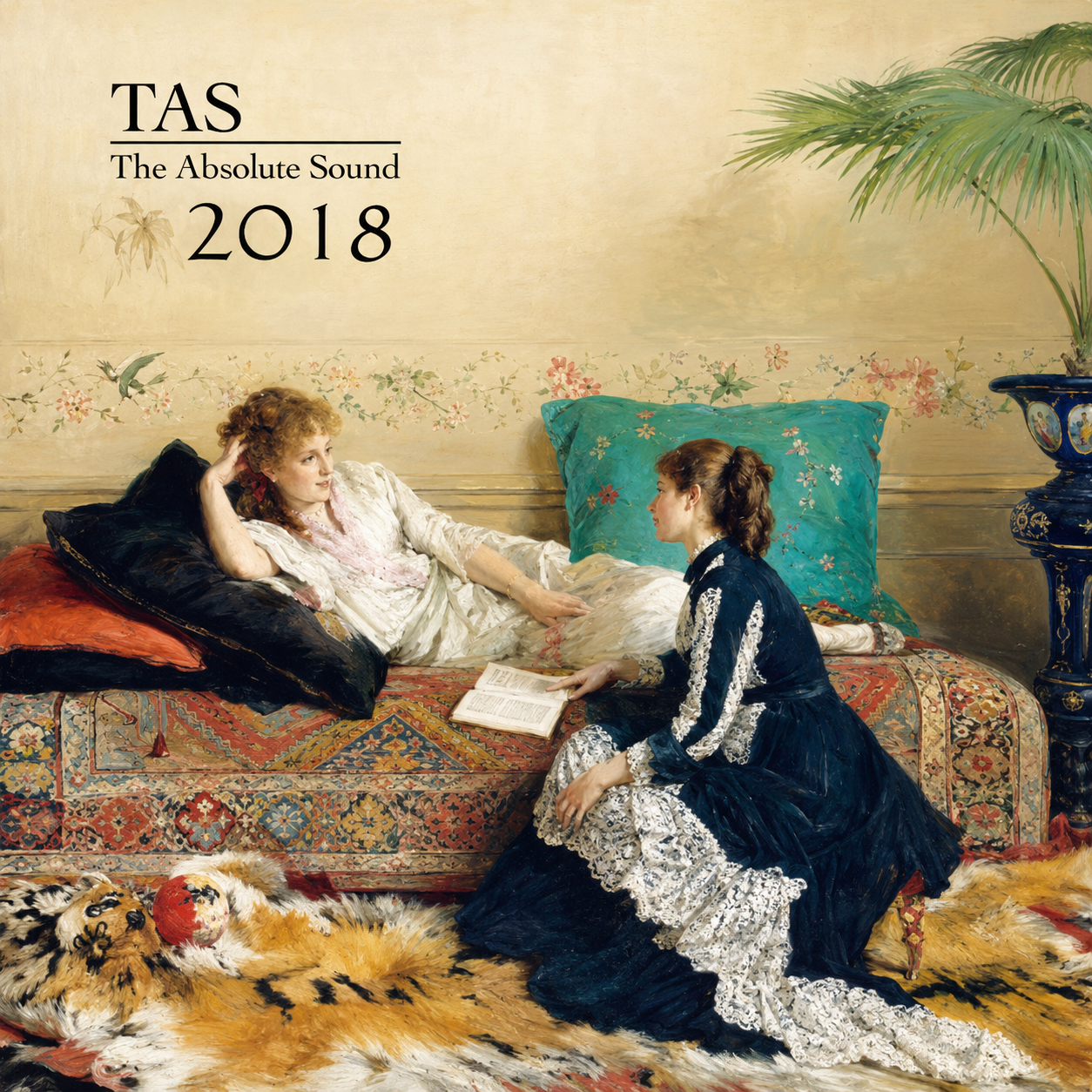
The Absolute Sound
2018
The Absolute Sound 2018, A Luxurious Audiophile Journey Through Voices, Memory and Musical Beauty
There are audiophile compilations that attempt to conquer the listener through spectacular effects, enormous percussion and bass powerful enough to shake the furniture, but The Absolute Sound 2018 chooses a more refined and lasting form of persuasion. This beautifully curated chapter in the celebrated TAS series does not behave like a collection of unrelated demonstration tracks. It unfolds with the grace of a carefully written book, beginning with the glow of a romantic serenade, travelling through intimate voices, acoustic storytelling, jazz interpretation and Nordic atmosphere, and finally arriving at the emotional grandeur of Tchaikovsky.
Released by Aurora Music International, The Absolute Sound 2018 brings together fourteen outstanding recordings selected for their musical character as well as their exceptional sound quality. Arve Tellefsen, Méav Ní Mhaolchatha, Benny Borg, Inger Marie Gundersen, Amber Rubarth, Reg Meuross, Paal and Maia Flaata, Barb Jungr, John McDaniel, Sigmund Groven, Saby O’, Ketil Bjørnstad and the Rembrandt Trio each contribute a distinctive chapter to an album that feels remarkably coherent despite its considerable variety.
For listeners searching for the best audiophile album for testing speakers, headphones, amplifiers, DACs, CD players and SACD systems, TAS 2018 offers an almost ideal programme. The recordings reveal vocal realism, stereo imaging, soundstage depth, bass definition, treble refinement and instrumental texture, but the album never allows technical performance to overshadow the music. Its greatest achievement is not that it makes a high-end audio system sound impressive, but that it gradually makes the system disappear.
A Serenade Opens the Door
The journey begins with Arve Tellefsen performing Enrico Toselli’s Serenata, and the choice immediately establishes an atmosphere of elegance, longing and timeless romance. Tellefsen’s violin rises with lyrical beauty, carrying a melody that seems to belong equally to the concert hall and to a distant memory. The performance is graceful without becoming sentimental, while the recording gives the instrument enough air and acoustic space to sound free from the physical boundaries of the loudspeakers.
The violin remains one of the most demanding instruments for any high-end audio system. Its upper harmonics can easily become metallic through an aggressive tweeter or an unrefined digital source, while a system that is too soft may remove the texture and energy of the bow. Through carefully balanced audiophile speakers, the instrument should possess brilliance without hardness, allowing the listener to hear the movement of the bow, the resonance of the wooden body and the natural decay surrounding every phrase.
Serenata is therefore outstanding classical music for testing speakers, yet its technical usefulness never interrupts its romantic beauty. The performance seems to float across a broad stereo soundstage, creating the sensation that the album has opened a curtain onto another time and place.
Méav Brings Celtic Light and Vocal Purity
Méav Ní Mhaolchatha follows with You Brought Me Up, introducing one of the album’s most luminous female vocal performances. Her voice combines purity, delicacy and emotional control, rising from the arrangement with an effortless quality that can make the listening room appear to grow quieter around her.
As audiophile female vocal music, the recording is exceptionally revealing. Méav should remain firmly focused within the centre of the stereo image, but she must never sound artificially fixed to a single point. Her voice needs natural body and dimensionality, while the surrounding reverberation should extend gently behind her and create a believable acoustic environment.
A bright system may exaggerate sibilance and make the upper register sound fragile, while an overly warm presentation can remove the openness that gives the performance its distinctive beauty. The finest high-end audio systems preserve both qualities, allowing the voice to remain clear, smooth and emotionally expressive.
You Brought Me Up demonstrates why the human voice remains one of the most reliable tools for evaluating hi-fi equipment. Listeners instinctively recognise when a voice sounds natural, and when Méav is reproduced correctly, the result feels less like playback and more like presence.
Benny Borg and the Tenderness of Remembrance
God Morgen, Min Kjære by Benny Borg brings warmth, maturity and profound tenderness into the programme. The performance feels personal from its opening moments, as though the singer is addressing someone whose presence remains vivid within memory.
Borg’s voice carries weight and experience, making the track an excellent test of lower-midrange accuracy. A system with excessive warmth may make the vocal sound heavy or indistinct, while a lean system can remove the physical presence and emotional authority that define the performance. Through a balanced amplifier and pair of transparent loudspeakers, his voice becomes textured, intimate and convincingly human.
The arrangement surrounds him with restraint, allowing every phrase to arrive naturally. Nothing appears to have been added merely to impress the listener, and that simplicity gives the song unusual emotional power. The quieter the room becomes, the more affecting the performance feels.
This is precisely where The Absolute Sound 2018 distinguishes itself from an ordinary audiophile test disc. It does not use recording quality as a spectacle. It uses clarity, space and tonal realism to bring the listener closer to the meaning of the music.
Inger Marie Gundersen Reimagines an ABBA Classic
When All Is Said and Done, performed by Inger Marie Gundersen, transforms the familiar ABBA composition into an intimate, sophisticated and beautifully restrained vocal interpretation. The original melody remains recognisable, but Gundersen slows the emotional world around it, allowing the words to acquire greater weight and reflection.
Her voice has the warmth and late-night elegance that have made her recordings favourites among audiophiles. It appears close enough to establish intimacy, yet the presentation retains sufficient space to avoid sounding artificial. The accompaniment is carefully proportioned, supporting the singer without competing against her.
The recording is superb for testing vocal focus, midrange transparency and long-term listening comfort. An excessively forward audio system may initially seem highly detailed, but it can quickly make a quiet performance tiring. A properly balanced system allows Gundersen’s voice to remain open and expressive without sharpening the edges of the recording.
When reproduced through high-quality audiophile headphones, small changes in breath and phrasing become especially clear. Through carefully positioned stereo speakers, the performance acquires greater physical presence and soundstage depth. In either case, the song becomes one of TAS 2018’s most elegant demonstrations of how a familiar composition can be transformed by interpretation.
Amber Rubarth and the Intimacy of One Last Look
Amber Rubarth’s One Last Look enters with the natural closeness of a singer-songwriter performing without unnecessary distance between herself and the listener. Her voice and acoustic instrumentation create a delicate emotional balance, giving the song the feeling of a farewell that is both deeply personal and quietly universal.
Acoustic recordings of this kind are extremely revealing because there are few layers available to hide tonal colouration or inaccurate imaging. Rubarth’s voice should sound clear and naturally proportioned, while the guitar requires a precise string attack followed by the resonance of the instrument’s wooden body.
A system that emphasises only the initial pluck may appear detailed but make the guitar sound thin, whereas excessive warmth can blur individual notes and weaken the rhythm. The best audiophile equipment connects the attack, body and decay into one complete tone.
One Last Look is excellent acoustic guitar test music, but its recording quality never feels separated from its emotional purpose. The silence around Rubarth is as meaningful as the notes themselves, giving the performance room to breathe and allowing the listener to experience its tenderness without distraction.
Reg Meuross Tells a Story from the Titanic
The Band Played ‘Sweet Marie’ by Reg Meuross is one of the album’s most powerful examples of musical storytelling. Inspired by the Titanic, the song carries history, tragedy, love and remembrance within an arrangement that remains intimate despite the scale of its subject.
Meuross does not turn the story into theatrical spectacle. His measured delivery allows the images to develop gradually, drawing the listener deeper into the narrative with every verse. His voice remains at the centre, supported by acoustic instruments that add colour without overwhelming the words.
This recording is particularly effective for testing centre-image stability and vocal intelligibility. The singer should remain firmly positioned, while the accompaniment develops in clearly organised layers around him. A system lacking soundstage depth may flatten the entire performance, but a transparent setup allows the instruments and acoustic ambience to extend naturally behind the voice.
The Band Played ‘Sweet Marie’ demonstrates how high-fidelity sound can intensify storytelling. Greater resolution does not simply uncover more recording details. It reveals the pauses, textures and emotional inflections that make the narrative feel real.
Tango Jalousie Ignites the Room
Arve Tellefsen returns with Tango Jalousie, replacing the romantic calm of Serenata with rhythm, tension and dramatic fire. The violin now possesses a sharper and more physical energy, moving through the famous melody with elegance and controlled intensity.
Tango is excellent music for testing transient response because every accent, pause and rhythmic shift must arrive with precision. A slow system can remove the tension from the performance, while excessive treble energy may make the violin sound aggressive. The finest audio systems preserve speed without hardness, allowing the music to dance rather than simply attack.
The stereo presentation should feel active and dimensional, with the violin free to move across a clearly defined acoustic space. Bass and accompanying instruments need enough control to maintain the rhythm without becoming heavy.
Tango Jalousie provides one of TAS 2018’s most exciting contrasts. The same violinist who opened the album with lyrical tenderness now fills the listening room with passion, reminding the listener that true instrumental realism includes both delicacy and power.
A Father and Daughter Look Toward Tomorrow
Come Tomorrow by Paal Flaata and Maia Flaata brings a warm country influence and the intimate chemistry of two voices connected by family. Their contrasting vocal colours give the song depth, while the relaxed arrangement allows the performance to move naturally.
Duet recordings are demanding because an audio system must preserve two individual vocal identities without separating them unnaturally. Paal’s deeper voice requires body and definition, while Maia’s lighter tone needs openness and smoothness. Both should occupy clear positions within the same believable acoustic environment.
The best high-end speakers allow the relationship between the singers to become part of the performance. Their voices remain distinct, yet the shared phrasing and musical connection are easy to hear. Come Tomorrow becomes more than a pleasant country duet. It becomes an intimate conversation captured with warmth and clarity.
Barb Jungr Walks Through New York
Englishman in New York, performed by Barb Jungr with John McDaniel, is one of the album’s most imaginative highlights. Jungr approaches Sting’s famous composition with the interpretive intelligence that has made her such a distinctive figure in contemporary cabaret and vocal jazz.
Rather than imitating the original, she reshapes the song through phrasing, dramatic timing and an unmistakable sense of personality. McDaniel’s accompaniment supports her with elegance, creating a performance that feels theatrical without becoming exaggerated.
Jungr’s voice is an excellent test of dynamic expression and midrange transparency. Her quieter phrases require low-level resolution, while the stronger moments need amplifier headroom and loudspeaker stability. The central image should remain firm as the emotional intensity changes, and the accompaniment must retain clarity throughout.
Englishman in New York proves that audiophile reference music can be witty, surprising and full of character. The recording rewards careful listening, but the interpretation is so engaging that the listener soon forgets about testing equipment altogether.
Changes Carries a Message Beyond the Listening Room
Changes by Niclas Lundin and Kristin Amparo introduces a modern duet with a serious emotional and social dimension. The performance addresses the destructive nature of conflict, using two voices and a broad arrangement to communicate vulnerability, urgency and hope.
The recording tests an audio system’s ability to maintain clarity within a fuller production. The vocals must remain focused while the instruments spread across the soundstage without collapsing into a dense background. Bass needs control and definition, and dynamic passages should grow without strain.
Kristin Amparo’s voice brings openness and emotional intensity, while Niclas Lundin provides balance and narrative weight. Their vocal contrast should remain clearly audible through a transparent system, giving the performance a strong sense of dialogue.
Changes adds another dimension to The Absolute Sound 2018. The album is not concerned only with beauty, romance and memory. It also gives space to music that looks outward and confronts the world beyond the listening room.
Sigmund Groven Makes the Harmonica Dance
The Miller Boys Walking Tune by Sigmund Groven brings instrumental lightness and optimism into the programme. Groven’s harmonica floats above the orchestral accompaniment with remarkable smoothness, proving that the instrument can possess elegance, subtlety and lyrical beauty.
Harmonica recordings can quickly reveal problems with treble quality. Through an aggressive system, the instrument may sound thin or piercing, but a refined setup preserves its breath, tone and metallic shimmer without introducing hardness.
The orchestral background creates a broad soundstage, allowing the harmonica to remain focused in front while the accompanying instruments extend behind it. Dynamic changes should feel effortless, and the rhythm needs enough agility to preserve the tune’s gentle walking motion.
The Miller Boys Walking Tune is one of the album’s most charming recordings. It introduces movement without drama and demonstrates how a simple melody can become captivating when performed and recorded with care.
Saby O’ Crosses a Sea of Glass
Sea of Glass by Saby O’ returns TAS 2018 to the world of luminous female vocals. The song has a spacious and almost dreamlike quality, with the voice appearing against an atmospheric background that seems to extend far beyond the speakers.
The recording is highly effective for testing soundstage width, vocal focus and high-frequency air. Saby O’ should remain clearly positioned while reverberation and instrumental textures develop around her. A system with poor imaging may reduce the track to a flat presentation, but a transparent stereo setup allows it to become immersive.
The upper frequencies require special care. The performance needs openness to create its sense of light and space, but excessive brightness can damage the vocal purity and long-term listening comfort. Through a well-balanced high-end audio system, Sea of Glass feels expansive, calm and emotionally weightless.
Ketil Bjørnstad and the Poetry of Silence
If Only by Ketil Bjørnstad introduces the deep stillness associated with the finest Nordic piano recordings. Bjørnstad does not fill every moment with notes. He allows silence, resonance and atmosphere to become essential parts of the composition.
The piano emerges from a dark background, with each note carrying a clear attack, harmonic body and gradual decay. A system lacking resolution may reproduce the melody while losing the surrounding acoustic information that gives the performance its emotional depth.
If Only is outstanding piano test music for evaluating tonal balance, low-level detail and digital refinement. The lower register requires weight without boom, while the upper notes need clarity without hardness. The entire instrument should feel physically present rather than reduced to a small image between the loudspeakers.
Bjørnstad’s performance prepares the album for its classical conclusion by slowing the passage of time. It feels like a quiet moment of reflection before the final chapter opens.
Tchaikovsky Brings the Journey to a Majestic Conclusion
The Absolute Sound 2018 closes with the Rembrandt Trio performing Tchaikovsky’s Piano Trio in A Minor, Opus 50, In Memory of a Great Artist. It is a magnificent choice, combining classical scale, instrumental conversation and profound emotional weight.
The piano, violin and cello present three very different tonal characters, and a high-end audio system must reproduce each one with accuracy while preserving the unity of the ensemble. The violin requires brilliance without sharpness, the cello needs warmth and texture, and the piano must possess weight, scale and natural decay.
Stereo imaging is essential. The three musicians should occupy clearly defined positions, but the recording must never sound divided into isolated channels. Natural reverberation connects the performers within a believable acoustic space, while dynamic changes require enough amplifier headroom to expand freely.
This is exceptional classical music for testing speakers, headphones and complete hi-fi systems, but its emotional impact rises far above its technical value. Tchaikovsky’s music brings memory, grief and beauty together, giving TAS 2018 a finale that feels both personal and monumental.
As the last notes fade, the album seems to gather every emotion that preceded them. Romance, loss, hope, storytelling, humour and reflection all find their place within the closing performance.
Final Verdict
The Absolute Sound 2018 is a magnificent audiophile compilation and one of the most elegant, intimate and emotionally satisfying entries in the TAS series. Its fourteen tracks move naturally through romantic violin music, Celtic vocals, acoustic storytelling, jazz interpretation, tango, country, harmonica, Nordic piano and classical chamber music.
It is enthusiastically recommended for listeners searching for the best audiophile album for testing speakers, high-quality SACD music, female vocal reference recordings, acoustic guitar test tracks, jazz vocals, piano music and classical recordings with a deep and expansive stereo soundstage.
Arve Tellefsen opens the album with lyrical beauty and later returns with tango fire, while Méav Ní Mhaolchatha and Inger Marie Gundersen provide exceptional female vocal performances. Amber Rubarth and Reg Meuross bring acoustic intimacy and storytelling, Paal and Maia Flaata offer warmth, and Barb Jungr transforms a familiar Sting song with intelligence and personality. Sigmund Groven adds instrumental charm, Saby O’ creates an atmospheric vocal landscape, Ketil Bjørnstad introduces Nordic stillness and the Rembrandt Trio closes the journey with the emotional grandeur of Tchaikovsky.
When The Absolute Sound 2018 is reproduced through a carefully assembled high-end audio system, it does not merely sound detailed, spacious and refined. It feels alive. Voices gain humanity, instruments acquire physical form and every recording creates its own believable environment.
The loudspeakers gradually disappear, the listening room seems to expand and fourteen individual tracks become one flowing musical story. For audiophiles, collectors of the Aurora Music International TAS series and music lovers who believe that better sound should always create a deeper emotional connection, The Absolute Sound 2018 is not simply recommended. It is an essential audiophile reference album that deserves to be heard slowly, repeatedly and with complete attention.
