
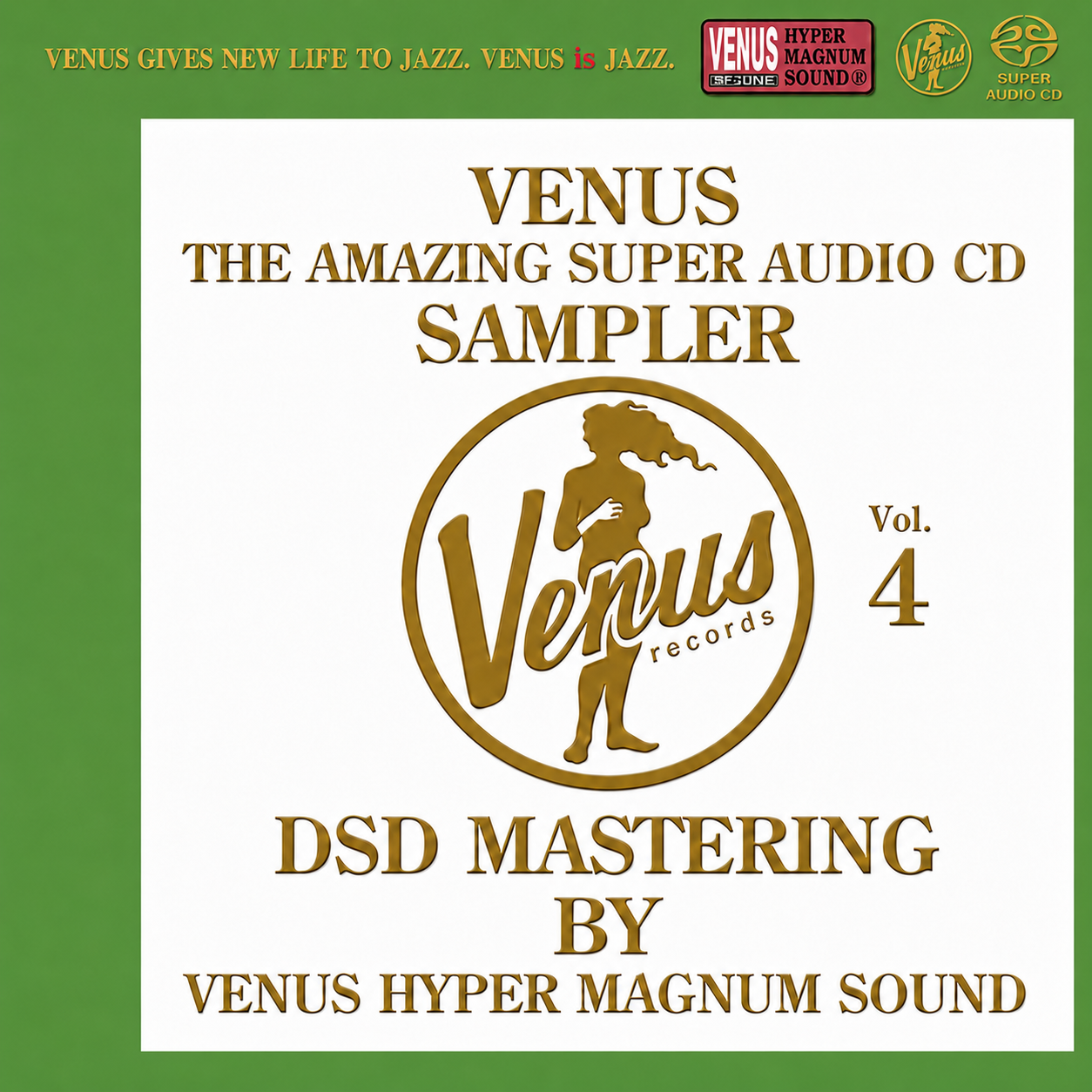
Venus – Amazing Super Audio CD Sampler Vol. 04
Venus – The Amazing Super Audio CD Sampler Vol. 4: An Audiophile Jazz Journey in Golden Sound
The evening begins with a Christmas melody, but this is not a conventional seasonal album. As the Eddie Higgins Trio enters with “God Rest Ye Merry Gentlemen,” the familiar tune is transformed into an intimate jazz performance, carried by elegant piano lines, a warmly recorded double bass and percussion that seems to emerge from the back of a private listening room. It is the opening scene of Venus – The Amazing Super Audio CD Sampler Vol. 4, a Japanese audiophile jazz compilation created to demonstrate both the musical identity and the distinctive high-resolution sound of Venus Records.
Released in Japan on April 15, 2015, under catalogue number VHGD-73, The Amazing Super Audio CD Sampler Vol. 4 is a stereo SACD compilation containing 15 recordings selected from Venus albums numbered VHGD-46 through VHGD-62. With a total playing time of approximately 83 minutes, the album offers a substantial journey through piano trios, vocal jazz, romantic ballads and expressive saxophone performances. (venusrecord.com)
The first two performances belong to the Eddie Higgins Trio. After “God Rest Ye Merry Gentlemen,” the group continues with “We Three Kings of Orient Are,” taken from the second volume of Higgins’s Christmas Songs. In another setting, these compositions might sound tied to a particular season. Here, they function as graceful jazz standards. Higgins treats the melodies with respect while surrounding them with delicate harmonic movement, turning holiday music into sophisticated late-night jazz.
Then the atmosphere changes. Steve Kuhn Trio’s “Swan Lake” takes Tchaikovsky’s classical theme and leads it into the world of the modern jazz piano trio. The melody remains recognisable, but its emotional character shifts as the musicians explore the space between classical romanticism and jazz improvisation. It is the kind of transformation that defines the Venus Records catalogue: familiar material is not simply reproduced but given new colour, rhythm and emotional depth.
By the time Archie Shepp appears with “More Than You Know,” the compilation has entered darker territory. Shepp’s tenor saxophone does not merely present the melody. It speaks through it, bringing weight, vulnerability and a sense of lived experience to the standard. The generous running time allows the performance to develop naturally, moving from reflective ballad playing toward more impassioned musical statements. It is one of the moments when the album stops feeling like an audiophile demonstration disc and begins to resemble a carefully constructed story.
That distinction is important. Many high-resolution audio samplers are designed primarily to expose the capabilities of a stereo system. They offer dramatic percussion, deep bass or sharply separated instruments but do not always create a unified listening experience. Venus – The Amazing Super Audio CD Sampler Vol. 4 takes a different approach. Its audiophile sound quality is inseparable from the emotional personality of the performances. The recording allows listeners to hear the texture of a saxophone reed, the decay of a piano note and the physical presence of an acoustic bass, but those details remain in service of the music.
The Eddie Higgins Quintet’s “Ghost of a Chance” continues the story with a larger instrumental palette. The official Venus listing identifies the performance with Higgins, Scott Hamilton and Ken Peplowski, bringing together piano, tenor saxophone and clarinet in an arrangement filled with old-school elegance. The musicians never rush the song. They allow its romantic uncertainty to remain suspended in the room, creating the impression of a jazz club after midnight, when the conversation has quieted and the audience is listening more closely. (venusrecord.com)
Eric Alexander follows with “Mona Lisa.” His tenor saxophone gives the famous melody a richer and more muscular identity, supported by a quartet that understands how to create intensity without disturbing the ballad’s calm surface. Alexander returns later with “Harlem Nocturne,” a composition naturally suited to his broad tone and dramatic phrasing. Heard together, the two performances show why the saxophonist became such a significant presence in the Venus Records discography.
At the centre of the album stands “Cleopatra’s Dream” by the Tsuyoshi Yamamoto Trio. Bud Powell’s composition arrives with rhythmic confidence and immediate energy, offering a compact contrast to the slower ballads surrounding it. Yamamoto’s piano has weight and clarity, while the rhythm section creates the firm foundation expected from a reference-quality jazz recording. For listeners using the album to evaluate an audiophile stereo system, this track offers an effective test of timing, transient response and the natural relationship between piano, bass and drums.
The New York Trio then enters with “Lover Come Back to Me,” bringing a refined Manhattan sensibility to Sigmund Romberg’s standard. Later, the group is joined by Ken Peplowski for “In the Middle of a Kiss,” one of the album’s longest and most spacious selections. The extended performance gives the musicians time to move beyond the theme, developing a conversation that feels measured, elegant and unforced.
Nicki Parrott provides the album’s vocal heart. Her first appearance, “April Showers,” balances nostalgia with light rhythmic movement. She returns with the more assertive “I Told Ya I Love Ya, Now Get Out,” a performance that allows humour and personality to enter the programme. The shift is refreshing: after several romantic instrumentals, Parrott’s direct delivery sounds like a character suddenly stepping forward to address the listener.
Her final performance, “Moonlight Serenade,” closes the album in a gentler mood. Glenn Miller’s famous composition becomes an intimate vocal scene rather than a large-band showcase. Parrott’s voice, supported by a polished arrangement, brings the journey to a quiet conclusion. The album does not end with a dramatic audiophile explosion. It fades into the atmosphere of a room in which the last song has been played and nobody is ready to leave.
Between Parrott’s appearances, Eddie Higgins offers “Again,” a concise performance that captures his lyrical approach to the piano trio format. Steve Kuhn’s “Blue Bossa” introduces a cooler, more rhythmically flowing character, while Eric Alexander’s “Harlem Nocturne” restores the smoky saxophone mood before the closing vocal. Together, these recordings create a sequence that feels varied without becoming disconnected.
The sound behind the collection is closely associated with producer and engineer Tetsuo Hara. According to the official album credits, Hara produced, mixed and mastered the compilation using the Venus Hyper Magnum Sound Direct Mix approach, while Artplan handled the design. This production philosophy helped establish the recognisable Venus Records sound: immediate, full-bodied and designed to give acoustic jazz a strong physical presence within the stereo image. (venusrecord.com)
For collectors of Japanese SACD releases, Venus – The Amazing Super Audio CD Sampler Vol. 4 represents more than a convenient introduction to several albums. It captures a particular view of jazz recording, one in which classic standards, luxurious presentation and high-resolution sound are treated as parts of the same artistic experience. The compilation features Eddie Higgins, Steve Kuhn, Archie Shepp, Eric Alexander, Tsuyoshi Yamamoto, Nicki Parrott, Ken Peplowski and the New York Trio, yet it maintains a consistent atmosphere from beginning to end. (venusrecord.com)
As an audiophile jazz album, it succeeds because it does not demand that listeners choose between musical substance and technical excellence. The SACD format reveals instrumental detail, dynamic nuance and stereo depth, while the programme remains warm, melodic and approachable. Listeners searching for high-resolution jazz, Venus Records SACD titles, Japanese audiophile music or a reference-quality jazz compilation will find plenty to admire, but the album’s lasting appeal lies beyond specifications.
The Amazing Super Audio CD Sampler Vol. 4 tells its story through familiar songs rediscovered by distinctive musicians. It begins with winter melodies, passes through classical themes, romantic standards, blues-inflected saxophone ballads and spirited piano performances, and ends beneath the soft glow of “Moonlight Serenade.” By the final note, the album has demonstrated not only what an audiophile recording can reveal, but also why beautifully recorded jazz remains worth hearing again and again.
