
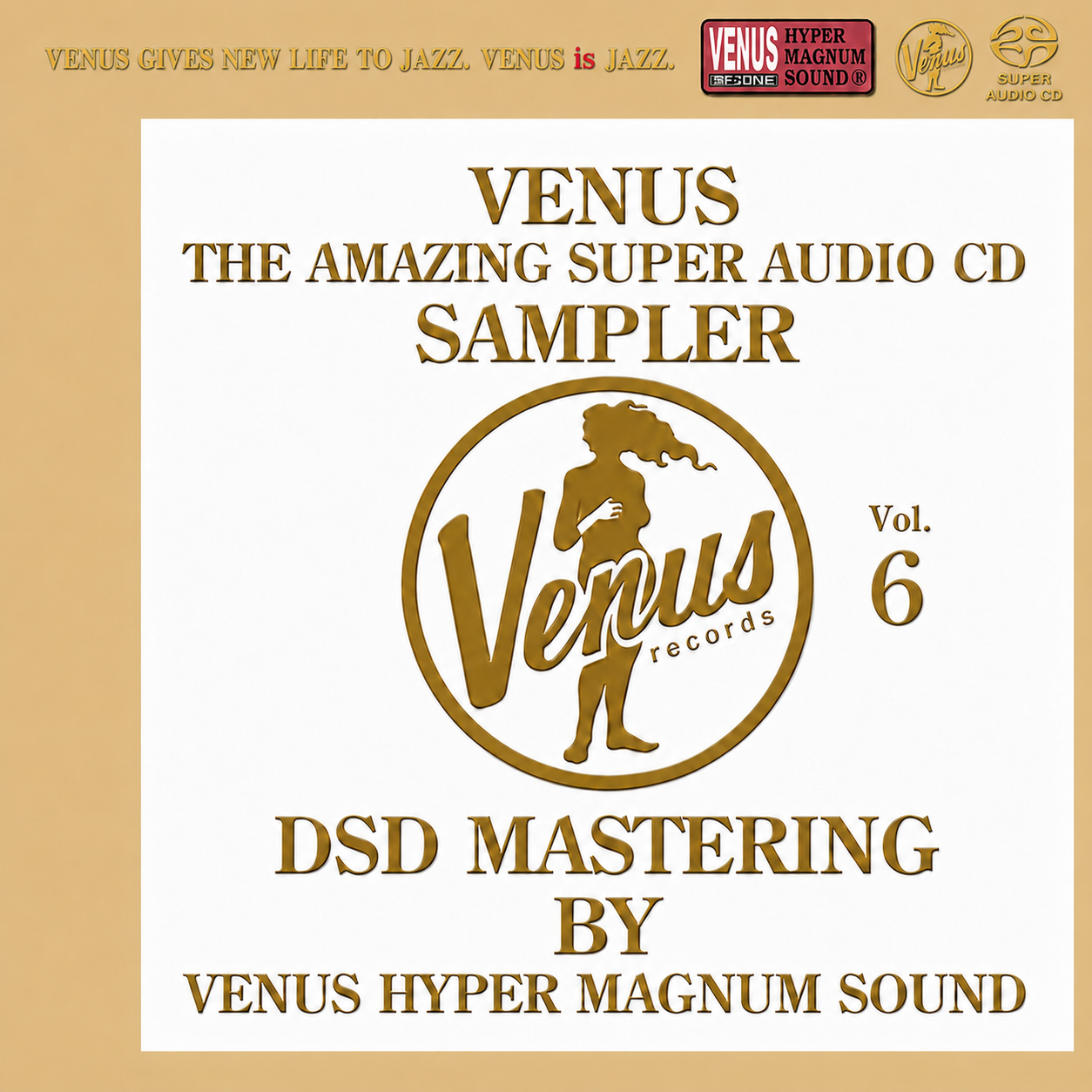
Venus – Amazing Super Audio CD Sampler Vol. 06
Venus – The Amazing Super Audio CD Sampler Vol. 6: A Grand Tour Through the Art of the Jazz Piano Trio
There is a special moment in jazz when three musicians begin to sound like one. The pianist introduces a melody, the bassist answers from the shadows, and the drummer quietly reshapes the rhythm beneath them. Nothing appears forced, yet every note depends on a shared understanding. That intimate conversation lies at the heart of Venus – The Amazing Super Audio CD Sampler Vol. 6, an ambitious audiophile jazz collection devoted entirely to the enduring magic of the piano trio.
Released in Japan on July 15, 2015, under catalogue number VHGD-89, the album carries the subtitle Venus Great Piano Trio <1>. It was conceived as the first chapter of a larger celebration involving 45 piano trios, divided across three collections. Volume 6 introduces the first 15 ensembles through 15 carefully selected performances and offers more than 85 minutes of music. (venusrecord.com)
Rather than functioning as a conventional greatest-hits compilation, The Amazing Super Audio CD Sampler Vol. 6 feels like an evening spent moving between jazz clubs in different cities. Each doorway reveals another pianist, another rhythm section and another interpretation of what a piano trio can become. Some performances are romantic and polished, others are rhythmically adventurous, while several reach back toward classical music, traditional melodies and the Great American Songbook.
The journey begins with the Steve Kuhn Trio performing Henry Mancini’s “Charade.” It is an inspired opening choice because the composition already possesses the atmosphere of a film unfolding in half-light. In the hands of a jazz trio, its familiar melody becomes something more private and conversational, immediately establishing the sophisticated mood that defines this Venus Records compilation.
The Derek Smith Trio follows with “Beautiful Love,” a standard that has long provided jazz musicians with space for lyrical improvisation. The transition demonstrates one of the album’s central strengths: it allows listeners to compare how different pianists approach melody, harmony and silence. The instrumentation may remain the same, but the musical personalities change completely.
With “Turquoise,” the Cedar Walton Trio brings an original composition into a programme dominated by standards. Walton’s presence adds a different kind of authority. The music does not merely interpret the jazz tradition; it speaks from within it. His composition gives the collection a stronger modern-jazz identity and reminds the listener that the piano trio has always been both a vehicle for reinvention and a laboratory for new ideas.
The atmosphere turns warmer when the Renato Sellani Trio arrives with “Besame Mucho.” The famous Latin melody receives the elegant treatment associated with romantic European jazz, connecting the intimacy of a late-night piano bar with the clarity expected from an audiophile SACD recording. Soon afterward, the Ted Rosenthal Trio takes on George Gershwin’s “Summertime,” one of the most frequently interpreted songs in jazz history. Its inclusion is not simply traditional; it provides another opportunity to hear how a familiar melody can acquire fresh colours through touch, timing and harmonic imagination.
Leon Russell’s “This Masquerade,” performed by the Rob Agerbeek Trio, moves the album toward a more contemporary songbook. Its melancholy character fits naturally into the Venus Records sound world, where emotional directness and luxurious recording quality often meet. The spelling appears as “This Masquarade” in the official Venus listing, but the composition is the well-known Leon Russell song. (venusrecord.com)
One of the collection’s most graceful moments arrives with the Barbara Carroll Trio and Cole Porter’s “You’d Be So Nice to Come Home To.” Carroll’s inclusion gives the album another layer of historical depth. Her performance sits comfortably beside the work of pianists from different generations, illustrating how the language of jazz piano can remain recognisable while continually changing in accent and personality.
The emotional temperature deepens with the John Hicks Trio performing “Cry Me a River.” Arthur Hamilton’s song has often been associated with vocal heartbreak, but in a piano trio setting the absence of lyrics allows the harmony itself to carry the feeling. The piece becomes less of a confession and more of an interior monologue.
Cole Porter returns through “So in Love,” performed by the John Di Martino Romantic Jazz Trio. The ensemble’s name already suggests its approach: melody is treated not as a framework to escape from, but as the emotional centre of the performance. On an album filled with contrasting styles, this romantic sensibility helps preserve a continuous narrative.
The journey then moves east with the Vladimir Shafranov Trio and “Midnight in Moscow.” Its Russian character introduces another cultural colour without breaking the collection’s intimate atmosphere. Shafranov’s trio belongs naturally within this sequence because the performance connects European lyricism with the swinging language of American jazz.
“Love Is a Many-Splendored Thing,” played by the Jon Davis Trio, returns the listener to cinema and popular song. Like several selections on the album, it shows why film themes have remained such valuable material for jazz musicians. Their melodies are immediately recognisable, but their harmonic structures leave enough room for interpretation, rhythmic displacement and personal expression.
The collection takes another turn with the Chano Dominguez Trio performing the traditional Spanish song “La Tarara.” Dominguez is closely associated with the meeting point between jazz and flamenco, and his appearance broadens the album beyond conventional American standards. The performance gives the sampler a stronger international identity, suggesting that the modern jazz piano trio is not limited by geography.
That Spanish thread continues with the Tete Montoliu Trio and “The Lady from Aragon.” Montoliu’s place in European jazz history makes his inclusion especially significant. His presence reinforces the sense that Venus Records was assembling not merely a collection of attractive recordings, but a survey of individual voices from across the international jazz piano tradition.
The penultimate performance belongs to the Dan Nimmer Trio, which interprets Johnny Mandel’s “The Shadow of Your Smile.” Its gentle, reflective melody creates a natural late-night atmosphere before the album’s unusual conclusion.
Instead of ending with another romantic standard, Venus Records closes the sampler with the Cyrus Chestnut Trio performing “Solfeggietto,” based on the famous keyboard work by C.P.E. Bach. This meeting between classical technique and jazz rhythm provides a witty and energetic finale. It also completes the album’s broader story: the piano trio is capable of absorbing almost anything, from Hollywood themes and Broadway songs to Spanish tradition and eighteenth-century keyboard music.
The sound of the collection was shaped by Tetsuo Hara, who served as both producer and mixing and mastering engineer. The official credits identify the recording approach as Venus Hyper Magnum Sound Direct Mix, with artwork designed by Artplan. (venusrecord.com) Hara’s production philosophy has become closely associated with the bold, immediate and richly detailed character sought by collectors of Venus Records SACDs.
That audiophile presentation is important, but it is not the only reason the album succeeds. A test disc may impress for a few minutes; a strong musical anthology invites repeated listening. Venus – The Amazing Super Audio CD Sampler Vol. 6 does both. The piano occupies the centre of the soundstage, yet the bass and drums remain essential partners rather than background accompaniment. For listeners evaluating a high-end audio system, the collection offers opportunities to hear differences in piano tone, bass definition, cymbal decay, stereo imaging and the natural interaction between musicians.
More importantly, the album tells a coherent story. Across 15 performances, the listener encounters Steve Kuhn, Derek Smith, Cedar Walton, Renato Sellani, Ted Rosenthal, Rob Agerbeek, Barbara Carroll, John Hicks, John Di Martino, Vladimir Shafranov, Jon Davis, Chano Dominguez, Tete Montoliu, Dan Nimmer and Cyrus Chestnut. The official sequence moves from “Charade” to “Solfeggietto,” creating a panorama of jazz piano styles rather than focusing on a single school or generation. (venusrecord.com)
For collectors searching for an audiophile jazz SACD, a Venus Records sampler, a reference-quality piano trio recording or a sophisticated introduction to international jazz pianists, The Amazing Super Audio CD Sampler Vol. 6 remains an especially rewarding release. It captures the piano trio not as a fixed format, but as a living conversation, one that changes whenever a new pianist sits down, the bassist finds the first note and the drummer begins to breathe beneath the melody.
By the time the final Bach-inspired phrases disappear, the album has made its argument without needing to state it directly. Three musicians, when listening closely enough to one another, can create an entire world.
