
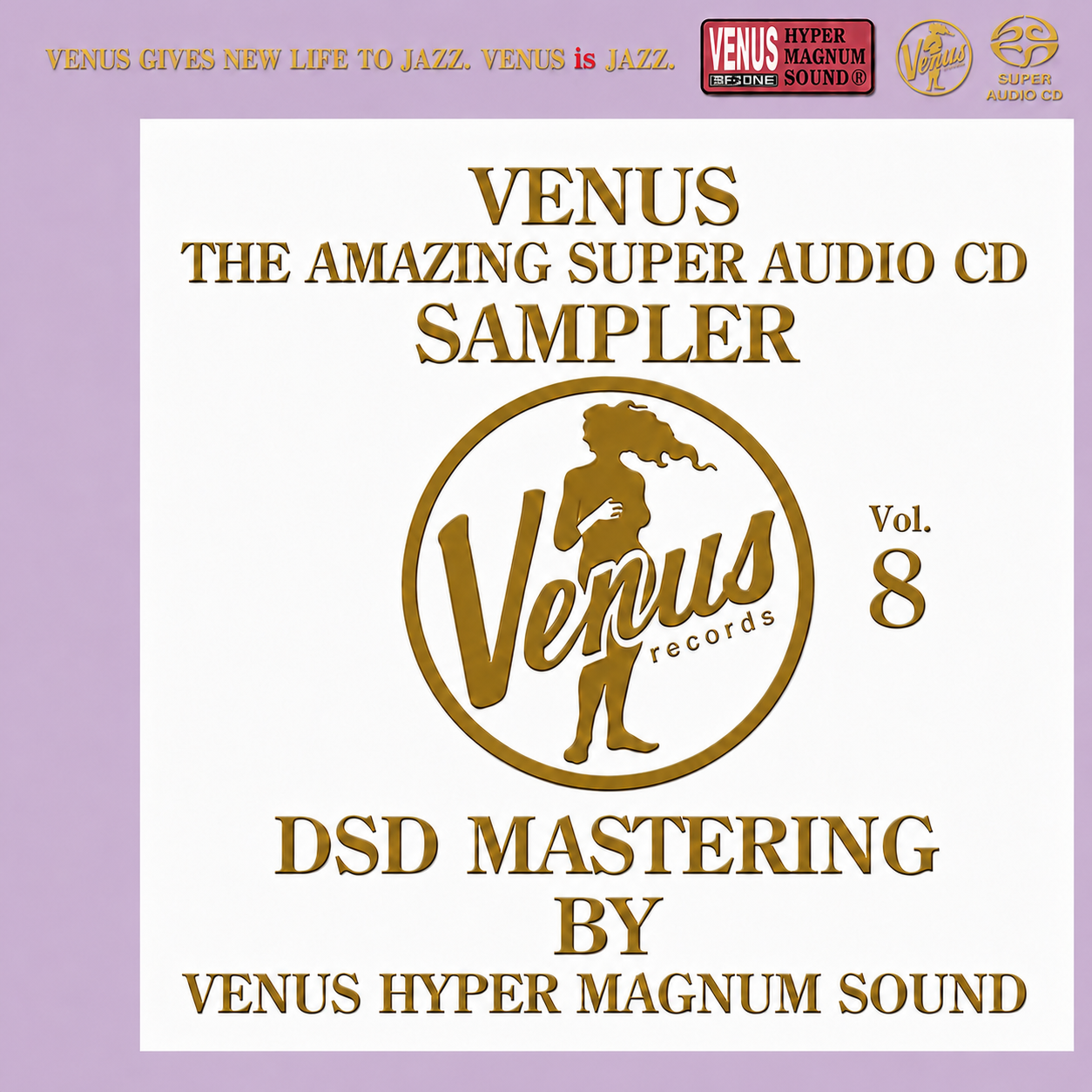
Venus – Amazing Super Audio CD Sampler Vol. 08
Venus – The Amazing Super Audio CD Sampler Vol. 8: Fifteen Piano Trios, One Audiophile Journey
There is something unmistakably intimate about a jazz piano trio. Three musicians enter the room, but the music they create can suggest an entire orchestra of emotions. A piano introduces the story, the double bass gives it weight, and the drums determine how quickly—or how slowly—the night will unfold. On Venus – The Amazing Super Audio CD Sampler Vol. 8, that classic formation becomes the heart of an ambitious journey through the catalogue of Japan’s celebrated Venus Records.
Released in 2015 under catalogue number VHGD-103, this audiophile jazz compilation carries the subtitle Venus Great Piano Trio <2>. It is the second instalment in a three-part celebration built around 45 different piano trios, with each volume presenting 15 performances. Vol. 8 alone stretches beyond 88 minutes, turning what might ordinarily be called a sampler into a substantial jazz programme in its own right. (venusrecord.com)
Venus Records has never treated the word “sampler” as an excuse for background music. Founded in Japan in 1992 by producer Tetsuo Hara, the label developed an international reputation for presenting American, European and Japanese jazz musicians with a distinctly physical, immediate sound. Its productions are closely associated with the label’s 24-bit Venus Hyper Magnum Sound mastering approach, created to give the instruments a powerful presence and bring the listener closer to the musicians. (Wikipedia)
That philosophy is perfectly suited to the piano trio. In this setting, there is nowhere for a musician to hide. The piano must remain expressive without overwhelming the rhythm section. The bass must provide harmonic depth while still sounding agile. The drums must add energy without disturbing the delicacy of the melody. A strong audiophile recording makes those relationships easier to hear, revealing not only what each musician plays but how the players respond to one another.
The album opens with the Eddie Higgins Trio performing Michel Legrand’s “I Will Wait for You,” the melody associated with The Umbrellas of Cherbourg. Higgins was particularly gifted at finding warmth inside familiar standards. Rather than treating the composition as a nostalgic film theme, his trio allows it to breathe like a late-night jazz ballad. The familiar melody becomes the doorway into the collection, welcoming the listener before the programme begins travelling through different generations, nationalities and approaches to piano jazz.
The mood changes quickly with the Massimo Faraò Trio and “Dark Eyes.” The traditional melody, long associated with Russian and European popular music, becomes a vehicle for rhythmic tension and dramatic improvisation. Where the opening track looks inward, “Dark Eyes” introduces movement and theatrical flair. It is an early indication that The Amazing Super Audio CD Sampler Vol. 8 is not designed around a single atmosphere. The album moves between romance, swing, classical influence, Brazilian colour and modern jazz freedom.
Sir Roland Hanna follows with “I Hear a Rhapsody.” Hanna belonged to that rare group of pianists who could sound refined without losing the earthy character of jazz. His performance connects elegance with forward momentum, placing the composition’s sweeping melody inside a trio conversation that remains disciplined yet emotionally open.
Claude Williamson’s interpretation of “Over the Rainbow” continues the album’s exploration of standards, but the song’s familiarity does not diminish its impact. On a weaker compilation, such a well-known composition might feel predictable. Here, it works as a test of personality. The important question is not whether the listener recognises the melody, but what the pianist discovers inside it. Williamson’s trio reminds us why jazz musicians repeatedly return to standards: the songs provide a common language, while interpretation turns that language into a personal statement.
“Andrea Pozza Trio’s “Alone Together” brings a darker, more nocturnal quality. The composition has long attracted improvisers because its harmonic movement encourages both lyrical playing and adventurous soloing. The track sits naturally within the Venus Records aesthetic, where romance is rarely separated from intensity. Even during the quieter passages, the music retains a sense of physical presence.
One of the collection’s most unusual moments arrives with the Pepe Rivero Trio performing Chopin’s “Waltz in D-flat Major, Op. 64 No. 1,” widely known as the “Minute Waltz.” By placing a classical composition inside a jazz trio programme, Rivero demonstrates how easily boundaries can dissolve when musicians concentrate on rhythm, melody and interaction. Chopin’s famous lines become raw material for a modern conversation rather than an untouchable museum piece.
The album then moves toward the distinctive Caribbean energy of the Monty Alexander Trio on “Sweet Lady.” Alexander’s playing has always drawn strength from the relationship between jazz and Jamaican rhythm, and his presence gives the compilation another change of temperature. His performance does not merely add variety; it expands the meaning of the piano trio itself, showing how the format can absorb different rhythmic traditions without losing its essential balance.
Kenny Werner approaches “Autumn Leaves,” one of the most frequently performed standards in jazz history. The danger with such material is familiarity, but Werner has built his career on searching beyond automatic habits. In this context, “Autumn Leaves” becomes less a routine standard than an opportunity to reconsider space, harmony and melodic direction.
The Dick Hyman Trio takes on “My Favorite Things,” a composition permanently connected to both Broadway and the radical transformations of John Coltrane. Hyman brings his own historical awareness to the piece. His performance functions as a bridge between jazz tradition and technical imagination, honouring the tune’s recognisable shape while refusing to treat it as a fixed object.
“Someday My Prince Will Come,” performed by the Harold Mabern Trio, continues the journey through songs that moved from popular culture into the jazz canon. Mabern’s muscular piano style gives the melody additional weight, replacing fairytale innocence with blues feeling and rhythmic authority. The result illustrates one of the compilation’s recurring themes: a famous melody can survive countless interpretations because the personality of the musician continually renews it.
Brazil enters the room through the Stefano Bollani Trio and Antônio Carlos Jobim’s “Agua de Beber.” Bollani is known for combining virtuosity with wit, and the Jobim composition gives him space to balance elegance, rhythmic lightness and improvisational surprise. The track brings fresh air into the second half of the programme, proving that audiophile jazz does not need to sound solemn in order to be sophisticated.
Walter Bishop Jr.’s “Speak Low” returns the album to a more urban atmosphere. Kurt Weill’s composition has been explored by generations of jazz musicians, yet its tense harmonic structure continues to invite new interpretations. Bishop’s performance belongs to the hard-bop tradition, but the trio format keeps the music flexible and conversational.
The Giovanni Guidi Trio then performs Ornette Coleman’s “Turnaround,” introducing a composition linked to one of jazz’s most important musical revolutionaries. Its inclusion prevents the collection from becoming a comfortable parade of romantic standards. Coleman’s influence brings sharper edges and a more modern sense of possibility, while Guidi’s trio places the music inside its own contemporary European perspective.
Near the end, the New York Trio performs “When Your Lover Has Gone.” The title alone suggests the emotional territory: absence, memory and the quiet hours after a relationship has ended. It is precisely the kind of material in which a piano trio can sound most complete. Without a vocalist, the instruments must carry the unspoken words, turning melody into narrative.
The closing performance, “Reginella” by the Danilo Rea Trio, gives the album an unmistakably Italian farewell. After travelling through American standards, Russian melody, classical repertoire, Broadway, Brazilian song and modern jazz, the compilation concludes with music rooted in the Neapolitan tradition. The ending feels appropriate for a Venus Records anthology: romantic, international and deeply aware of melody.
The physical edition of Venus – The Amazing Super Audio CD Sampler Vol. 8 was issued as a single-layer stereo SACD rather than a hybrid disc. That means it requires SACD-compatible playback equipment and will not operate as an ordinary compact disc in a standard CD player. The Japanese release carries the barcode 4571292517447 and was presented in a hardcover digibook-style package. (hraudio.net)
For audiophiles, the album offers an opportunity to hear how different piano trios occupy an acoustic space. The attack and decay of the piano notes, the body of the double bass and the texture of brushes or cymbals become part of the musical experience. Yet the value of the collection goes beyond high-resolution sound. It succeeds because the recording quality serves the performances rather than replacing them.
The Amazing Super Audio CD Sampler Vol. 8 is therefore more than a demonstration disc for an expensive audio system. It is a portrait of the jazz piano trio as one of music’s most durable and adaptable formations. Eddie Higgins, Massimo Faraò, Sir Roland Hanna, Claude Williamson, Monty Alexander, Kenny Werner, Harold Mabern, Stefano Bollani and the other featured pianists do not share one uniform style. What unites them is the ability to transform melody through interaction.
In an age of hurried playlists and disposable listening, Venus Records offers something deliberately different: 15 piano trios, more than 88 minutes of music and a sequence designed to reward concentration. Played late at night through a revealing stereo system, the album becomes what every great audiophile jazz recording should be—not simply a test of equipment, but an invitation to forget the equipment entirely and enter the music.
