
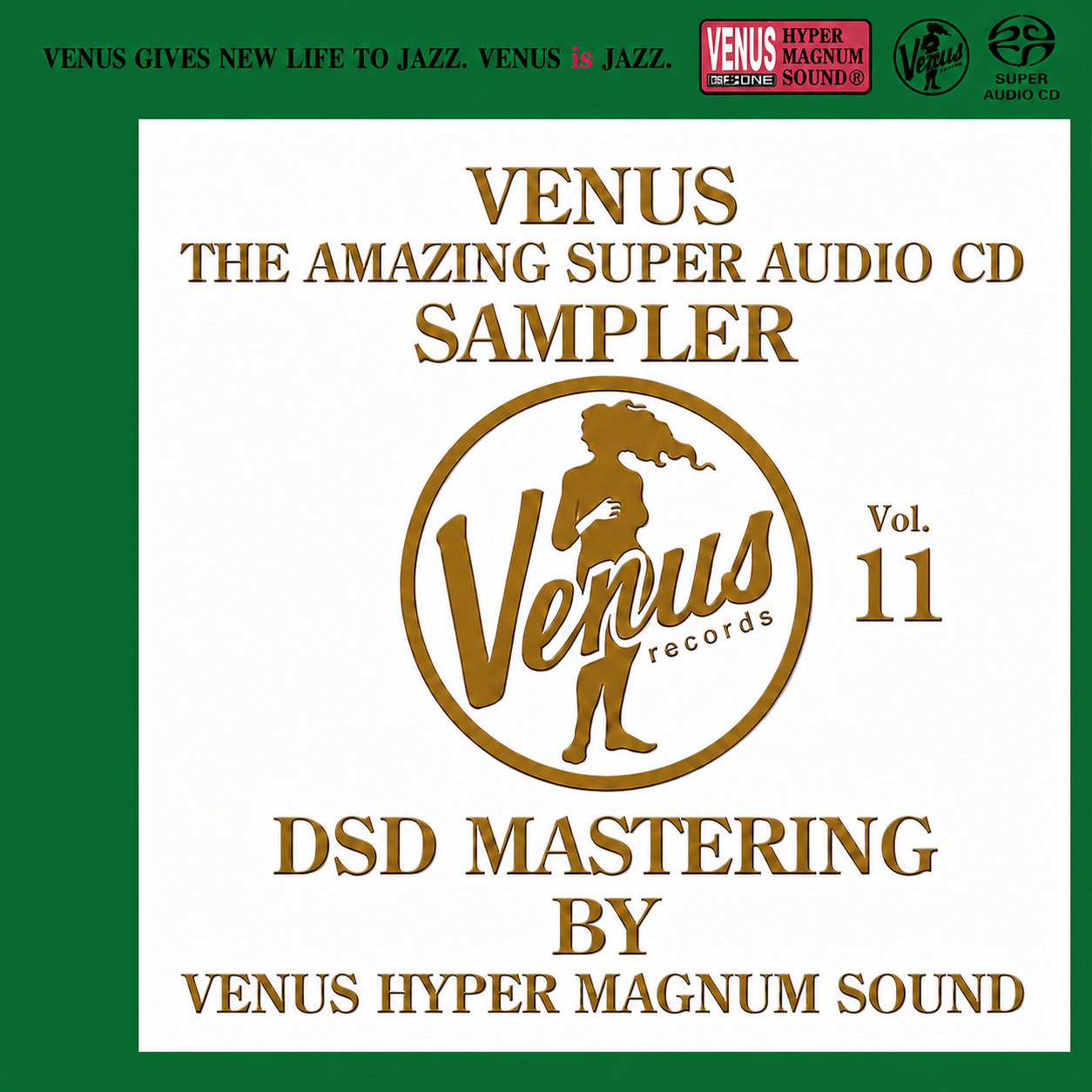
Venus – Amazing Super Audio CD Sampler Vol. 11
Venus – The Amazing Super Audio CD Sampler Vol. 11: Fifteen Tenor Saxophones and the Sound of a Jazz Tradition
The tenor saxophone does not merely enter a jazz performance. It announces a presence.
Its lowest notes can sound like a voice speaking from the back of a darkened room, while its upper register can cut through a rhythm section with startling emotional force. In the right hands, the instrument can whisper, shout, console, provoke and confess. Few instruments reveal the personality of a musician so quickly, and few recording formats expose the differences between players with such clarity.
That expressive range becomes the central story of Venus – The Amazing Super Audio CD Sampler Vol. 11, a high-resolution jazz compilation devoted entirely to the tenor saxophone. Issued in Japan on December 16, 2015, under catalogue number VHGD-121, the album carries the subtitle Venus Great Tenor Saxophone and presents 15 performances by 15 different saxophonists. The programme moves from Eric Alexander to Dewey Redman, placing mainstream swing, hard bop, romantic balladry, soul jazz and more adventurous forms of expression inside one long, carefully sequenced listening experience.
With a running time of approximately 88 minutes and 49 seconds, The Amazing Super Audio CD Sampler Vol. 11 is not a brief promotional collection. It is an extended portrait of the tenor saxophone as one of jazz’s most personal instruments.
The journey begins with “Dear Old Stockholm,” performed by Eric Alexander.
The traditional Swedish melody has appeared throughout jazz history because its graceful theme contains enough harmonic space for improvisers to reshape it. In Alexander’s hands, it becomes a vehicle for a large, confident tenor sound. The performance immediately establishes the album’s audiophile character. The listener does not hear the saxophone as a distant melodic line. The instrument appears close and physical, with breath, reed vibration and tonal weight becoming part of the musical experience.
Alexander’s strength lies not only in volume or technical command but in the way his phrases gather momentum. He can begin with a clean statement of the melody and gradually increase the intensity until the entire quartet seems to be moving behind him. “Dear Old Stockholm” therefore works as an ideal opening chapter. It introduces a familiar song but makes the tenor saxophone itself the real subject.
The transition to Scott Hamilton could hardly be more revealing.
Hamilton performs Cole Porter’s “It’s All Right with Me,” and the atmosphere changes from hard-driving modern jazz to polished, conversational swing. His tenor tone has a rounded warmth, and his phrasing gives the impression that every note has been chosen for its place inside a complete sentence. Where Alexander pushes forward, Hamilton appears to lean back slightly, allowing the rhythm to carry him.
This contrast explains the purpose of Venus Great Tenor Saxophone. The album does not attempt to identify one correct tenor sound. Instead, it celebrates the instrument’s capacity to reflect the character of the person playing it. The same basic construction of metal, keys, reed and mouthpiece produces entirely different emotional worlds.
Clarinetist and saxophonist Ken Peplowski follows with Leonard Bernstein’s “Lucky to Be Me.” The melody arrives with elegance, and Peplowski shapes it with restraint. His performance does not demand attention through force. It draws the listener closer through control, lyricism and the subtle placement of phrases.
The first three tracks already create the feeling of walking through three different jazz clubs on the same night. In one room, a powerful modern tenor solo rises above a hard-swinging quartet. In another, an experienced stylist turns a Cole Porter standard into relaxed late-night conversation. In the third, a lyrical musician allows a Broadway melody to unfold with almost vocal tenderness. The official sequence places Eric Alexander, Scott Hamilton and Ken Peplowski at the beginning of the programme, immediately demonstrating the album’s range.
The fourth performance introduces a distinctly European voice.
French saxophonist Barney Wilen plays Sonny Rollins’ “Valse Hot,” a composition built around the unusual combination of jazz improvisation and waltz rhythm. The three-beat pulse creates a sense of circular movement. Instead of walking in a straight line, the music seems to turn continuously, offering Wilen new angles from which to approach the melody.
There is historical awareness in the choice of material, but the performance does not feel trapped by history. “Valse Hot” becomes a reminder that jazz standards remain alive only when musicians are willing to reconsider them. Wilen’s tenor sound gives the composition a different shade, placing American jazz language inside a European sensibility.
With “Hush-A-Bye,” Nicolas Montier returns the album to a more intimate setting. The Sammy Fain melody has the gentle outline of a lullaby, yet its harmonic movement gives a saxophonist room to create tension beneath the surface. Montier allows the tune to remain tender without becoming overly sweet.
This is one of the points where the high-resolution SACD presentation becomes especially important. In quieter jazz, the spaces between the notes matter as much as the notes themselves. A soft tenor phrase can reveal the air moving through the instrument, while the decay of a piano chord or the light touch of a cymbal can establish the dimensions of the recording space.
Then the mood changes dramatically.
Eddie Harris appears with “Freedom Jazz Dance,” his own composition and one of the most rhythmically distinctive selections on the album. The track replaces romantic balladry with funk, repetition and forward motion. Its sharp melodic figure locks into the rhythm section, creating a performance that feels physical from the opening bars.
Harris’ presence expands the meaning of the tenor saxophone. The instrument is no longer only a singer of standards or ballads. It becomes part of the groove, repeating and bending phrases until rhythm and melody are almost inseparable. The official Venus sequence places “Freedom Jazz Dance” directly after “Hush-A-Bye,” making the shift in energy particularly striking.
The album then reaches one of its emotional centres with Pharoah Sanders performing “I Want to Talk About You.”
The Billy Eckstine ballad has long provided tenor players with an opportunity to reveal their most vulnerable side. Sanders is often associated with intensity and spiritual force, but here the melody invites patience. His sound carries a rough human edge, suggesting that beauty does not require perfect smoothness.
Every phrase seems to contain both tenderness and strain. The tenor does not simply reproduce the tune; it appears to search inside it. The result feels less like a polished reading of a jazz standard than a personal declaration delivered through the instrument.
That sense of personality continues with Archie Shepp and “Gigi.”
The title song from the Lerner and Loewe musical might seem an unexpected choice for a saxophonist known for expressive freedom and a deeply individual sound. That contrast is precisely what makes the performance compelling. Shepp does not abandon the melody, but neither does he treat it as fragile material that must remain untouched.
His tenor tone introduces friction into the romantic composition. Notes can sound grainy, heavy or deliberately exposed. The familiar theme is still present, but its emotional meaning changes. What once belonged to the polished world of musical theatre becomes something older, rougher and more personal.
By placing Pharoah Sanders and Archie Shepp beside more traditional stylists, The Amazing Super Audio CD Sampler Vol. 11 avoids presenting jazz history as a simple progression from old to new. Mainstream lyricism and freer expression coexist on the same disc. The listener is encouraged to hear them not as opposing camps but as different solutions to the same musical question: how can a saxophonist make a melody speak with an individual voice?
The ninth track brings Carmen Leggio to “Autumn Leaves,” one of the most frequently performed songs in jazz.
Familiar material creates a special challenge. The listener already knows where the melody is expected to go, and perhaps has heard dozens of celebrated recordings. A successful interpretation must therefore create freshness through sound, timing and interaction rather than through novelty alone.
Leggio approaches “Autumn Leaves” as a working jazz musician’s standard: direct, melodic and open to improvisation. The performance provides a moment of balance after the emotional weight of Sanders and Shepp. It also demonstrates why certain compositions remain central to the jazz repertoire. Their durability lies in the freedom they offer to each new player.
The modern popular songbook enters through Brandon Fields, who performs Stevie Wonder’s “My Cherie Amour.”
The melody is immediately recognisable, but the absence of vocals changes the listener’s relationship with it. The tenor saxophone must carry both the tune and the emotional suggestion of the missing words. Fields gives the song a polished contemporary sound, connecting jazz improvisation with soul and pop melody.
Its inclusion is important because it prevents the collection from becoming a museum of mid-century standards. Jazz has always absorbed material from the popular culture surrounding it. “My Cherie Amour” shows that the process did not stop when Broadway ceased to dominate popular songwriting.
The next performance travels toward Brazil.
George Garzone interprets Luiz Bonfá’s “Gentle Rain,” a composition whose soft melodic movement creates an atmosphere of quiet melancholy. Garzone is capable of highly complex improvisation, but the song encourages him to concentrate on tone and space.
The rhythm seems to fall around the tenor like the rain suggested by the title. The music remains calm, yet it never becomes static. Small changes in phrasing, harmony and instrumental colour keep the performance moving beneath its reflective surface.
For an audiophile listener, “Gentle Rain” offers an opportunity to hear how well a sound system reproduces low-level detail. The emotional effect depends on subtlety: the saxophone’s breathiness, the body of the bass, the soft percussion and the natural decay around the piano.
Joel Frahm follows with “Delilah,” composed by Victor Young.
The track brings renewed energy. Frahm’s tenor sound combines warmth with agility, and the melody gives him room to move between lyrical statements and more forceful improvisation. His playing illustrates the balance required of a modern mainstream saxophonist. The sound must be distinctive enough to command attention but flexible enough to serve the composition.
The album’s sequence now begins to feel like a conversation across generations. Each player inherits a tradition shaped by countless earlier tenor saxophonists, yet each must avoid becoming an imitation. Technique alone is not enough. The identity of the musician must remain audible.
That identity is unmistakable when Bob Kindred begins “Blue Moon.”
The Rodgers and Hart standard has travelled through theatre, jazz and popular music, but Kindred treats it as an intimate instrumental song. His tenor sound is mature and unhurried. He does not rush toward the solo or decorate every available space. The melody is allowed to stand.
In a collection filled with contrasting approaches, “Blue Moon” demonstrates the expressive power of understatement. The track does not need dramatic changes in volume or tempo. Its emotional weight comes from patience and tone.
Italian saxophonist Gianni Basso then performs “Stardust,” one of the most enduring American popular standards.
Hoagy Carmichael’s melody has an almost dreamlike shape, and Basso approaches it with an elegant romantic sound. The performance feels suspended between memory and the present, which is appropriate for a song that seems to carry its own atmosphere wherever it appears.
“Stardust” also reinforces the international character of the Venus Records catalogue. The music may come from the American songbook, but its emotional language has travelled far beyond its place of origin. An Italian tenor player, recorded for a Japanese jazz label, can make the composition feel entirely natural and personal.
The final performance belongs to Dewey Redman, who closes the album with “Satin Doll.”
The Duke Ellington and Billy Strayhorn standard is often approached with polished swing, but Redman brings a broader, earthier sound. His tenor can retain the melody while placing pressure on its edges. The performance feels rooted in tradition without being confined by it.
Ending with “Satin Doll” is a clever decision. The song is among the most recognisable pieces in jazz, yet Redman’s presence prevents the conclusion from becoming predictable. The familiar melody appears changed by the 14 tenor voices that have preceded it.
The listener has already heard Eric Alexander’s power, Scott Hamilton’s warmth, Ken Peplowski’s refinement, Barney Wilen’s European cool, Nicolas Montier’s lyricism, Eddie Harris’ rhythmic drive, Pharoah Sanders’ spiritual intensity, Archie Shepp’s raw expression, Carmen Leggio’s command of the standard repertoire, Brandon Fields’ contemporary polish, George Garzone’s harmonic depth, Joel Frahm’s flexibility, Bob Kindred’s patience and Gianni Basso’s romance. Dewey Redman does not summarise those approaches. He adds one final voice to the conversation.
The official album credits identify Tetsuo Hara as producer, mixing engineer and mastering engineer, with the music presented through the label’s Venus Hyper Magnum Sound Direct Mix. The cover and package design are credited to Artplan.
That production identity is essential to the appeal of Venus – The Amazing Super Audio CD Sampler Vol. 11. The Venus sound is designed to make jazz feel immediate. Tenor saxophones possess weight and texture, double basses sound full rather than distant, and drums retain both impact and fine detail.
Because the same instrument appears throughout the album, the compilation can also function as an unusually revealing audiophile reference recording. A high-quality stereo system should make the differences between the saxophonists unmistakable. Scott Hamilton should not sound like Archie Shepp. Pharoah Sanders should not sound like Bob Kindred. Eddie Harris should not sound like Gianni Basso.
Those differences involve far more than volume or frequency balance. They can be heard in the shape of each note, the amount of air surrounding the tone, the hardness or softness of the attack, the use of vibrato and the musician’s position within the rhythm. The SACD format gives the listener the opportunity to concentrate on those qualities, but the recording technology never becomes the main event.
The music remains central.
That distinction matters because some audiophile compilations can become technical demonstrations without a convincing emotional narrative. The Amazing Super Audio CD Sampler Vol. 11 avoids that problem by organising the programme around a strong musical idea. Fifteen players are given the same instrument and roughly the same amount of space, yet each creates a separate identity.
The compilation is therefore not only a celebration of great tenor saxophone recordings. It is also a study of individuality.
Jazz musicians spend years learning a shared language. They study many of the same standards, scales, harmonies and rhythmic traditions. They may even use similar instruments and perform with comparable quartet formations. Yet the goal is not to sound identical. The goal is to become recognisable after only a few notes.
Vol. 11 makes that process audible.
When Eric Alexander opens “Dear Old Stockholhttps://soundcloud.com/audiophilestreaming/sets/venus-amazing-super-773877140?si=f6ffd9d8bf2b4c0e892cc44a4aff6db6&utm_source=clipboard&utm_medium=text&utm_campaign=social_sharingm,” the listener enters through strength and momentum. When Scott Hamilton begins “It’s All Right with Me,” the language becomes smoother and more conversational. Pharoah Sanders turns a ballad into an emotional search, while Archie Shepp exposes roughness inside a theatrical melody. Eddie Harris makes the saxophone dance with the rhythm section, and Gianni Basso allows it to sing with romantic elegance.
By the time Dewey Redman reaches the final phrases of “Satin Doll,” the tenor saxophone no longer seems like one instrument. It has become 15 separate voices, each shaped by a different life, musical history and idea of beauty.
That is the lasting achievement of Venus – The Amazing Super Audio CD Sampler Vol. 11: Venus Great Tenor Saxophone. It can be played as a high-resolution SACD demonstration, used to explore the Venus Records catalogue or enjoyed as an introduction to some of jazz’s most distinctive tenor players. But its deeper value emerges when the listener stops comparing recordings and begins hearing personalities.
The album starts with metal, breath and reed. It ends with something far more human: the sound of 15 musicians telling their stories without speaking a word.
