
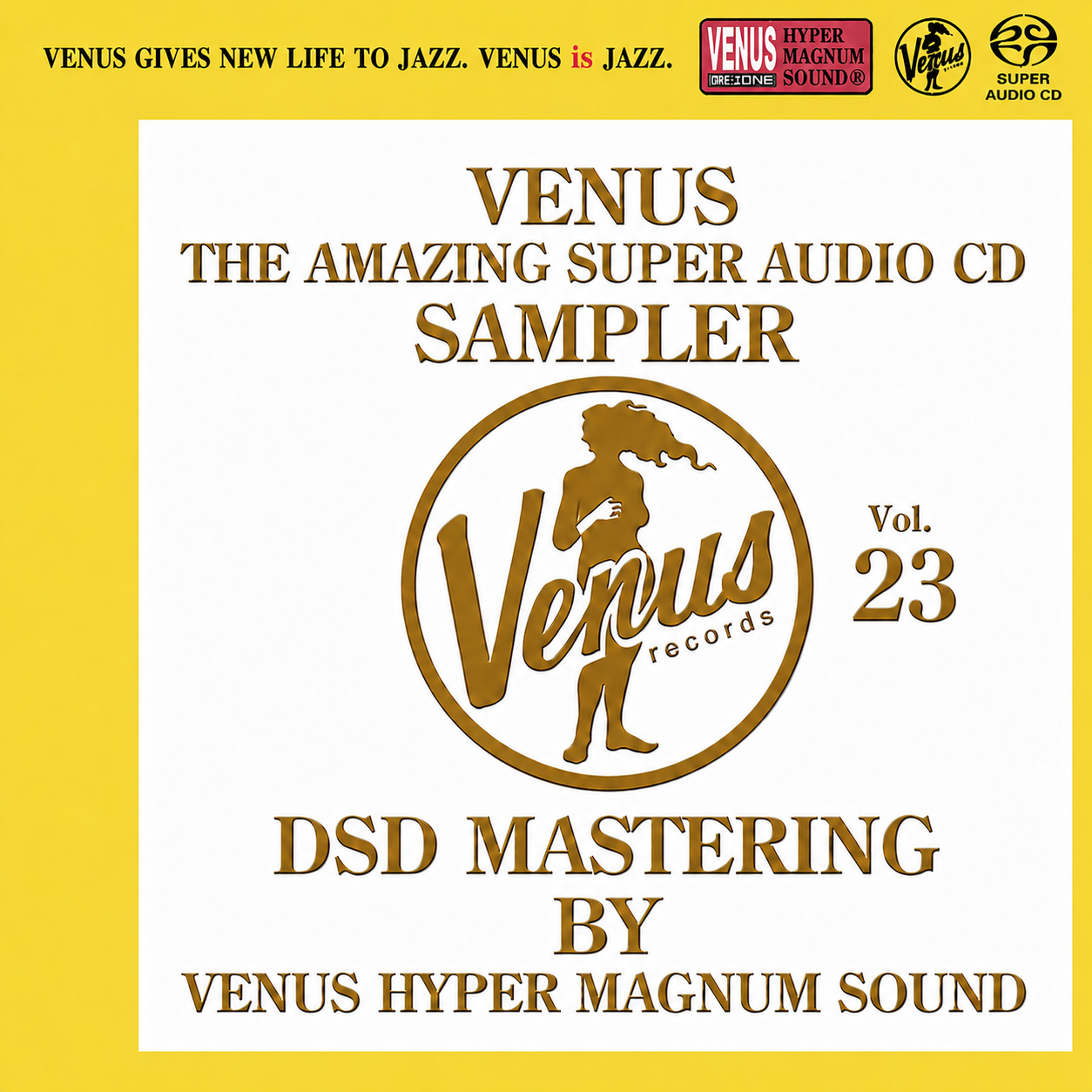
Venus – Amazing Super Audio CD Sampler Vol. 23
Venus – The Amazing Super Audio CD Sampler Vol. 23: A Journey Through Romantic Jazz, Bebop Memory and Audiophile SACD Sound
The opening melody arrives with the elegance of a film scene already in motion. Massimo Farao’ sits at the piano and begins “Charade,” Henry Mancini’s famous theme, not as a piece of cinematic nostalgia but as a living jazz composition. The tune retains its mystery, yet the trio gives it new movement. Piano chords rise with authority, the bass provides a firm centre, and the drums quietly shift the emotional light around the melody.
It is a fitting beginning to Venus – The Amazing Super Audio CD Sampler Vol. 23, an album that repeatedly takes familiar material and gives it another life. Released in Japan on May 16, 2018, by Venus Records, the compilation appeared under catalogue number VHGD-293. The official SACD contains 15 tracks and runs for approximately 85 minutes and 40 seconds, bringing together piano trios, saxophone-led groups, a vibraphone quartet, vocal jazz and performances drawn from several generations of the international jazz tradition.
By the twenty-third volume, the Amazing Super Audio CD Sampler series had developed a clear identity. These albums were created to demonstrate the vivid, close and full-bodied sound associated with Venus Records, but they also functioned as musical journeys through the label’s catalogue. Volume 23 continues that tradition with performances by Massimo Farao’, Phil Woods, Rob Agerbeek, Steve Nelson, Jay Leonhart, Davide Palladin, Denise King, Hideaki Yoshioka, Emil Viklický, John Hicks, Walter Bishop Jr., Stanley Cowell, Renato Sellani and Adela Dalto.
The presence of so many different artists could have made the compilation feel fragmented. Instead, the sequence creates the atmosphere of a long evening spent moving between several jazz rooms. One door opens onto romantic piano, another onto bebop memory. A tenor or alto saxophone enters, then a vibraphone, then a singer. The styles change, but the emphasis on melody, communication and instrumental presence remains constant.
Massimo Farao’ Trio’s “Charade” establishes that emotional and sonic world immediately. Mancini’s melody is graceful, but beneath its elegance lies uncertainty. Farao’ gives the composition a darker weight than a conventional film-theme arrangement might suggest. The piano is not merely decorative; it drives the narrative.
For listeners interested in audiophile jazz recordings, the track is also an effective introduction to the Venus SACD sound. The piano carries physical scale, the bass has a clearly defined position, and the drums retain the crisp decay of cymbals and brushes. Yet the best moments arrive when those technical qualities disappear from conscious attention. The trio begins to feel present, and “Charade” becomes less a soundtrack memory than a private conversation.
The same Massimo Farao’ Trio continues with “Memories of You.” Placing two performances by the same group at the beginning allows the sampler to reveal different sides of its musical personality. “Charade” contains mystery and movement, while “Memories of You” turns inward.
The title alone suggests reflection, and Farao’ treats the melody with patience. His playing does not become overly sentimental. Instead, the performance develops through restraint, with the spaces between phrases carrying as much emotional meaning as the notes themselves.
The rhythm section remains sensitive to the shape of the piano line. The bass does not simply mark harmony, and the drums do not merely maintain time. Both respond to Farao’s touch, allowing the trio to breathe together. The result is romantic jazz, but romance understood as memory rather than decoration.
After two piano-trio selections, the Phil Woods Quintet arrives with “Souvenirs.” Woods’ alto saxophone brings a different kind of authority. His tone is bright, focused and unmistakably connected to the bebop tradition, yet the performance is shaped by experience rather than speed.
“Souvenirs” suggests objects carried from the past, and Woods plays as though every phrase contains a history. His lines have clarity, but they also carry warmth and a slightly weathered emotional edge. The quintet supports him with balance, allowing the saxophone to lead without turning the rhythm section into background.
The recording gives the horn vivid presence. A lesser system might emphasize only its brightness, but a well-balanced stereo presentation reveals the body beneath the tone, the breath behind each phrase and the subtle dynamic changes that make the instrument sound human.
Within the album’s story, “Souvenirs” expands the theme introduced by “Memories of You.” The compilation is not simply presenting standards. It is exploring how jazz musicians carry memory through sound.
Rob Agerbeek Trio’s “Besame Mucho” shifts the setting again. The famous Latin song has been interpreted in countless styles, but Agerbeek’s trio finds a direct path between romantic melody and piano jazz.
The performance does not need an elaborate arrangement. The tune is strong enough to support itself, and the trio understands that familiarity can become an advantage when handled with confidence. The melody enters clearly, then gradually opens into improvisation.
Agerbeek’s piano playing has weight, but it never overwhelms the song’s natural sensuality. The bass and drums establish a gentle pulse, preserving the Latin character without reducing it to a rhythmic cliché.
“Besame Mucho” is one of those songs that risks disappearing beneath its own reputation. Here it feels fresh because the trio treats it seriously. The performance reminds the listener that popular melodies often became jazz standards precisely because they contain harmonic and emotional possibilities that musicians can continue to rediscover.
The Steve Nelson Jazz Quartet follows with “East of the Sun.” Nelson’s vibraphone immediately changes the album’s colour. Where the piano has weight and percussive depth, the vibraphone creates a more floating, luminous sound.
Its notes appear briefly, then shimmer into silence. The instrument can sound delicate, but Nelson’s performance also contains rhythmic precision. He shapes the melody with clarity while the quartet provides a stable swing beneath him.
“East of the Sun” has long carried an atmosphere of escape and romance. In this setting, the vibraphone gives it a dreamlike quality. The notes seem suspended in the air, yet the rhythm section keeps the music grounded.
For audiophile listeners, the track reveals how well a system reproduces tonal decay. Each vibraphone note should retain its metallic attack, resonant centre and gradual disappearance. If the sound is compressed or overly bright, much of the instrument’s character is lost. On the Venus SACD, the vibraphone becomes both melody and atmosphere.
Jay Leonhart Trio’s “Just in Time” brings the focus toward bass-led jazz. Leonhart is known for combining musicianship with personality, and the trio setting gives the double bass more than a supporting role.
The composition carries natural forward motion. Its title suggests arrival at the final possible moment, and the performance moves with a sense of urgency that never becomes rushed. Leonhart’s bass lines are melodic, articulate and rhythmically confident.
The piano and drums respond closely, creating a performance in which the traditional hierarchy of the trio becomes more flexible. The bass is not hidden beneath the piano. It participates openly in the conversation.
This makes “Just in Time” another useful audiophile recording, but not simply because it contains strong low frequencies. The challenge is reproducing the double bass with body, pitch definition and the texture of fingers against strings. The instrument must sound physical without becoming exaggerated.
The Davide Palladin Trio follows with “Gentle Art of Love,” a title that accurately describes the performance’s character. Guitar replaces piano as the central harmonic voice, and the album enters a quieter, more intimate space.
Palladin’s tone is warm and controlled. He does not overcrowd the melody with rapid runs. Instead, the phrasing is measured, allowing individual notes to retain their emotional weight.
The trio creates a late-night atmosphere. Bass and drums remain understated, while the guitar seems to speak directly to the listener. There is elegance in the performance, but also vulnerability.
The title suggests that love is not an act of conquest but a discipline of attention. The musicians reflect that idea through the way they listen to one another. Nothing is forced. Every phrase seems shaped in response to what has just been heard.
Denise King’s “Skylark” introduces the human voice and becomes one of the album’s emotional centres. The song’s melody is spacious, almost airborne, and King approaches it with warmth and control.
Her voice is recorded closely, but it does not sound artificially enlarged. The listener hears breath, texture and the small changes in tone that give each line meaning. The accompaniment leaves enough room around her, allowing the lyric and melody to unfold naturally.
“Skylark” is a song built around longing for something distant and difficult to name. King does not overstate that feeling. Her interpretation is strong precisely because it remains restrained.
The vocal sits at the centre of the soundstage, while the accompanying instruments form a believable acoustic space around it. This is one of the qualities that have made Venus Records vocal jazz releases attractive to audiophile collectors: the singer feels present, but the performance remains musical rather than clinical.
Hideaki Yoshioka Trio’s “Moment to Moment” returns the album to piano jazz. The title suggests impermanence, and the trio gives the composition a reflective flow.
Yoshioka’s piano touch is clear and lyrical. The melody moves gradually, supported by bass and drums that respond with subtle shifts rather than fixed patterns. The trio sounds connected, but never rigid.
The performance captures the essence of jazz interaction. Nothing appears isolated. A bass note changes the direction of a piano phrase. A cymbal accent alters the emotional balance of a chord. The music develops through small decisions made in real time.
“Moment to Moment” also reflects the structure of the sampler itself. Each track creates a temporary world, then disappears. The listener moves from one group of musicians to another, carrying traces of the previous performance into the next.
Emil Viklický Trio’s “The Forlorn Peach Tree” introduces a more unusual title and a more distinctly European character. Viklický’s music often combines jazz language with influences from his Czech background, and this performance carries a lyrical quality that feels both familiar and difficult to place.
The piano melody has a folk-like simplicity, but the harmonies give it depth. George Mraz on bass and Lewis Nash on drums form a distinguished rhythm section, providing both sensitivity and authority.
The image of a forlorn peach tree suggests beauty marked by loneliness. The trio captures that emotional contradiction. The piece is gentle, but not peaceful. Beneath the melody lies a quiet sense of absence.
Viklický does not need dramatic gestures. The sadness emerges gradually through touch, harmony and silence. It is one of the sampler’s most atmospheric selections and a reminder that jazz storytelling does not always depend on a familiar standard.
John Hicks Trio’s “No Problem” changes the tone with a firmer rhythmic profile. The composition, written by Duke Jordan, has become a durable jazz vehicle, and Hicks approaches it with the authority of a pianist deeply rooted in hard bop.
Recorded at Sear Sound in New York with bassist Marcus McLaurine and drummer Victor Lewis, the performance reflects the strength of a trio in which every musician understands both structure and freedom.
Hicks’ piano playing has force, but it also contains elegance. His chords land with purpose, and his melodic lines move confidently through the harmony. McLaurine’s bass provides a flexible foundation, while Lewis adds sharp rhythmic detail.
“No Problem” brings welcome energy after the reflective world of “The Forlorn Peach Tree.” Yet the shift does not feel abrupt. Both tracks depend on strong trio communication, even if their emotional landscapes are very different.
The Venus recording captures the physical character of Hicks’ playing. The piano has body, the drums have impact, and the bass remains clear beneath the harmonic movement. It is a track that can demonstrate the speed and control of a stereo system, but its main achievement is musical momentum.
Walter Bishop Jr. Trio’s “Keiko’s Samba” introduces another rhythmic turn. Recorded in New York with bassist Paul Brown and drummer Al Harewood, the performance connects samba influence with Bishop’s bebop-rooted piano language.
The title suggests movement, and the trio delivers it immediately. The piano lines are agile, the bass remains light and active, and the drums create a pulse that feels buoyant rather than heavy.
Bishop understood how to bring rhythmic sophistication into a performance without sacrificing melodic clarity. “Keiko’s Samba” swings, but it also dances.
The track broadens the cultural range of Volume 23. The album has already moved through American standards, Latin romance, European lyricism and hard bop. Here Brazilian rhythm enters the conversation, not as a separate category but as another language jazz can absorb.
Stanley Cowell Trio’s “Ole Texas” follows with a stronger sense of space and individuality. Cowell was a pianist and composer whose work often moved between hard bop, modal jazz, African influence and more exploratory forms.
The title suggests a landscape rather than a conventional standard, and the performance has an open quality. Cowell’s piano lines seem to survey the harmonic terrain, sometimes moving directly and sometimes pausing as though considering several possible routes.
The trio maintains structure, but there is freedom within it. Bass and drums do not merely support the piano. They help define the piece’s changing shape.
“Ole Texas” adds a more modern compositional voice to the sampler. After several familiar melodies, the track reminds the listener that the Venus catalogue also included original jazz writing with its own identity.
Renato Sellani Trio’s “Donna” brings the album back toward romance. Sellani’s piano playing is elegant, economical and deeply melodic. He rarely needs excessive decoration to communicate emotion.
“Donna” unfolds like a portrait. The melody is simple enough to feel immediate, but the trio gives it depth through harmony and pacing. Sellani’s touch is gentle without becoming fragile.
The rhythm section supports him with discretion, leaving room for the piano to sing. The result is intimate Italian jazz, shaped by the same values that define many of the finest Venus piano-trio recordings: warmth, balance and respect for melody.
As the album approaches its conclusion, “Donna” feels like a moment of stillness. The music does not demand attention. It earns it gradually.
The final track belongs to Brazilian vocalist Adela Dalto, whose “Blue for You” closes the sampler with a combination of jazz, soul and vocal intimacy. Her voice introduces another emotional texture, one that connects naturally with the album’s romantic themes while bringing its own warmth and directness.
The title suggests the blues, but the performance does not rely on heaviness. Dalto sings with control, allowing the emotional colour to emerge through phrasing.
The accompaniment remains clear and supportive. The voice is placed forward, yet the musicians around her retain their identity. It feels like a complete ensemble performance rather than a singer placed over a backing track.
As a closing selection, “Blue for You” brings the album’s many strands together. It contains melody, memory, intimacy and the emotional openness that runs through the entire compilation. The final note does not create a dramatic conclusion. It simply leaves the room quieter than before.
The official track sequence of Venus – The Amazing Super Audio CD Sampler Vol. 23 comprises “Charade,” “Memories of You,” “Souvenirs,” “Besame Mucho,” “East of the Sun,” “Just in Time,” “Gentle Art of Love,” “Skylark,” “Moment to Moment,” “The Forlorn Peach Tree,” “No Problem,” “Keiko’s Samba,” “Ole Texas,” “Donna” and “Blue for You.”
Together, these 15 performances create an unusually varied portrait of the Venus Records jazz catalogue. Piano remains central, but the album also makes room for alto saxophone, guitar, vibraphone, bass-led trio playing and vocal jazz. The programme connects romantic standards with original compositions, Brazilian rhythm, European lyricism and the language of bebop and hard bop.
As an audiophile SACD compilation, Volume 23 contains material capable of revealing almost every important quality of a high-end audio system. The piano tracks expose tonal balance, attack and harmonic decay. Steve Nelson’s vibraphone tests the reproduction of delicate resonance. Phil Woods’ saxophone reveals whether the upper midrange remains vivid without becoming aggressive. Jay Leonhart’s bass examines low-frequency definition, while Denise King and Adela Dalto test vocal presence and centre imaging.
Yet the album’s real achievement lies beyond sound-system evaluation. Technical quality matters because it helps the listener feel the musicians’ presence. It allows a piano chord to retain its weight, a cymbal to fade naturally and a voice to carry breath and vulnerability.
The best audiophile albums eventually stop sounding like demonstrations. The equipment disappears, and the listener enters the performance.
That is what happens throughout The Amazing Super Audio CD Sampler Vol. 23. The album may have been assembled from separate releases, but its sequencing creates an emotional continuity. It begins with the cinematic mystery of “Charade,” moves through memory, romance, swing, Brazilian rhythm and modern composition, and closes with a blues-coloured vocal statement.
For collectors of Japanese SACD releases, Volume 23 is an important entry in the Venus sampler series. Its official 2018 Japanese edition, catalogue number VHGD-293, offers more than 85 minutes of music in stereo SACD format. For newcomers, it provides a broad introduction to the label’s characteristic combination of intimate recording, melodic jazz and international musicianship.
But the word “sampler” still feels too limited. This is not merely a group of tracks selected to promote other albums. It has its own pace, mood and narrative.
The story begins with a film theme and ends with the blues. Between them, memories return, lovers dance, a skylark searches the air, a lonely peach tree stands in silence and several generations of jazz musicians find new ways to make melody speak.
When Adela Dalto’s final phrase fades, what remains is not simply the impression of excellent SACD sound. It is the sense of having travelled through a living jazz catalogue, one shaped by romance, rhythm, history and individual expression.
Venus – The Amazing Super Audio CD Sampler Vol. 23 is therefore more than an audiophile showcase. It is a carefully sequenced jazz story in which familiar standards and lesser-known compositions share the same intimate space. The sound may bring the musicians closer, but the performances are what make them stay.
