
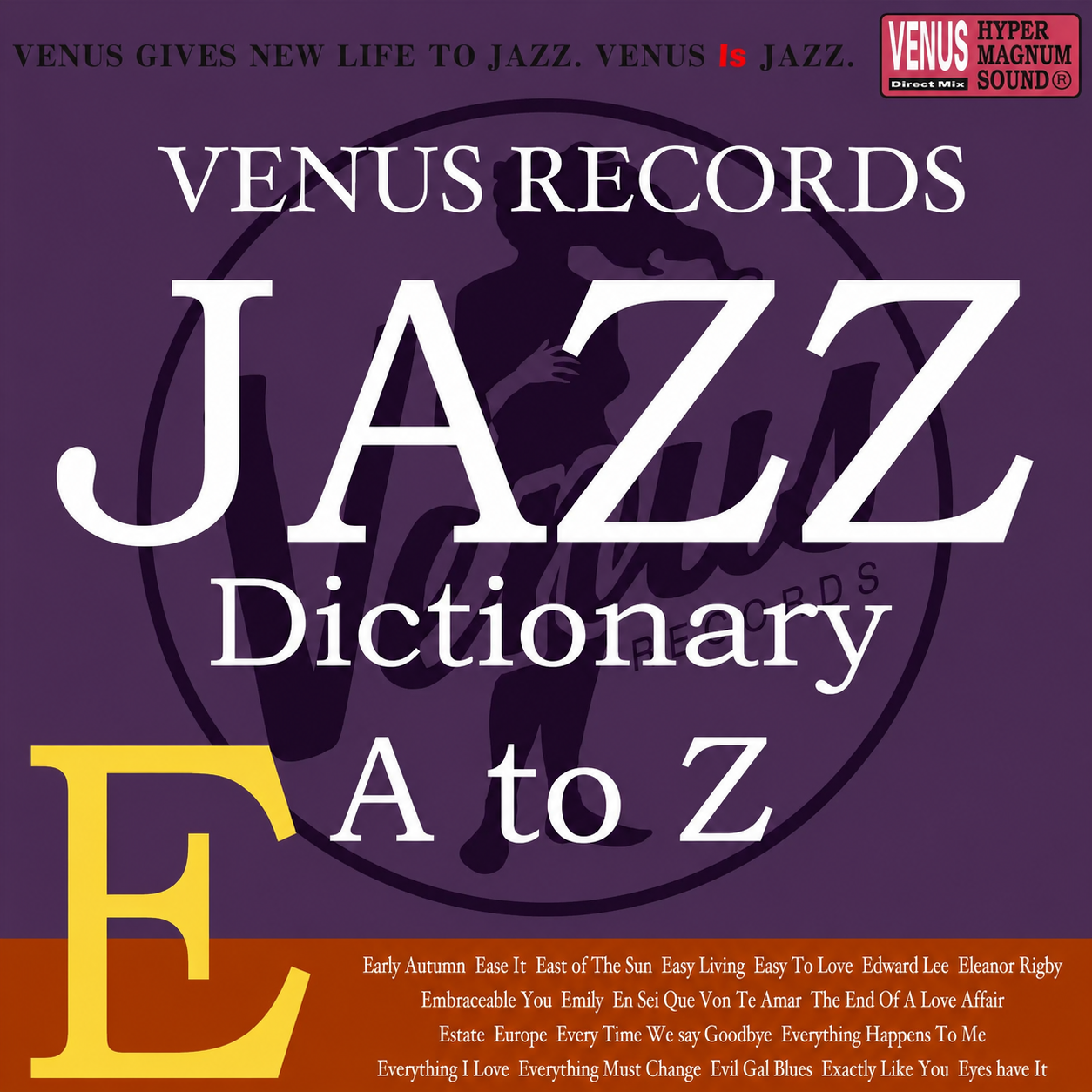
Venus Records
Jazz Dictionary E
Venus Records – Jazz Dictionary E: Elegance, Emotion and the Everlasting Language of Jazz
There is something quietly ambitious about the Venus Records Jazz Dictionary series. Rather than treating jazz history as a collection of dates, names, and genres, the Japanese label turns it into a living alphabet, one in which every letter opens the door to another set of standards, interpretations, and musical memories. With Venus Records – Jazz Dictionary E, the series reaches a new chapter built around compositions beginning with the letter E, but the album’s real subject is far broader: the enduring power of jazz to renew familiar music through personality, rhythm, and improvisation.
From the opening moments, Jazz Dictionary E carries the unmistakable identity of Venus Records. The sound is immediate, full-bodied, and intimate, presenting the musicians with the atmosphere of a late-night jazz club rather than the distance of a conventional studio recording. Piano chords arrive with weight and definition, the double bass moves with a warm, rounded presence, and the drums add both momentum and texture. Cymbals shimmer naturally, while the space around each instrument gives the performance a sense of depth and realism.
This careful sonic presentation has made Venus Records audiophile jazz albums especially popular among listeners who value both musical quality and high-end sound reproduction. Jazz Dictionary E is not simply a themed compilation. It is also a showcase for the recording philosophy that helped establish Venus Records as one of the most recognizable Japanese jazz labels among collectors of audiophile CDs, SACDs, and premium digital editions.
The idea of organizing jazz standards alphabetically might appear academic, but the listening experience is anything but. The music unfolds as a sequence of stories, with each performance revealing a different mood. Some pieces move with elegance and restraint, while others bring sharper rhythmic energy. Ballads create moments of reflection, and faster arrangements remind the listener that jazz is driven as much by instinct and conversation as by written composition.
That constant conversation between musicians is one of the album’s greatest strengths. A pianist may introduce a melody with measured delicacy, only for the bassist to reshape its emotional center beneath the surface. The drummer responds not merely by keeping time, but by adding punctuation, tension, and release. In the strongest moments, the trio or ensemble sounds less like a group following an arrangement and more like a circle of musicians exchanging ideas in real time.
This is where the Jazz Dictionary concept becomes most convincing. The series may begin with the titles of songs, but it ultimately becomes a dictionary of expression. Swing, silence, touch, tone, timing, and improvisation are the true vocabulary. Jazz Dictionary E demonstrates how a familiar standard can change completely depending on tempo, phrasing, harmonic choices, and the emotional character of the performers.
For newcomers, the album offers an accessible route into classic jazz repertoire. The listener does not need specialist knowledge to appreciate the melodies, the relaxed flow, or the sense of atmosphere. At the same time, experienced collectors can listen more deeply, comparing interpretations and focusing on the subtle choices that distinguish one performance from another. That balance makes Jazz Dictionary E valuable both as an introduction to jazz standards and as a serious addition to an established collection.
The album also works exceptionally well as reference music for high-end audio systems. Its acoustic detail can reveal the tonal character of loudspeakers, headphones, amplifiers, and digital-to-analog converters. A well-balanced system should reproduce the bass with definition rather than excess, preserve the natural attack of the piano, and allow the percussion to remain crisp without becoming harsh. The album’s layered soundstage and dynamic contrasts make it suitable for critical listening while never reducing the music to a technical demonstration.
Yet the lasting appeal of Venus Records – Jazz Dictionary E comes from emotion rather than engineering. Venus Records has always understood that audiophile sound matters only when it serves the performance. Clarity allows the listener to hear the pressure of a piano key, the vibration of a bass string, or the fading resonance of a cymbal, but those details become meaningful because they bring the human presence of the musicians closer.
In an age when playlists often move rapidly from one track to another, Jazz Dictionary E encourages a slower kind of listening. It invites the audience to remain with the music, to notice how a solo develops, how the rhythm section responds, and how a well-known melody gains a new identity through interpretation. The album rewards concentration, but it also retains the warmth and accessibility needed for relaxed evening listening.
For listeners searching for Venus Records jazz albums, best audiophile jazz recordings, Japanese jazz compilations, high-quality jazz standards, or reference albums for stereo systems, Jazz Dictionary E represents another carefully crafted entry in a distinctive series. It continues the alphabetical journey without becoming repetitive, because jazz itself is never static.
More than a collection of songs linked by the letter E, Jazz Dictionary E is a portrait of jazz as an evolving language. Elegant, expressive, and recorded with the richness associated with Venus Records, the album preserves the tradition of the standards while allowing each musician to speak in a voice of their own.
