
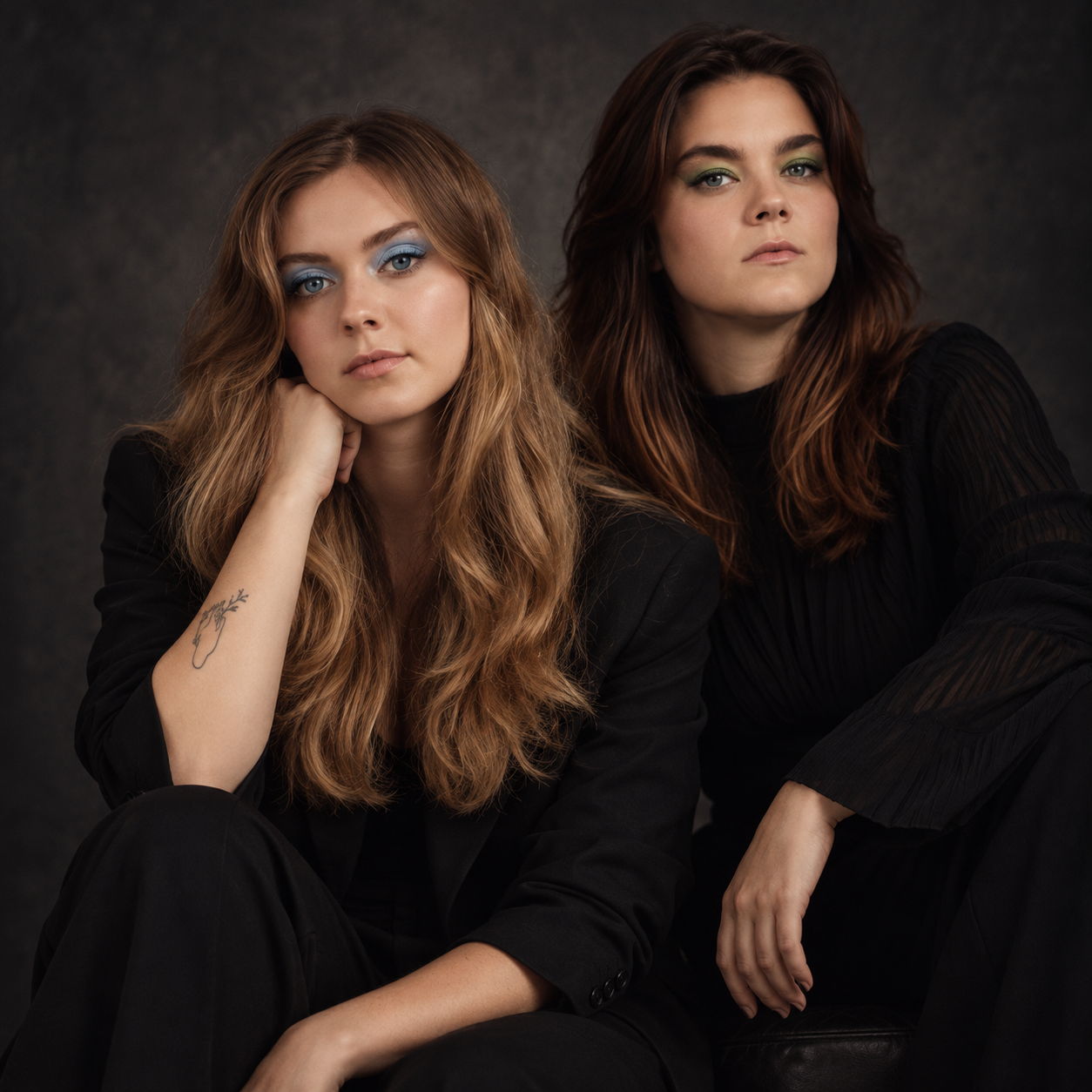
First Aid Kitt
GREAT CHOICE: First Aid Kitt!
Great music deserves to be discovered, enjoyed and shared.
CAN YOU SPARE A CUP OF COFFEE?
Audiophile-Streaming is a personal passion project, built with countless hours of discovering, selecting and sharing exceptional music.
I personally cover, without sponsors, the ongoing costs of hosting, software and subscriptions to keep the music discoveries coming. If you enjoy my work, your support is always appreciated.
A LITTLE THANK YOU IN RETURN
Just one coffee gives you lifetime access to the Coffee Club and all its playlists.
No subscriptions. No recurring fees.
With First Aid Kitt, I am talking about the Swedish sister duo First Aid Kit, and for me their identity begins with something very simple: two voices that sound stronger together than either one would on its own. Klara Söderberg, born on 8 January 1993, and her older sister Johanna Söderberg, born on 31 October 1990, grew up in Enskede in Stockholm, Sweden. Klara often takes the more prominent lead vocal while Johanna’s lower, darker voice fills out the harmony, but reducing their sound to lead singer and backing singer misses the point. The real character appears in the space between those voices, especially when their phrasing locks together without becoming too neat. On a revealing pair of speakers or good headphones, I can hear two individual singers rather than one artificially thickened vocal line, and that distinction is a large part of what makes First Aid Kit such rewarding audiophile music.
The sisters began making music together while still very young, initially recording at home and absorbing American folk, country and indie music from Sweden. An early turning point came when their 2008 performance of Fleet Foxes’ “Tiger Mountain Peasant Song” attracted widespread attention online. What could easily have remained a clever cover-video story instead became the start of a serious recording career. Their debut album, The Big Black & the Blue, followed in 2010 through Wichita Recordings, already showing that their harmonies were not a novelty but the foundation of their own songwriting. The production was relatively modest, which I actually find useful when listening back now because there is less between the listener and those young voices.
Finding Their Own Version of Americana
The major step forward for me is The Lion’s Roar from 2012. Recorded at ARC Studios in Omaha with producer Mike Mogis, the album gave First Aid Kit more space, more instrumental colour and a noticeably greater sense of scale without burying the sisters under production. Conor Oberst appears on the album, and the connection with the Bright Eyes circle was particularly appropriate because Klara had been strongly influenced by that music while developing as a songwriter. The arrangements use acoustic guitars, percussion, strings and country textures with enough restraint that the vocal harmonies remain at the centre. On a transparent system, I like the way the voices can sit firmly in front while instrumental details extend beyond them rather than competing for attention.
“Emmylou” is the song I would use to explain First Aid Kit to someone who has never heard them. Its references to Emmylou Harris, Gram Parsons, June Carter and Johnny Cash make the sisters’ affection for American country music explicit, but the song works because it is more than an exercise in musical nostalgia. There is an easy rise and fall in the melody, pedal steel adding colour around the vocals, and a chorus that demonstrates how naturally Klara and Johanna can move from individual lines into harmony. What I notice most is that the blend is not perfectly smooth. Their voices retain different textures, and that slight contrast gives the harmony life. Good midrange transparency makes this especially enjoyable because you can follow each sister separately and still experience them as one musical unit.
Their move to Columbia Records for Stay Gold in 2014 brought a broader and more polished sound. Mike Mogis again produced, with arrangements by Nate Walcott helping the duo move beyond the more intimate folk setting of the earlier records. “My Silver Lining” is an excellent example of that development. The rhythm has more forward motion, the strings are an important part of the arrangement rather than simple decoration, and the vocals remain recognisable even as the production becomes larger. I like this track on a system with convincing dynamics because the arrangement expands naturally as the song develops. There is plenty happening, yet the stereo image does not depend on exaggerated effects to sound spacious.
Stay Gold also showed that First Aid Kit could make sophisticated, carefully arranged records without losing the directness that had made the early material attractive. That balance matters to me. Some folk-derived artists sound more impressive as production values rise but less personal, while First Aid Kit generally managed to keep the voices emotionally close even when the soundstage became considerably wider. Their writing was also becoming more reflective, dealing increasingly with travel, instability and the consequences of a life spent moving from one place to another. The sisters were no longer teenagers interpreting an imagined American musical world. They had toured extensively and had begun writing from a much larger collection of their own experiences.
A Broader Sound Without Losing the Voices
After Stay Gold, the 2018 album Ruins introduced another change. This time they worked with producer Tucker Martine in Portland, Oregon, with musicians including R.E.M. guitarist Peter Buck and Midlake drummer McKenzie Smith contributing to the sessions. The basic First Aid Kit vocabulary remained intact, but the album contains rougher edges and a wider range of textures. “Fireworks” is one of the tracks I value most from this period because the production leaves plenty of room around the melody while the rhythm has an almost old-pop simplicity. The voices are still beautiful, but they no longer sound like the only reason for the record to exist. By this point, the songwriting and arrangements had developed enough to carry equal weight.
I also find Ruins useful when judging equipment because it demonstrates an important difference between detail and musical communication. A highly resolving DAC or pair of headphones can expose the layers in the harmonies, small reverberant cues and changes in instrumental texture, but none of that matters if the system makes the voices thin or overly bright. First Aid Kit need a convincing midrange. Klara’s voice can have a clear, slightly cutting quality while Johanna gives the lower part of the harmony more body, and a well-balanced system allows that contrast to remain obvious without turning either singer into a technical demonstration.
Their fifth studio album, Palomino, released by Columbia in November 2022, changed the atmosphere again. Unlike the American-recorded albums that preceded it, Palomino was made in Sweden at Studio Rymden in Stockholm with producer Daniel Bengtson. The sisters described it as their most pop-sounding record to that point, and I hear the same thing. Tracks such as “Out of My Head” have a lighter, more immediate momentum, with cleaner pop structures and a sense of movement that contrasts with some of the heavier emotional weight of Ruins. It is still unmistakably First Aid Kit, but the production shows how far they had moved from the stripped-back sound of their debut.
That willingness to change is important to their lasting value. First Aid Kit became internationally recognised by drawing on American folk and country traditions, but they have never sounded to me like simple revivalists. Their influences are often obvious, sometimes deliberately so, yet their Swedish background and especially their unusual sibling vocal blend give the music its own identity. They have also demonstrated that harmony singing can remain the centre of contemporary songwriting without requiring retro production or imitation of an earlier era. Their performances of other writers’ material, including their extensive engagement with Leonard Cohen’s songs, further underline how naturally they understand harmony, phrasing and the emotional weight of a lyric.
For a new listener, I would still begin with The Lion’s Roar, and particularly “Emmylou”, because it captures the essential First Aid Kit combination before later albums enlarged the production around it. From there, “My Silver Lining” demonstrates how well their sound can handle a more expansive arrangement, while Palomino shows a mature duo comfortable moving closer to pop without abandoning the vocal relationship that defines them. Across those records I hear better production, broader instrumentation and more experienced songwriting, but the basic pleasure has remained remarkably consistent. What finally decides my view of First Aid Kit is not the folk styling, the country references or even the quality of the recordings. It is the unmistakable contrast between Klara and Johanna Söderberg’s individual voices and the way those two voices become something richer the moment they sing together.
HiFi’ve, Ronald – Your EarFluencer
