
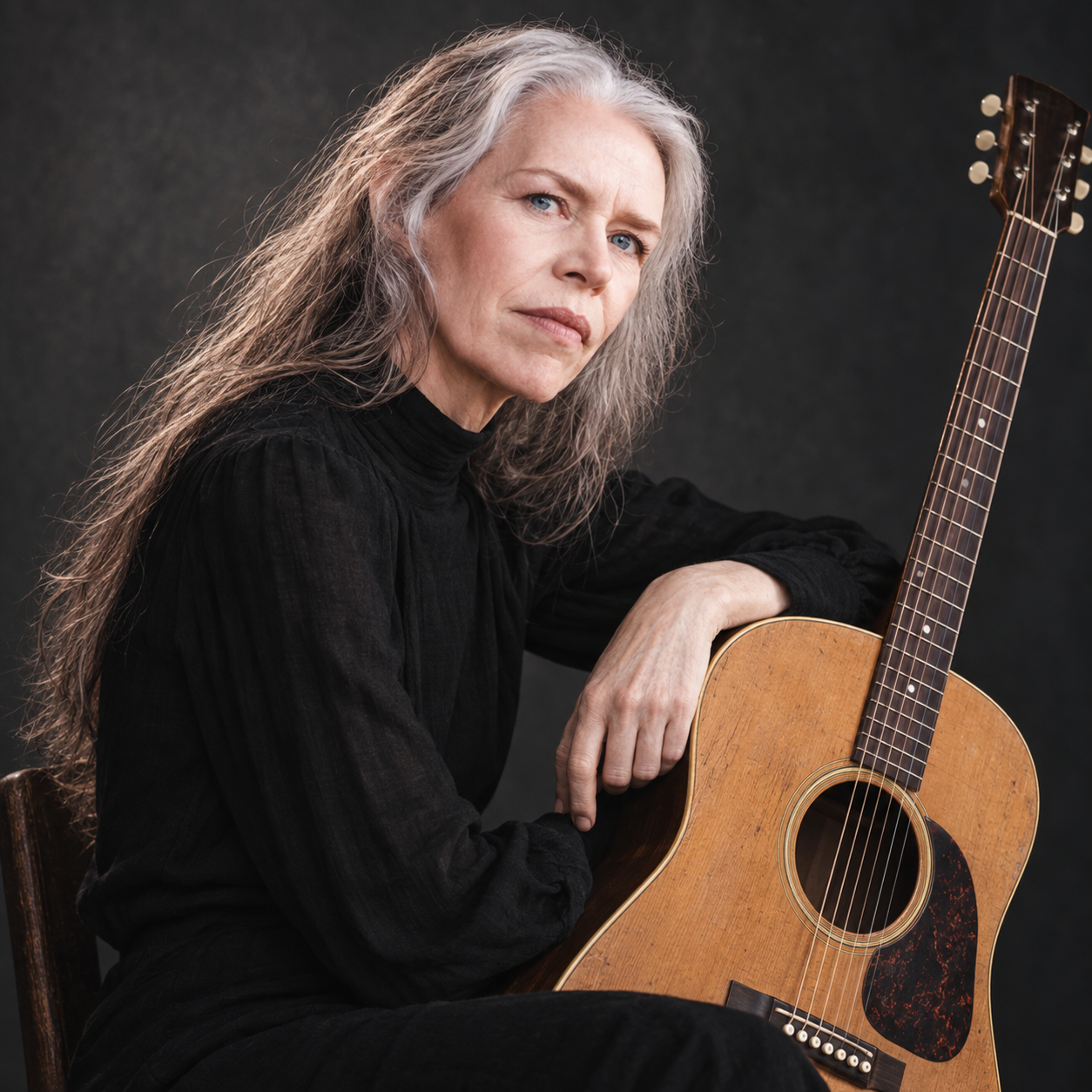
Gillian Welch
GREAT CHOICE: Gillian Welch!
Great music deserves to be discovered, enjoyed and shared.
CAN YOU SPARE A CUP OF COFFEE?
Audiophile-Streaming is a personal passion project, built with countless hours of discovering, selecting and sharing exceptional music.
I personally cover, without sponsors, the ongoing costs of hosting, software and subscriptions to keep the music discoveries coming. If you enjoy my work, your support is always appreciated.
A LITTLE THANK YOU IN RETURN
Just one coffee gives you lifetime access to the Coffee Club and all its playlists.
No subscriptions. No recurring fees.
The first thing I notice with Gillian Welch is how little she needs to make a song feel complete. A voice, two acoustic guitars, David Rawlings beside her, and enough silence for every note to have a purpose. Gillian Howard Welch was born on October 2, 1967, in New York City, was adopted as a child, and grew up in Los Angeles in a musical household. There is nothing showy about the way she sings, yet her phrasing is instantly recognisable: slightly dry, controlled, sometimes almost conversational, but capable of carrying a remarkable amount of tension. For me, that restraint is the key to her music. She never seems to push a song harder than it needs to go.
Welch first studied photography at the University of California, Santa Cruz before turning seriously toward music and studying songwriting at Berklee College of Music in Boston. That decision changed everything because Berklee was where she met guitarist David Rawlings, another member of the class of 1992. They met while auditioning for a country ensemble and soon discovered that playing together produced something neither was finding elsewhere. After Berklee they moved to Nashville, where they developed the close two-person arrangements that have defined much of their work ever since. Welch has described being strongly attracted to artists including the Stanley Brothers, Bill Monroe and Bob Dylan, and I can hear that connection clearly, although her music has never sounded to me like an exercise in recreating the past.
Two Musicians, One Musical Language
It is difficult to discuss Gillian Welch properly without discussing David Rawlings. Her name may have appeared alone on the covers of the early records, but the sound is very much the result of two musicians listening to each other at an unusually deep level. Welch’s rhythm guitar can appear almost simple until I concentrate on the timing, the tiny pauses and the way she supports the vocal line. Rawlings then moves around that foundation with guitar parts that can be melodic, angular or surprisingly restless. Their harmony singing works in much the same way. Instead of making everything smoother, the second voice often adds another little edge.
Their first album, Revival, arrived in 1996 and was produced by T Bone Burnett. It is still one of the best introductions to Welch because the essential ingredients were already there. Songs such as “Orphan Girl” sound rooted in old American folk and country traditions, but the writing is contemporary rather than archival. What interests me most on Revival is the balance between Welch’s steady delivery and the movement around her. On a revealing system, the acoustic instruments have real texture without becoming oversized, and the vocal sits naturally rather than being pushed dramatically forward. It is exactly the kind of recording where midrange transparency matters more to me than spectacular bass or an enormous soundstage.
Burnett also produced 1998’s Hell Among the Yearlings, but Welch and Rawlings eventually wanted greater control over their work. In 2001 they founded Acony Records, their own independent label, and its first release was Time (The Revelator). That move was important because it gave them control not only over what they recorded, but over how and when the music reached listeners. By then their partnership had become so distinctive that heavy production would probably have worked against it.
Time (The Revelator)
If I had to choose one Gillian Welch album to explain why she matters, I would start with Time (The Revelator), released on July 31, 2001 and produced by David Rawlings. It is sparse even by Welch’s standards, but never sounds unfinished. “Revelator” establishes that character immediately, with voices and guitars occupying a believable space and very little between the listener and the performance. Rawlings’ guitar does not simply decorate Welch’s singing. It answers it, interrupts it and sometimes seems to pull against it before finding its way home again.
“Everything Is Free” is one of the songs I find especially interesting because its subject has only become more relevant. Written at a time when digital distribution was beginning to change the economics of recorded music, it considers what happens when the creative work itself appears to lose its monetary value. What makes the song effective is that Welch does not turn it into a lecture. The melody remains restrained and the singing almost matter-of-fact, which makes the message stronger for me. Through good speakers or headphones, I listen less for audiophile fireworks than for vocal realism, the attack and decay of the guitar strings, and the small changes in level that reveal how closely the two musicians are reacting to each other.
Around the same period, Welch also became part of the extraordinary success of the O Brother, Where Art Thou? soundtrack, working again with T Bone Burnett and singing with Alison Krauss and Emmylou Harris on “Didn’t Leave Nobody But the Baby.” The soundtrack won the Grammy Award for Album of the Year in 2002 and brought traditional American music to an audience far beyond the usual folk and bluegrass circles. For Welch it was important exposure, but I do not hear it as a moment when she changed direction to chase that wider audience. Her own records remained stubbornly personal and understated.
After Soul Journey in 2003, a record that introduced more varied instrumental combinations, there was a long gap before another Gillian Welch studio album appeared. When The Harrow & The Harvest finally arrived in 2011, Welch and Rawlings deliberately returned to the duet format. That decision suits them beautifully. “Dark Turn of Mind” is a good example of why. Nothing is crowded, the tempo is unhurried and the voices never compete with the instruments. On a good high-end audio system the space around the guitars becomes part of the recording, but the equipment should disappear quickly because the musical communication is more interesting than the sound effects.
I also value The Harrow & The Harvest because it shows how much complexity Welch and Rawlings can create without increasing the number of musicians. Their arrangements depend on timing, touch and tiny shifts in emphasis. This is reference music in an unusual sense: not because it throws a huge soundstage across the room, but because a transparent DAC, amplifier and pair of speakers can expose just how much information exists inside an apparently simple acoustic performance. If a system makes every guitar string equally bright or pushes the vocal too far forward, the balance is easily disturbed.
Still Developing
Welch and Rawlings have never kept their partnership confined to albums bearing her name. They have released music under Rawlings’ name, worked with other musicians and contributed to film projects. Welch and Rawlings were nominated for an Academy Award for writing “When a Cowboy Trades His Spurs for Wings” for the Coen brothers’ The Ballad of Buster Scruggs. In 2020, their album All the Good Times, released jointly as Gillian Welch & David Rawlings, won the Grammy for Best Contemporary Folk Album.
Their 2024 album Woodland made that joint billing even more significant. Recorded at their own Woodland Sound Studios in Nashville, produced by Rawlings and released by Acony Records on August 23, 2024, it sounds like the work of musicians who no longer need to demonstrate how stripped-down they can be. There is still plenty of space, but the palette is broader and the years of playing together are obvious in the relaxed interaction. “Empty Trainload of Sky” has the recognisable Welch-Rawlings balance of careful storytelling, closely connected voices and guitar playing that rewards attention rather than demanding it. Woodland went on to win the 2025 Grammy Award for Best Contemporary Folk Album.
What I admire most about Gillian Welch is that her music never depends on nostalgia even when the language of old-time music is clearly present. She and Rawlings learned from the Stanley Brothers, the Carter Family, bluegrass, country and folk traditions, but they developed their own musical grammar from those sources. Not everyone will immediately connect with the deliberate tempos and lack of obvious studio drama, and I understand that. For me, though, repeated listening makes the precision more obvious rather than exposing limitations. From Revival through Time (The Revelator) and The Harrow & The Harvest to Woodland, the biography, the songwriting and the sound all lead to the same conclusion: Gillian Welch’s greatest musical quality is her ability to make restraint feel completely expressive.
HiFi’ve, Ronald – Your EarFluencer
