
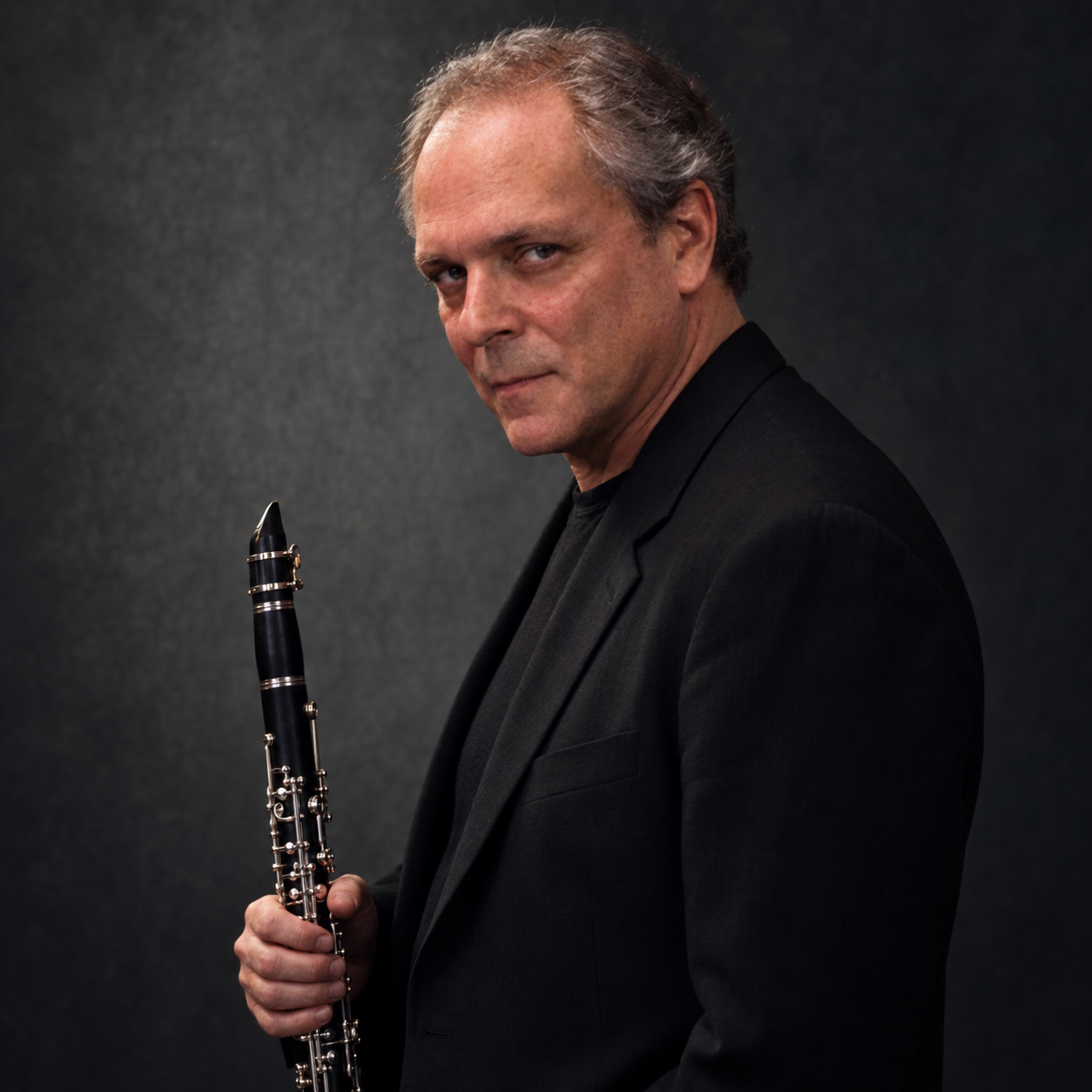
Ken Peplowski
GREAT CHOICE: Ken Peplowski!
Great music deserves to be discovered, enjoyed and shared.
CAN YOU SPARE A CUP OF COFFEE?
Audiophile-Streaming is a personal passion project, built with countless hours of discovering, selecting and sharing exceptional music.
I personally cover, without sponsors, the ongoing costs of hosting, software and subscriptions to keep the music discoveries coming. If you enjoy my work, your support is always appreciated.
A LITTLE THANK YOU IN RETURN
Just one coffee gives you lifetime access to the Coffee Club and all its playlists.
No subscriptions. No recurring fees.
There is a particular quality in Ken Peplowski’s clarinet playing that I notice almost immediately: the instrument sounds complete. Not just bright at the top or airy around the edges, but with real body through the middle, enough wood and reed texture to make the clarinet feel physical. On a revealing system that difference is obvious. The instrument does not float as a thin line between the speakers. It has weight, breath and shape. Kenneth Joseph Peplowski was born on May 23, 1959, in the Cleveland area of Ohio, and he grew up playing clarinet in a family polka band organised by his father. That early experience may seem far removed from sophisticated jazz, but I think it helps explain something essential about Peplowski: he understood from childhood that music has to communicate directly with people.
Peplowski was already performing professionally at around ten years old and later studied clarinet at Cleveland State University while playing jazz around the city. A major turning point came when trombonist Buddy Morrow heard him at a Cleveland jazz festival and hired him for the Tommy Dorsey Orchestra, where Peplowski played lead alto and was given a regular clarinet feature. Touring with the band became what he later described as a kind of road school. During that period he met tenor saxophonist Sonny Stitt, studied with him and absorbed lessons from a musician whose consistency and command Peplowski greatly admired. He moved to New York around 1980 and began working across a wide range of jazz settings, building a reputation not only as a clarinetist but also as a very accomplished tenor saxophonist.
Finding His Own Place in Swing
Another important moment arrived in 1984, when Benny Goodman assembled a new band and personally hired Peplowski as a tenor saxophonist. The connection is significant because Goodman was inevitably one of the reference points for any modern jazz clarinetist, but Peplowski never became a Goodman copy. His musical vocabulary stretched much further, incorporating the direct swing tradition as well as the influence of Sonny Stitt and the freedom of musicians who treated standards as material for fresh improvisation rather than fixed arrangements. He could move comfortably from traditional jazz to bebop language, ballads and more contemporary material without making the changes sound forced.
That versatility became particularly clear after he signed with Concord Records in the late 1980s. His early Concord albums established him as a leader at a time when straight-ahead swing was hardly the most fashionable corner of jazz, but Peplowski never sounded as though he was trying to recreate a particular decade. He recorded and performed with musicians including Charlie Byrd, Howard Alden, Scott Hamilton, Hank Jones and George Shearing, while his ability to support singers also brought work with artists such as Mel Tormé and Rosemary Clooney. What connects those different settings for me is Peplowski’s sense of proportion. He knows when to fill the space and, equally important, when not to.
One album that makes this especially clear is The Natural Touch from 1992. The title suits him unusually well because there is very little sense of effort in his playing. His technical control is obvious, especially when phrases become fast or harmonically busy, but technique never becomes the subject of the performance. I hear a musician concentrating on the shape of the melody, the relationship with the rhythm section and the exact weight of each note.
This is also where Peplowski becomes particularly interesting from an audiophile perspective. On a modest system, you hear a smooth, elegant clarinet. On a more transparent one, you start hearing the mechanics of expression: the slight bite at the beginning of a note, the soft release at the end, the movement of air through the instrument and the way the tone changes when he leans into a phrase. Good midrange transparency matters here far more than spectacular bass or exaggerated treble. If the system is too bright, the clarinet can become glassy. If it is too warm, much of the articulation disappears. When the balance is right, his playing gains texture without losing ease.
Beyond the Benny Goodman Connection
Last Swing of the Century, released by Concord in 1999, explores Peplowski’s connection with Benny Goodman much more directly. Recorded with a 13-piece band during a Japanese tour, the album uses arrangements associated with the Goodman orchestra, including work by Fletcher Henderson, Edgar Sampson and Jimmy Mundy. It could easily have turned into a respectful historical exercise, but that is not what I hear. Peplowski understands the style too well to exaggerate it, and the band plays with real momentum rather than nostalgic stiffness.
Tracks such as “King Porter Stomp”, “Stealin’ Apples” and “Don’t Be That Way” show how much Peplowski values rhythm. His clarinet can sound remarkably smooth, but there is always a firm rhythmic centre to the phrasing. This album is also a good test of stereo imaging because there is a lot happening at once, yet a good system should let the sections remain separate without pulling the music apart. I like hearing the clarinet sit clearly in front of the ensemble while brass and reeds spread behind it with enough width to suggest scale. The best setups do not make the soundstage artificially enormous. They make the arrangement easier to read.
I also listen closely to the dynamic contrast on this recording. Peplowski can move from a soft, almost conversational phrase into a much stronger attack without sounding compressed or suddenly oversized. That is where amplifiers and speakers with good microdynamics reveal their worth. The difference is not about playing louder. It is about hearing how much pressure, energy and intent changes within a single phrase.
A very different side of his musical personality appears on Maybe September, released by Capri Records in 2013 and recorded in New York with pianist Ted Rosenthal, bassist Martin Wind and drummer Matt Wilson. The repertoire tells you immediately that Peplowski was never interested in restricting himself to one jazz period. Alongside Duke Ellington and standards, the album includes Brian Wilson’s “Caroline, No”, the Beatles’ “For No One”, Harry Nilsson’s “Without Her” and music adapted from Francis Poulenc’s Clarinet Sonata. I find that mixture much more revealing than another collection of familiar swing tunes would have been.
“Caroline, No” is particularly interesting because Peplowski does not try to make the song sound more obviously jazzy than it needs to be. He allows its melancholy melody to breathe, using tone and timing rather than unnecessary ornamentation to hold my attention. This is the kind of track I use to judge whether a system preserves emotional scale. The performance is intimate, so I do not want the clarinet enlarged to the size of a brass band instrument or the piano stretched across the room. I want stable image size, natural decay and enough low-level information to hear the space around the musicians.
The quartet recording also gives his instruments plenty of physical presence. The clarinet has body through the midrange instead of becoming thin or piercing, while his tenor carries a warmer, heavier texture that makes the contrast between the two instruments very easy to hear. On headphones, I notice the breath and articulation first. On good speakers, the relationship between the musicians becomes more important. The piano has its own space, the bass has proper pitch definition instead of generic low-frequency weight, and the drums add movement without dominating the stage. A transparent DAC helps, but only if the rest of the chain avoids sharpening the upper midrange.
That willingness to look beyond the expected repertoire continued throughout his later career. Peplowski recorded for labels including Capri, Arbors, Venus and Nagel-Heyer, worked extensively with guitarist Howard Alden and clarinetist Kenny Davern, and continued touring internationally. One of his most fascinating late projects was Unheard Bird, released by Arbors Records in 2024. The album uses string arrangements originally commissioned by Charlie Parker but never recorded by Parker himself, giving Peplowski the difficult task of approaching material connected with one of jazz’s most distinctive voices without turning the project into imitation. It was exactly the kind of challenge that suited him: respect the history, understand the language and then play as yourself.
For listeners interested in audiophile recordings, Peplowski is useful because his music exposes tonal problems very quickly without behaving like test material. A clarinet is unforgiving when reproduced badly. Too much energy in the presence region makes it hard and metallic, while a recessed midrange removes the woody centre and much of the musician’s personality. His tenor saxophone presents a different challenge, with more mass, more lower-midrange energy and a stronger sense of breath pushing through the instrument. When both sound convincing on the same system, I know the tonal balance is probably close.
Ken Peplowski died on February 2, 2026, at the age of 66, after a career that had taken him from a childhood family band in Ohio to jazz stages around the world. His importance, to me, is not simply that he helped keep the jazz clarinet visible after the instrument had largely disappeared from the centre of modern jazz. He showed that swing, standards and traditional jazz language could remain flexible when played by someone with enough curiosity to keep developing. The Natural Touch is an excellent introduction to the texture and ease of his playing, Last Swing of the Century reveals his command of ensemble swing and dynamic control, while Maybe September shows how beautifully he handles space, tone and smaller-scale interaction. Across all three, the quality I value most is the physical truth of his phrasing: breath, attack, timing and tone arriving together in a way that lets a good audio system reveal more of the musician without getting between me and the music.
HiFi’ve, Ronald – Your EarFluencer
