
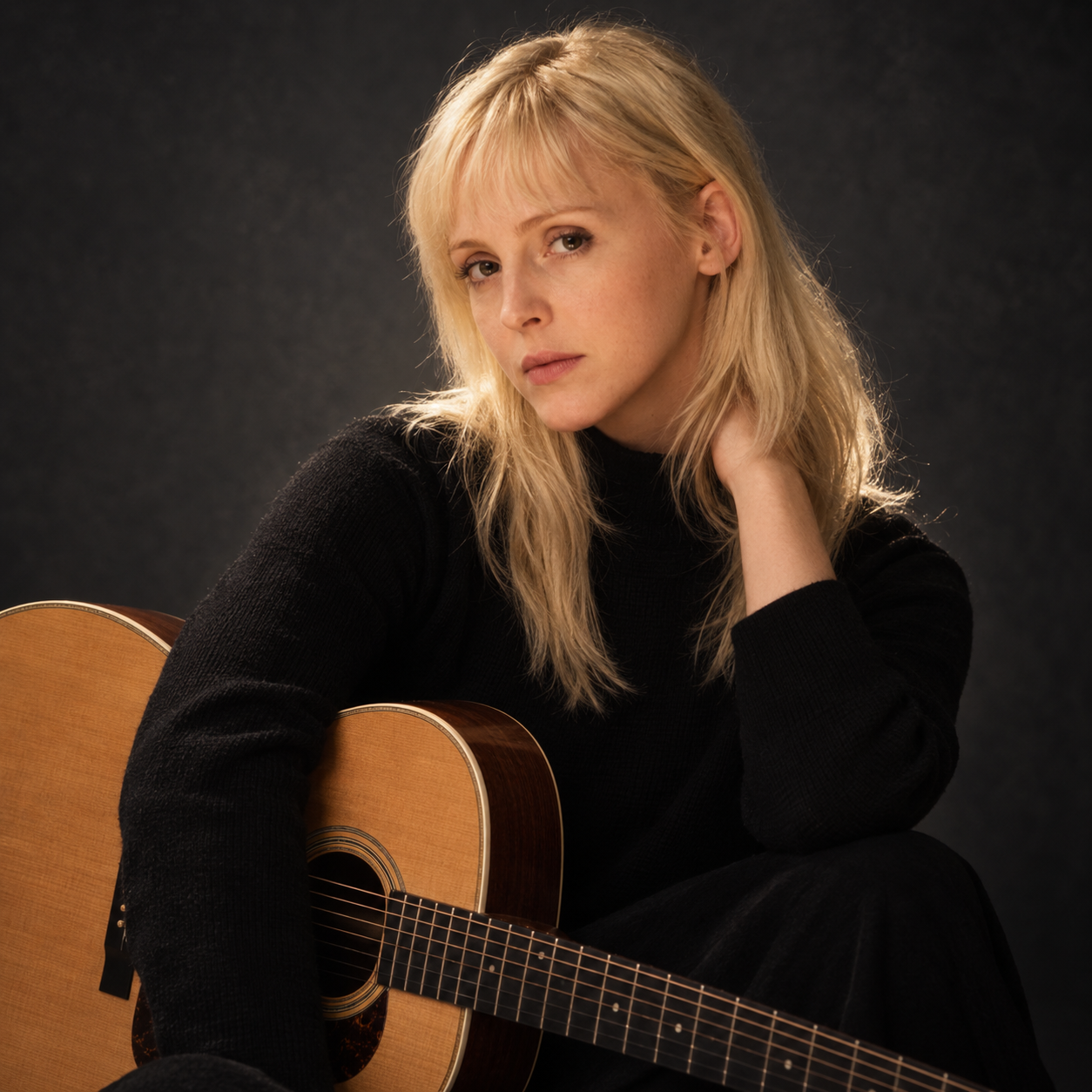
Laura Marling
GREAT CHOICE: Laura Marling!
Great music deserves to be discovered, enjoyed and shared.
CAN YOU SPARE A CUP OF COFFEE?
Audiophile-Streaming is a personal passion project, built with countless hours of discovering, selecting and sharing exceptional music.
I personally cover, without sponsors, the ongoing costs of hosting, software and subscriptions to keep the music discoveries coming. If you enjoy my work, your support is always appreciated.
A LITTLE THANK YOU IN RETURN
Just one coffee gives you lifetime access to the Coffee Club and all its playlists.
No subscriptions. No recurring fees.
Laura Marling can make a small change in the pressure of her voice feel as important as a full arrangement. That is one of the first things I notice when I listen closely to her music, especially on a system with good midrange transparency. Her voice is not difficult to reproduce because it is huge or spectacular, but because so much of the expression sits in very small changes of breath, tone and distance from the microphone. The same applies to her guitar playing. On an average setup you hear an acoustic guitar and a singer; on a more resolving system you start hearing the difference between the initial string attack, the resonance of the instrument and the quieter decay that follows. Laura Beatrice Marling was born on 1 February 1990 in Eversley, Hampshire, England, and by her late teens she had already become part of the London folk scene that also included artists such as Noah and the Whale, Johnny Flynn and Mumford & Sons. What separates her for me, however, is how quickly she developed beyond being associated with a particular scene.
Her debut album Alas, I Cannot Swim arrived in 2008, when she was only eighteen, and was nominated for the Mercury Prize. Two years later, I Speak Because I Can made the development obvious. Ethan Johns produced the album, and Marling sounded more certain of how little she needed to make a song work. Her voice had weight without becoming heavy, and the acoustic instruments were allowed to carry rhythm instead of simply providing a soft background. On a good pair of speakers, that difference is immediately audible. The guitars have real leading edges, but the recording does not become sharp, and her voice sits firmly in the centre without being detached from the musicians around her. The album was another Mercury Prize nominee, and in 2011 Marling won the BRIT Award for British Female Solo Artist, but when I listen now it is the rapid growth in her writing, timing and control that interests me much more.
Where a good system starts to matter
I Speak Because I Can is still one of the records I would recommend to someone trying to understand Laura Marling, but it is also a useful test of whether a system can separate energy from brightness. “Devil’s Spoke” is particularly revealing because the guitar has a hard rhythmic attack and the arrangement builds considerable momentum. On equipment with an aggressive upper midrange, it can become slightly wiry and overemphasised. On a balanced system, the same track sounds fast, physical and surprisingly full-bodied, with the guitar strings carrying both bite and wood resonance. I also pay attention to how her voice changes as she pushes harder. A good amplifier and DAC keep those changes intact without making the louder phrases jump unnaturally forward.
That is an important part of her appeal for me. Marling’s recordings often reward equipment that is good at low-level information rather than sheer scale. The smallest details matter: the end of a consonant, a breath before a phrase, fingers moving on strings, the way an instrument loses energy into the room. None of this should be exaggerated. If a system presents those details as separate hi-fi effects, something is wrong. With Laura Marling, the best playback lets those details merge naturally into the performance, which is exactly why I find her music so useful when judging midrange quality and tonal balance.
Her fourth album, Once I Was an Eagle, released in 2013, pushed that confidence further, but Marling did not simply keep refining the same acoustic formula. She moved to Los Angeles for a period, then returned to London to record Short Movie, released in 2015. Electric guitar became more prominent, and the tougher surfaces of that record were an important reminder that her identity was never limited to quiet folk music. Two years later she released Semper Femina, co-produced with Blake Mills, through her own More Alarming label. The album received a Grammy nomination for Best Contemporary Folk Album, and for me it is one of the points where her songwriting, performance and recording quality come together particularly well.
Semper Femina is also where I would send an audiophile who wants to hear what Marling can do on a revealing system. “Soothing” is the obvious example, but not because it has exaggerated bass or an artificially large soundstage. The low end is deep and controlled, and it tells me a lot about how a system handles weight without slowing the rhythm. The bass should sound solid but still textured, while the percussion needs to remain separate and quick. Marling’s voice sits slightly forward of the instrumental field, yet there is enough depth behind her to avoid the flat, cut-out presentation that some vocal recordings can have. Through good headphones, I notice the slight dryness in her vocal tone and the way the recording preserves tiny shifts in mouth position and breath. Through good loudspeakers, the same track gives a more convincing impression of front-to-back space and instrument size.
Natural sound instead of hi-fi spectacle
Marling’s collaboration with producer Mike Lindsay as LUMP, beginning with their self-titled 2018 album, opened another door. The project gave her room to work with more electronic and unconventional textures, while her solo records continued to become increasingly focused. In 2020 she released Song for Our Daughter, co-produced with Ethan Johns and recorded with longtime engineer Dom Monks involved in the sessions. The album was loosely inspired by Maya Angelou’s Letter to My Daughter and received both a Mercury Prize nomination and a Grammy nomination for Best Contemporary Folk Album.
For a new listener, Song for Our Daughter may be my favourite starting point because it also shows how differently a well-recorded intimate album can behave on different systems. “Fortune” is a good example. The guitar has enough body to sound like an instrument rather than a collection of strings, and Rob Moose’s string arrangement sits around the vocal instead of forming a separate layer behind it. On a resolving setup, the stereo image is stable but not unnaturally wide. Her voice has a believable size, and that matters to me. Some systems make intimate vocals sound three metres tall, which can be impressive for ten seconds but is not realistic. Here I want Marling to sound like a person in a real acoustic space, with a clear central image and enough air around her to show the boundaries of the recording.
The album is also very good at exposing excessive warmth. If the lower midrange is too thick, her voice loses some of its articulation and the acoustic instruments start blending together. If the system is too lean, the guitar loses its wooden body and the recording can sound more clinical than it should. That balance makes Marling particularly interesting for high-end audio. Her music does not need extreme frequency extension to reveal differences between speakers, amplifiers or DACs. It shows those differences through texture, timing and the ability to preserve natural proportions.
What has changed most as Marling has matured is not simply her sound but her willingness to leave things unresolved. Earlier recordings can sometimes feel densely written, as though every thought needs to find its place inside the song. Her later work gives the listener more room. She can repeat a simple guitar figure for longer, let a phrase end without underlining it, or allow silence to become part of the timing. From an audiophile perspective, those pauses are important too. A quiet background, low noise floor and good microdynamics make the spaces between notes feel active rather than empty. I find that especially rewarding during longer listening sessions because the system stops drawing attention to itself.
That quality became even clearer on Patterns in Repeat, her eighth studio album, released on 25 October 2024 through Chrysalis and Partisan. By then Marling had become a mother, and she wrote and recorded much of the album in her London home studio, producing it herself with Dom Monks as co-producer and Rob Moose contributing arrangements. The circumstances changed the scale of the recording rather than reducing its ambition. There is a domestic closeness to much of the sound, with guitar, piano, strings and voice occupying carefully judged spaces instead of competing for attention.
“Patterns” is one of the tracks where I hear how far she has travelled as a performer and how useful her music can be for critical listening. Nothing is rushed. Her voice is clear but not polished into an unnaturally smooth surface, the guitar has both string definition and body, and the arrangement develops without constantly increasing volume. On speakers with good transient response, the guitar starts and stops cleanly without sounding etched. On a system with strong imaging, the instruments have distinct positions but still belong to the same acoustic picture. I also listen for the decay after notes because that is often where differences in resolution become obvious. Better playback does not make the track brighter or more detailed in an obvious way. It simply lets the room, the instrument and the performance last a little longer.
Laura Marling’s importance is partly reflected in the awards and repeated Mercury and Grammy recognition, but that does not fully explain why I rate her so highly. Across I Speak Because I Can, Semper Femina, Song for Our Daughter and Patterns in Repeat, I hear an artist steadily removing anything that is not needed while continuing to broaden the musical possibilities around her. She is an excellent guitarist, but technique never becomes the subject, and she has a distinctive voice without relying on vocal power. For me, she is especially valuable in audiophile music because her recordings reward the qualities I care about most: natural vocal scale, believable instrument tone, fine dynamic shading, stable imaging and the preservation of small details without exaggeration. The defining Laura Marling quality is control, and a good audio system makes that control easier to hear without ever getting in the way.
HiFi’ve, Ronald – Your EarFluencer
