
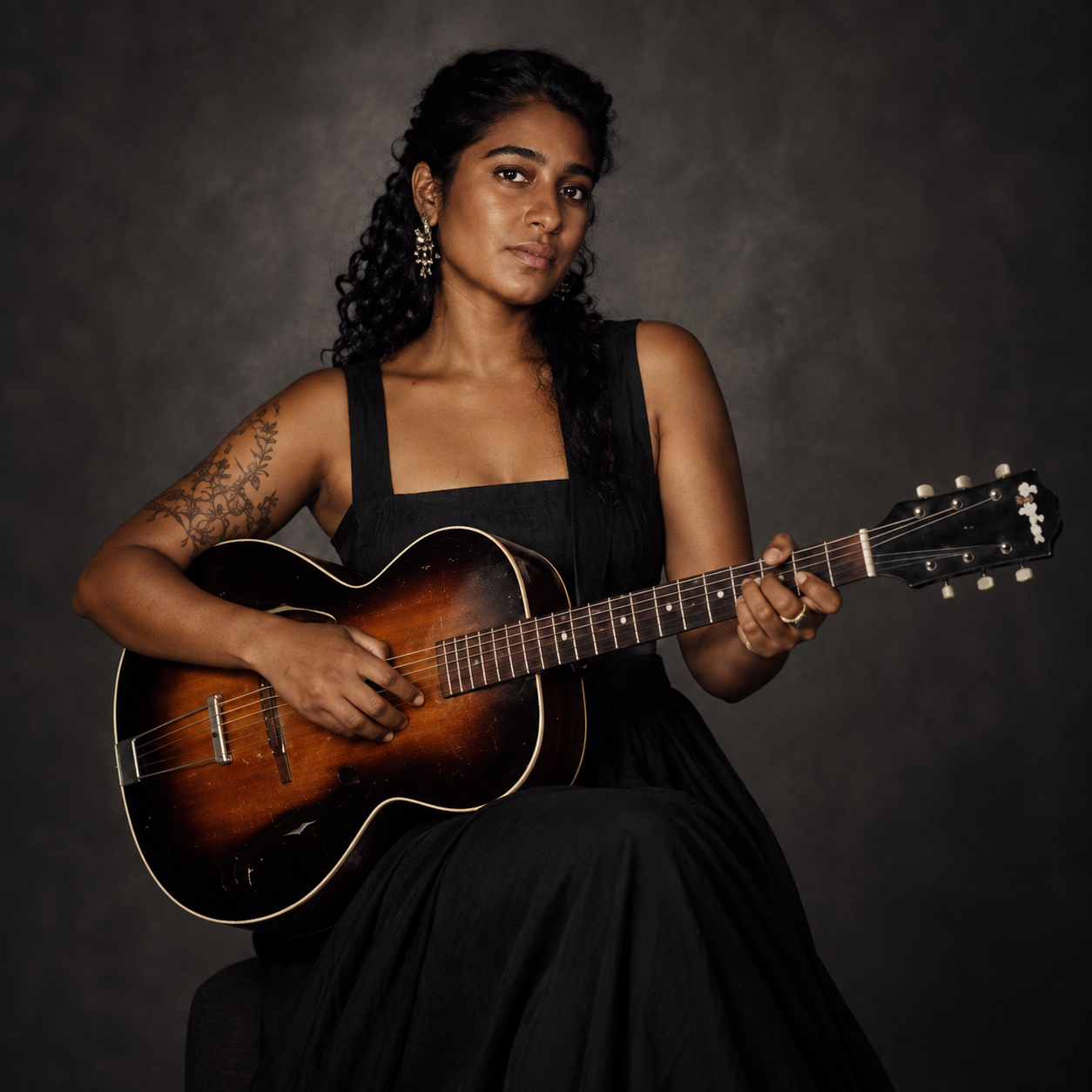
Leyla McCalla
GREAT CHOICE: Leyla McCalla!
Great music deserves to be discovered, enjoyed and shared.
CAN YOU SPARE A CUP OF COFFEE?
Audiophile-Streaming is a personal passion project, built with countless hours of discovering, selecting and sharing exceptional music.
I personally cover, without sponsors, the ongoing costs of hosting, software and subscriptions to keep the music discoveries coming. If you enjoy my work, your support is always appreciated.
A LITTLE THANK YOU IN RETURN
Just one coffee gives you lifetime access to the Coffee Club and all its playlists.
No subscriptions. No recurring fees.
The cello is not an instrument I normally associate with Haitian folk music, old-time American roots, banjo traditions and political songwriting all at once, but Leyla McCalla has made that combination feel completely natural. Her music can be spare and intimate one moment, rhythmically insistent the next, and she has a way of letting history enter a song without turning it into a lecture. Leyla Sarah McCalla was born on October 3, 1985, in New York City to Haitian parents, and her background has remained central to the way she thinks about language, identity and music. She sings in English, French and Haitian Kreyòl and plays cello, tenor banjo and guitar, yet none of those elements feels added simply for colour. What interests me most about Leyla McCalla is how completely she has built her own musical language from things that, on paper, might appear to belong to different worlds.
McCalla grew up in Maplewood, New Jersey, and began learning cello through the public school system when she was young. Classical training gave her considerable control over the instrument, but the conventional classical career path did not give her the sense of personal expression she was looking for. After college she spent time in Brooklyn before moving to New Orleans in 2010, a decision that proved important both musically and personally. She played cello on the streets, including Bach, while also becoming increasingly interested in Louisiana traditions and the links between New Orleans and Haiti. That curiosity was very different from simply collecting musical influences. She was trying to understand where the music came from, who carried it forward and how it connected with her own Haitian-American background.
A major turning point came when McCalla became part of the Carolina Chocolate Drops, the Black string band built around reclaiming and presenting traditions that had often been pushed out of the accepted history of American folk and country music. She contributed to the group’s 2012 album Leaving Eden and toured with the band before leaving in 2013 to concentrate on her own work. I think that period helped sharpen something that remains essential in her music: traditional material is not treated as a museum object. She listens to the history behind it, then finds a way to make it function as living music. Her cello is especially revealing in this respect. She can use it melodically, rhythmically or almost like a bass instrument, often leaving much more space than a classically trained player might be expected to leave.
Finding Her Own Voice
Her debut album, Vari-Colored Songs: A Tribute to Langston Hughes, released in 2014 and reissued by Smithsonian Folkways in 2020, remains one of the clearest introductions to McCalla’s musical identity. She had encountered Langston Hughes as a teenager after her father gave her a collection of his poetry, and years later she began setting his words to music. The album combines those Hughes settings with traditional Haitian material and original compositions. What could easily have become an overly serious literary project instead feels remarkably direct. The arrangements are often small, using voice, cello, banjo and guitar without surrounding the songs with unnecessary decoration.
“Heart of Gold”, adapted from Hughes, is a particularly good example of why the album works for me. McCalla does not push the text forward with dramatic singing. Her voice is controlled, clear and conversational, allowing the words and rhythm to do most of the work. On a transparent system, the pleasure is in the relationship between the voice and the instruments rather than in spectacular production. The plucked cello has body and texture, small changes in pressure are easy to follow, and the spaces between phrases become part of the arrangement. It is the sort of audiophile recording where midrange transparency matters more to me than huge bass or an artificially wide soundstage.
Her second album, A Day for the Hunter, A Day for the Prey, followed in 2016 on Jazz Village and widened that musical world. McCalla mixed original writing with Haitian and Louisiana material, while guests included Rhiannon Giddens and guitarist Marc Ribot. By this point it was already clear that she was not interested in being placed neatly under either “folk” or “world music”. The rhythms, languages and instrumentation keep moving between traditions while remaining recognisably hers. I particularly enjoy the way her cello can sit underneath a song rather than dominate it, giving the music weight without making the arrangement heavy.
The next step, The Capitalist Blues in 2019, pushed her sound outward again with a broader band and a stronger rhythmic character. That same year she appeared with Rhiannon Giddens, Allison Russell and Amythyst Kiah as Our Native Daughters on Songs of Our Native Daughters, released by Smithsonian Folkways. The project examined Black history, slavery, resistance and the experiences of Black women through newly written music informed by historical sources. McCalla co-wrote “I Knew I Could Fly” with Allison Russell, and the project makes sense beside her solo work because both use historical research as a starting point rather than an endpoint. For me, that is an important distinction. She is not trying to recreate the past exactly. She is asking what that past means now.
History Made Audible
Breaking the Thermometer, released by ANTI- Records in 2022, may be the album that best demonstrates how far McCalla is willing to take that idea. The record grew out of a multidisciplinary work commissioned by Duke Performances after Duke University acquired the archives of Radio Haiti, the independent station that became enormously important for reporting news and discussing Haitian politics and culture in Haitian Kreyòl. McCalla combines songs, traditional material, interviews and archival Radio Haiti broadcasts, so documentary voices become part of the musical fabric. That could easily have produced something intellectually interesting but difficult to live with as an album. Instead, I find it one of her most involving recordings because the human voices keep the history immediate.
“Dodinin” is one of the tracks I would choose for someone wanting to understand McCalla beyond the quieter folk arrangements of her debut. The rhythm moves with an easy physical pulse while her vocal line remains measured rather than forceful. Around it, the instrumentation has enough openness that individual percussion sounds and instrumental entrances remain easy to follow. Through good speakers or headphones, the record can change scale very quickly. One moment feels intimate and close, then an archival voice or additional rhythm changes the whole perspective. Those shifts in texture make Breaking the Thermometer particularly rewarding for me on a revealing system, because low-level information and differences between recorded sources are part of the storytelling rather than technical decoration.
Her fifth studio album, Sun Without the Heat, arrived on ANTI- in April 2024 and shows another side of her development. Produced by Maryam Qudus and recorded during an intensive nine-day session at Dockside Studios, it features longtime collaborators Shawn Myers on drums and percussion, Pete Olynciw on electric bass and piano, Nahum Zdybel on guitars, with Qudus contributing keyboards and backing vocals. McCalla expanded the rhythmic palette with influences including Afrobeat, Ethiopian music, Brazilian Tropicalismo, American folk and blues. The difference is noticeable immediately. The music has more movement and colour, but her voice remains calm at the centre of it.
The title track “Sun Without the Heat” is a good example of the balance she has reached. Its ideas were influenced in part by Frederick Douglass and by questions of struggle and social transformation, yet the song never feels burdened by the weight of its references. I hear a songwriter who has become increasingly confident about placing serious subjects inside music that can also have momentum and pleasure. That balance matters because McCalla is at her strongest when the research disappears into the song. I do not need to know every historical reference to respond to the rhythm, the grain of her voice or the way the arrangement develops.
There are moments in McCalla’s catalogue where the conceptual background asks more attention from the listener than the songs themselves, particularly when historical documents and political ideas are central to the project. For some listeners, that may make parts of Breaking the Thermometer less immediately accessible than Vari-Colored Songs or Sun Without the Heat. I do not see that as a weakness so much as part of the bargain she offers. These records reward active listening. The more I understand about what she is drawing from, the more the musical decisions make sense.
Her influence now reaches beyond her own recordings. The Carolina Chocolate Drops helped bring renewed attention to the overlooked Black history of American string-band music, while Our Native Daughters extended that conversation from a distinctly Black female perspective. McCalla has continued that work independently, and in 2025 she was named founding artistic director of the Shockoe Institute in Richmond, an organisation focused on examining the continuing impact of racial slavery in the United States. That appointment feels consistent with the work she has been making for years rather than like a separate career move. Music, research and historical memory have always been closely connected for her.
For a new listener, I would still begin with Vari-Colored Songs because it gives the clearest view of the essentials: the unforced voice, the cello, the Haitian material, Langston Hughes and the sense of space around every note. Then I would move to Breaking the Thermometer to hear how ambitious her storytelling became, before using Sun Without the Heat to discover the broader rhythmic language of her later work. Across those records, I hear an artist who has become progressively less interested in separating folk, classical technique, Haitian tradition, American history and contemporary songwriting. Leyla McCalla’s music matters to me because she can carry all of that information without losing directness. The quality that finally defines her best is her ability to make history feel personal through rhythm, voice and the unmistakable sound of her cello.
HiFi’ve, Ronald – Your EarFluencer
