
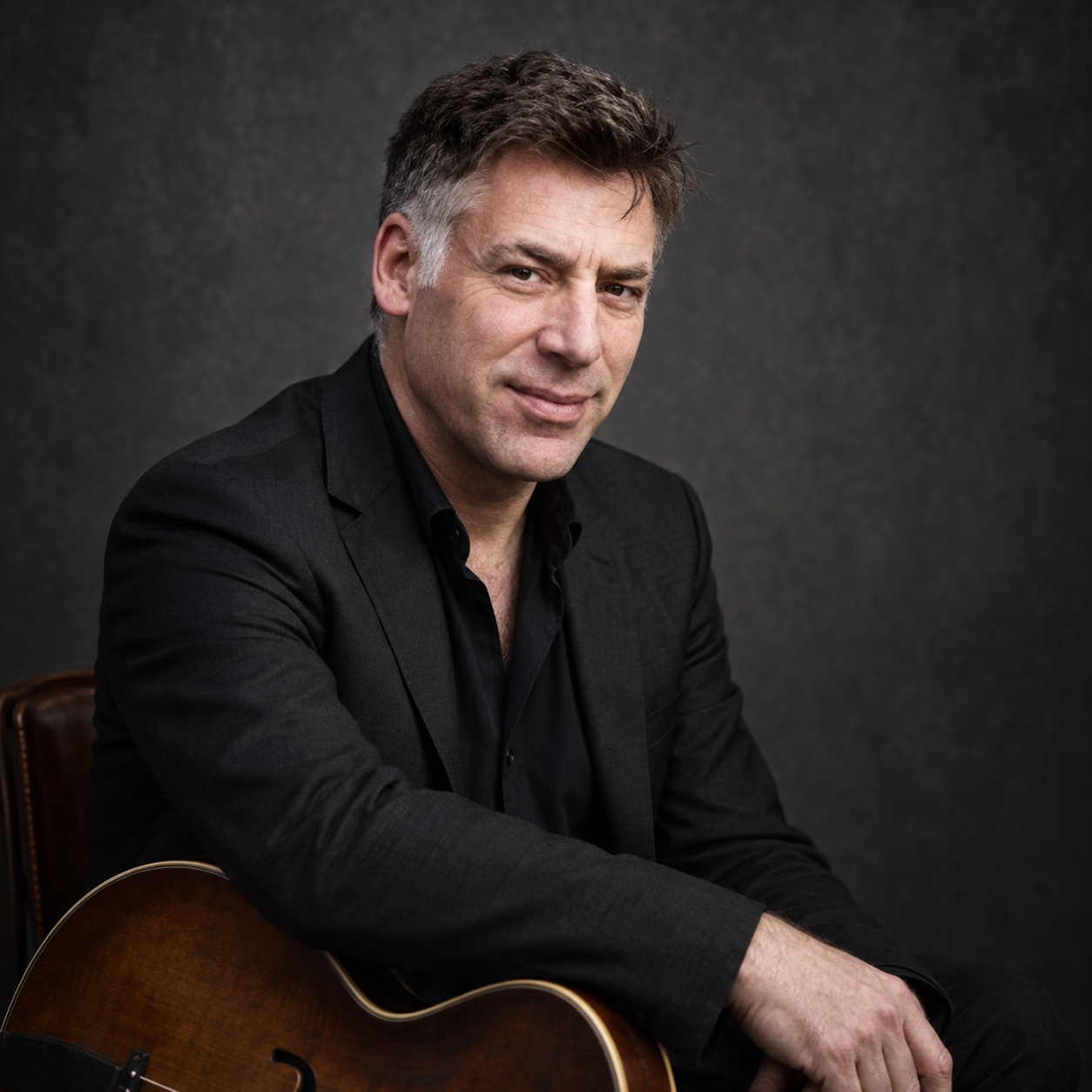
Peter Bernstein
GREAT CHOICE: Peter Bernstein!
Great music deserves to be discovered, enjoyed and shared.
CAN YOU SPARE A CUP OF COFFEE?
Audiophile-Streaming is a personal passion project, built with countless hours of discovering, selecting and sharing exceptional music.
I personally cover, without sponsors, the ongoing costs of hosting, software and subscriptions to keep the music discoveries coming. If you enjoy my work, your support is always appreciated.
A LITTLE THANK YOU IN RETURN
Just one coffee gives you lifetime access to the Coffee Club and all its playlists.
No subscriptions. No recurring fees.
A guitar does not need effects, excessive volume or a stream of fast notes to hold my attention. Peter Bernstein proves that point almost every time he plays. His sound is warm and direct, but the real attraction for me is the way he shapes a line, leaving enough space for the rhythm section while still making every phrase feel deliberate. Peter Bernstein, born Peter Andrew Bernstein on September 3, 1967, in New York City, has built a career around that kind of musical judgment. He belongs to a generation of jazz musicians who clearly understand the tradition, yet his playing never feels like an imitation of an earlier era.
Bernstein started with piano at the age of eight and moved to guitar when he was thirteen, initially learning much of the instrument by ear. He later studied jazz at Rutgers University with guitarist Ted Dunbar and pianist Kenny Barron before completing his studies at The New School in New York. An important connection there was guitarist Jim Hall, who became both an influence and mentor. In 1990 Hall invited Bernstein to perform in his JVC Jazz Festival concert at New York’s Town Hall, alongside a remarkable group of guitarists that included John Scofield and Pat Metheny. That same period also brought Bernstein into the orbit of alto saxophonist Lou Donaldson, whose band he would work with regularly for much of the 1990s.
What interests me about those early associations is how clearly they connect with Bernstein’s later musical personality. He learned from players who valued time, tone, blues feeling and communication more than spectacle. You can hear elements of Wes Montgomery, Grant Green, Kenny Burrell and Jim Hall in the background of his musical language, but Bernstein developed a touch that is very recognisable as his own. The notes have a rounded attack without becoming soft, and his lines can move through complicated harmony while still sounding conversational. He rarely seems interested in showing us how difficult the guitar can be. He is much more interested in making the music swing.
Finding His Own Voice
Bernstein’s first album as a leader, Somethin’s Burnin’, was recorded in New York on December 22, 1992 and released by Criss Cross Jazz in 1994. The quartet already tells you something about the level at which he was working: Brad Mehldau on piano, John Webber on bass and Jimmy Cobb on drums. I like this album because the Peter Bernstein personality is already there. On originals such as “Afterglow” and “Booker’s Little Blues”, he has the confidence to let melodic ideas develop rather than filling every available space. Cobb gives the music a firm pulse underneath him, and Mehldau provides exactly the kind of harmonic partner who can push a guitarist without crowding him.
The following Signs of Life, recorded with Mehldau, Christian McBride and Gregory Hutchinson, became another important part of Bernstein’s early catalogue. More than twenty years later, that same quartet finally came together in concert, resulting in Signs LIVE!, recorded at Jazz at Lincoln Center on January 4, 2015 and released by Smoke Sessions Records in 2017. For me, this is one of the best places to understand Bernstein as a mature improviser. Pieces such as “Blues for Bulgaria” and “Jive Coffee” show how much he trusts the band. He can play a compact phrase, leave it hanging for a moment and allow Mehldau, McBride or Hutchinson to answer before continuing the conversation.
Signs LIVE! also works particularly well from an audiophile listening perspective because the live character remains important to the recording. I hear musicians occupying their own space rather than being pushed into a polished studio wall of sound. Bernstein’s guitar stays clearly defined in the midrange, while McBride’s bass carries genuine weight and Hutchinson’s cymbals provide air around the ensemble. On revealing speakers or headphones, the interesting detail is not simply separation. It is how easily you can follow the reactions between the players, particularly when the rhythm changes underneath one of Bernstein’s solos.
His career as a sideman is just as significant. Bernstein has worked with musicians including Joshua Redman, Jimmy Cobb, Dr. Lonnie Smith, Lee Konitz, Sonny Rollins, Diana Krall and David “Fathead” Newman. He played in Redman’s group from 1995 to 1997 and was part of Krall’s quartet around the turn of the century. These are very different musical environments, which says something about his adaptability. Yet I rarely hear him disappear stylistically. That dry, warm attack and his slightly behind-the-beat ease remain identifiable.
The Organ Trio and the Art of Restraint
One musical relationship deserves special attention: Bernstein’s long-running trio with Hammond B-3 organist Larry Goldings and drummer Bill Stewart. The musicians began playing together in New York around the end of the 1980s, developing a partnership that has lasted for more than three decades. Their albums include Earth Tones, Ramshackle Serenade, Toy Tunes, Perpetual Pendulum and, most recently, Rhombus, released by Smoke Sessions Records on August 7, 2026. This trio brings out another side of Bernstein because the Hammond organ can occupy so much harmonic and tonal space. Instead of fighting that density, he finds openings inside it.
I particularly enjoy the way the three musicians handle repertoire on Rhombus. The programme reaches from Keith Jarrett and Wayne Shorter to Abdullah Ibrahim, Randy Weston, Thelonious Monk and Irving Berlin, alongside original material. Bernstein never treats those compositions as museum pieces. On a track such as Wayne Shorter’s “Penelope”, the appeal lies in the trio’s collective control rather than any single solo. Stewart can disturb the pulse without losing it, Goldings can move from accompaniment to counterpoint almost invisibly, and Bernstein reacts with short phrases that often say more than a longer solo would.
That economy also made Bernstein a natural interpreter of Thelonious Monk. His 2008 album Monk, recorded for Xanadu with bassist Doug Weiss and Bill Stewart, contains pieces including “Let’s Cool One”, “Pannonica”, “Brilliant Corners”, “Ruby, My Dear” and “Reflections”. Guitarists can easily make Monk sound too tidy because the instrument naturally encourages smooth lines and clearly voiced chords. Bernstein does not remove the awkward corners. I like hearing him preserve the pauses, accents and strange little turns that give Monk’s writing its character while still allowing the guitar to sound like a guitar.
A more recent album that I would recommend to anyone meeting Bernstein for the first time is Better Angels, released by Smoke Sessions Records on September 27, 2024. Here he plays with Brad Mehldau, bassist Vicente Archer and drummer Al Foster. The session mixes Bernstein originals with standards and was recorded at Power Station Studio A in New York, with the recording made at 96 kHz/24-bit resolution. The sound has clarity without becoming sterile, and Bernstein’s guitar has a believable body to it. You can hear the initial attack of a note, the fuller tone behind it and the small changes in intensity as a phrase develops.
“Perpetual Pendulum” is especially useful for understanding what I value in his playing. Bernstein does not need to dominate the performance to establish his identity. Foster’s drumming and Archer’s bass create movement underneath him, Mehldau opens the harmony, and Bernstein responds with lines that feel connected to the rhythm rather than placed on top of it. That relationship between touch and timing is the heart of his style. His technique is considerable, but technique is rarely the subject of the music.
Peter Bernstein’s importance in modern jazz guitar comes partly from his ability to connect generations. Jim Hall recognised his talent early, while musicians such as Lou Donaldson, Sonny Rollins and Jimmy Cobb trusted him in traditional jazz settings. At the same time, collaborations with Brad Mehldau, Christian McBride, Joshua Redman, Larry Goldings and Bill Stewart placed him firmly inside the development of modern New York jazz. His recordings for Criss Cross, Xanadu, SmallsLIVE, Pirouet and Smoke Sessions document that progression without showing any need for a dramatic reinvention. The sound became deeper and the musical relationships became richer, but the basic values remained remarkably consistent.
For a new listener, I would start with Signs LIVE! if you want to hear Bernstein reacting to a world-class quartet in real time, then move to Monk for his approach to interpretation and Better Angels for a beautifully recorded example of his mature playing. After that, the Goldings, Bernstein and Stewart catalogue opens another large part of the story. What keeps me interested is not speed or guitar technique on its own. It is the way Bernstein can take a sophisticated harmonic idea and make it sound natural, relaxed and human. After more than three decades of recording, that combination of touch, timing and restraint remains the musical quality that best explains why I rate Peter Bernstein so highly.
HiFi’ve, Ronald – Your EarFluencer
