
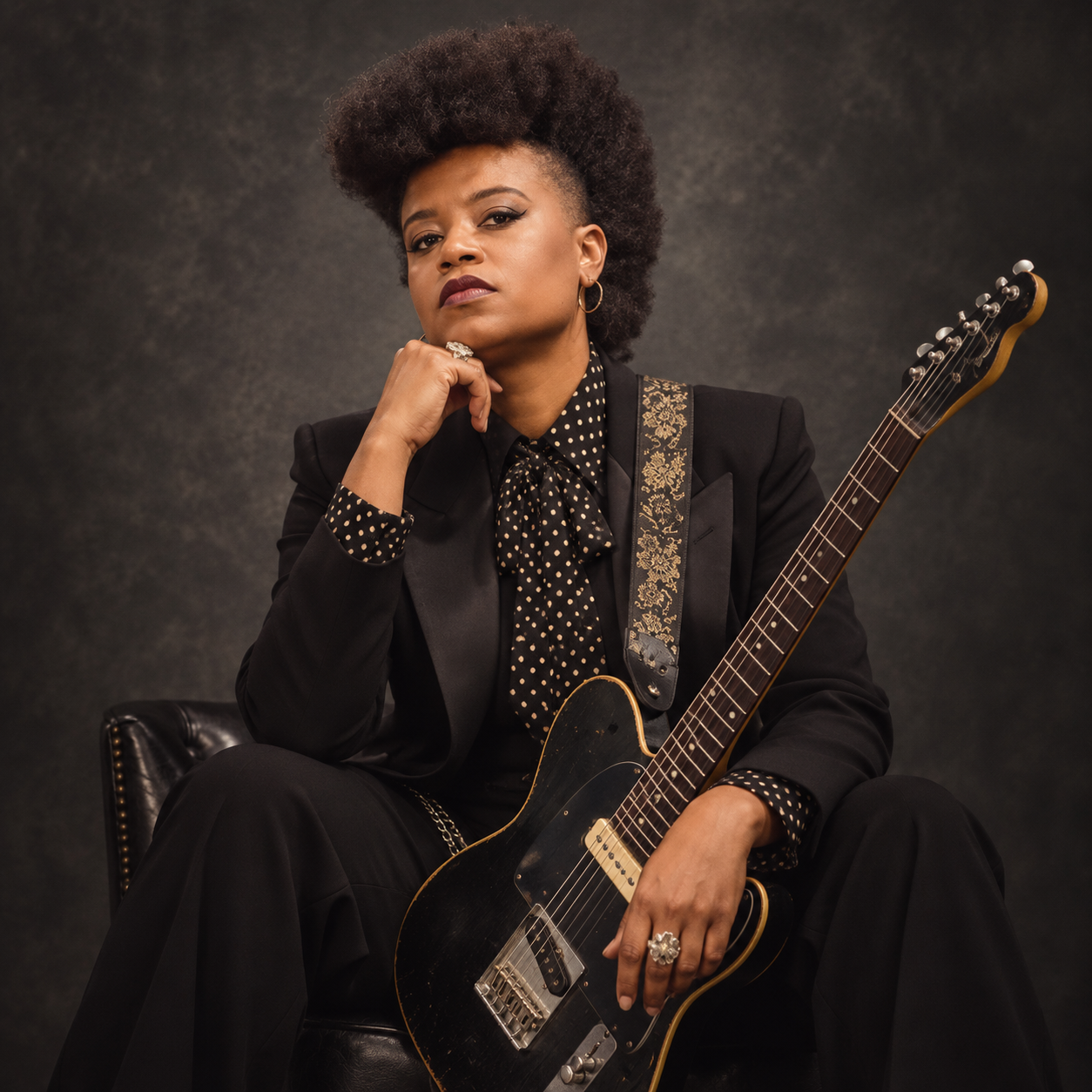
Amythyst Kiah
GREAT CHOICE: Amythyst Kiah!
Great music deserves to be discovered, enjoyed and shared.
CAN YOU SPARE A CUP OF COFFEE?
Audiophile-Streaming is a personal passion project, built with countless hours of discovering, selecting and sharing exceptional music.
I personally cover, without sponsors, the ongoing costs of hosting, software and subscriptions to keep the music discoveries coming. If you enjoy my work, your support is always appreciated.
A LITTLE THANK YOU IN RETURN
Just one coffee gives you lifetime access to the Coffee Club and all its playlists.
No subscriptions. No recurring fees.
Amythyst Kiah caught my attention because she refuses to fit neatly into one musical box. Folk, blues, Appalachian roots, alternative rock and Americana all belong in her music, but none of those labels fully explains what she does. Born in Chattanooga, Tennessee, on December 11, 1986, she later studied Bluegrass, Old-Time and Roots Music at East Tennessee State University, an important part of her development as a guitarist, banjo player, singer and songwriter. What interests me most is how naturally she connects those traditional foundations with the darker guitar sounds and alternative music that influenced her when she was younger. Her recordings can sound traditional for a moment and surprisingly modern a few seconds later, and that tension gives her music much of its personality.
An important step in Kiah’s wider recognition came through Our Native Daughters, the project she formed with Rhiannon Giddens, Leyla McCalla and Allison Russell. Their 2019 Smithsonian Folkways album Songs of Our Native Daughters examined Black history and the experiences of Black women through music rooted in African American and Appalachian traditions. Kiah contributed “Black Myself,” a song that became one of the project’s defining statements and earned her a Grammy nomination for Best American Roots Song. It is also a useful introduction to her voice. There is weight behind it, but she rarely sounds as though she is trying to demonstrate vocal power simply for effect. I hear firmness, controlled intensity and a slightly rough edge that makes the words feel immediate.
Wary + Strange
Her 2021 Rounder Records album Wary + Strange is where all the different parts of Amythyst Kiah really came together for me. Produced by Tony Berg and recorded with musicians including Blake Mills, the album moves far beyond a straightforward Americana production. Traditional roots elements remain present, but they sit beside electric guitars, heavier rhythms and arrangements that sometimes come surprisingly close to alternative rock. That combination matters because Kiah does not sound like a folk singer who has simply added louder instruments. The rock influences seem to be part of the original musical idea.
“Black Myself” appears again on Wary + Strange, reworked from the Our Native Daughters version into something much more forceful. The rhythm has greater physical weight, the electric instruments give the song extra tension, and Kiah’s voice remains firmly at the centre instead of being buried by the production. On a revealing system, I especially like the contrast between the solidity of the low end and the texture in her vocal. The soundstage does not need to be enormous because the arrangement gets its impact from focus and density. Good speakers or headphones make it easier to hear how carefully the layers have been assembled without reducing the song to a technical demonstration.
“Wild Turkey” shows another side of the album. The song deals with the death of Kiah’s mother and is far more exposed, both musically and emotionally. I find the relative restraint important because a larger arrangement could easily have weakened what she is saying. Her voice carries small changes in pressure and tone that become very noticeable through a transparent midrange, and the space around the instruments gives those details room to register. It is one of those recordings where vocal realism matters because the performance depends on intimacy rather than spectacle.
I also like “Fancy Drones (Fracture Me)” because it makes the alternative side of Kiah’s musical background impossible to ignore. The guitar textures are tougher, the rhythm has more drive and the recording feels less connected to conventional acoustic Americana. It helps explain why I find Wary + Strange more interesting than many albums that combine roots music with modern production. There is genuine contrast from track to track, yet Kiah’s voice and songwriting keep the album together. I would not call every arrangement equally immediate, but repeated listening reveals details in the percussion, guitar layers and backing textures that are easy to miss at first.
Still + Bright
Kiah changed direction again with Still + Bright, released by Rounder Records on October 25, 2024. This time she worked with producer Butch Walker at his Nashville studio and opened her songwriting process to more collaboration than before. Contributors and co-writers included artists such as Tim Armstrong, Sadler Vaden, Avi Kaplan and Sean McConnell, while the finished album also features Billy Strings and SG Goodman. The musical palette became broader as well, combining distorted guitars and harder electronic textures with banjo, pedal steel and more familiar roots instrumentation. I hear it as a continuation of Wary + Strange, but with fewer boundaries around what an Amythyst Kiah record is supposed to sound like.
“Play God and Destroy the World,” featuring SG Goodman, immediately shows that change. The two voices have different textures, and that contrast gives the song much of its character. Rather than placing everything in one smooth vocal blend, the production lets each singer retain her identity, which I find much more interesting. There is also considerable depth behind the vocals, with guitars and atmospheric elements occupying different positions instead of collapsing into a flat wall of sound. On a capable system, the pleasure is not simply hearing more detail but understanding how those details create tension around the singers.
“I Will Not Go Down,” featuring Billy Strings, brings another combination into focus. His presence could easily have pushed the track toward familiar bluegrass territory, but the arrangement instead uses his playing as part of a much wider and more muscular sound. I like that decision because it reflects Kiah’s entire career. She understands traditional music well enough to use its language without feeling obligated to remain inside it. Her banjo can belong beside distorted guitar, and an Appalachian musical reference can coexist with a production that would not feel out of place on an alternative rock record.
That willingness to mix musical worlds is ultimately what I value most about Amythyst Kiah. The historical importance of “Black Myself” and her work with Our Native Daughters deserves attention, but I would not want that story to overshadow the music she has made since. Wary + Strange demonstrated how convincingly she could combine deeply personal songwriting with roots music and alternative rock, while Still + Bright expanded that idea through collaboration and a more adventurous studio palette. Her recordings also reward good playback because the differences between acoustic and amplified textures, close vocals and deeper atmospheric layers are part of the arrangements rather than decoration. For me, the strongest thing about Amythyst Kiah is that she uses tradition as a foundation, not a restriction, and that gives her music an identity I can recognise within a few bars.
HiFi’ve, Ronald – Your EarFluencer
