
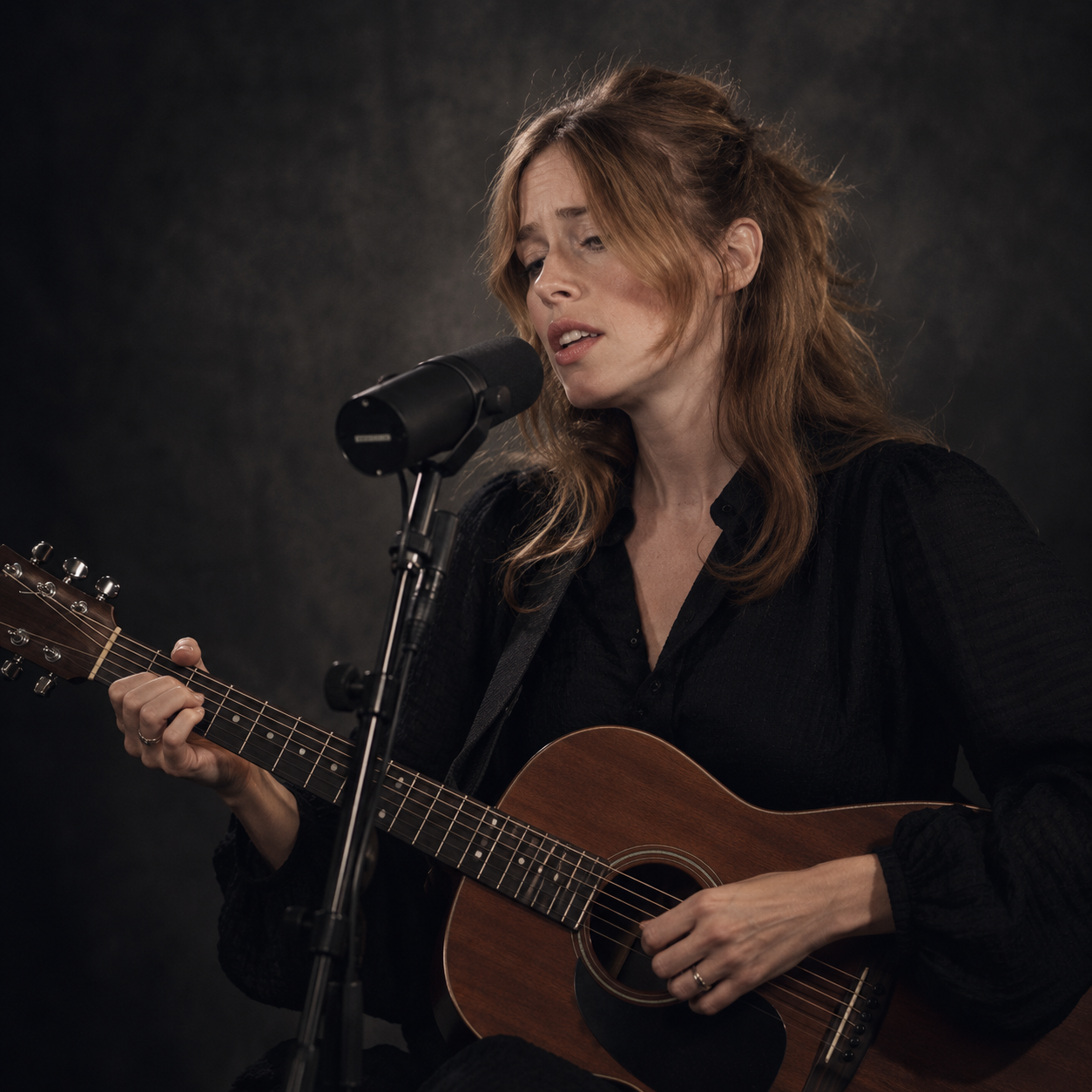
Anna St. Louis
GREAT CHOICE: Anna St. Louis!
Great music deserves to be discovered, enjoyed and shared.
CAN YOU SPARE A CUP OF COFFEE?
Audiophile-Streaming is a personal passion project, built with countless hours of discovering, selecting and sharing exceptional music.
I personally cover, without sponsors, the ongoing costs of hosting, software and subscriptions to keep the music discoveries coming. If you enjoy my work, your support is always appreciated.
A LITTLE THANK YOU IN RETURN
Just one coffee gives you lifetime access to the Coffee Club and all its playlists.
No subscriptions. No recurring fees.
The first thing I notice about Anna St. Louis is her timing. She rarely pushes a song forward when she can let it breathe, and her voice often seems to sit just behind the rhythm. That gives her music an unhurried character that suits both her songwriting and the simple, natural sound of her recordings. Anna St. Louis was born and raised in Kansas City, Missouri, although a reliable full birth date does not appear to have been made public. She grew up painting and singing in punk bands, later studied at art school in Philadelphia, and after graduating moved to Los Angeles, where she taught herself guitar and began writing and recording songs in her bedroom. It is quite a journey from punk bands to the restrained folk and country music she makes now, but I can still hear a certain independence in the way she refuses to overdecorate a song.
Her first substantial introduction was First Songs, originally released as a cassette in November 2017 through Woodsist and Mare Records, Kevin Morby’s Woodsist imprint. The title could hardly have been more accurate. These recordings capture St. Louis at the beginning of her development as a guitarist and songwriter, with the music built around voice, guitar and very little that distracts from either. Influences including Patsy Cline, John Fahey, Neil Young, Elizabeth Cotten, Buffy Sainte-Marie, Loretta Lynn and Townes Van Zandt have been connected with her music, but I do not hear someone trying to reproduce an older style. What interests me is how much space she leaves between notes. Her guitar playing can be economical to the point of appearing simple, yet the pauses, repeated patterns and slight changes in emphasis are often doing as much work as the chords themselves.
“Fire” from First Songs is a good example of why her music benefits from careful listening. There is no attempt to impress with vocal power or instrumental complexity. Instead, her slightly smoky, restrained delivery and the close relationship between voice and guitar create the character of the recording. On revealing speakers or headphones, I enjoy listening to the texture of the vocal rather than just the melody. You hear the small changes in pressure and phrasing that can disappear when a singer projects too aggressively. It is exactly the kind of intimate recording where midrange transparency matters more to me than spectacular bass or an enormous soundstage.
Finding Her Own Sound
The major step came with If Only There Was a River, released on October 12, 2018 through Woodsist and Mare Records. It was Anna St. Louis’ first full-length studio album and was produced by Kevin Morby and Kyle Thomas, better known as King Tuff, with Thomas engineering the sessions at his home studio in Mount Washington, Los Angeles. Justin Sullivan of Night Shop played drums and Oliver Hill contributed as a multi-instrumentalist. The album retains the intimacy of First Songs, but it sounds more deliberate and complete. The songs have greater depth without losing the feeling that St. Louis is sitting only a short distance away, playing because the song requires it rather than because a studio is waiting to be filled.
“Water” is one of the tracks I would use to introduce her to somebody who has never heard her music. Her vocal delivery is calm but never emotionally blank, and the repetitive guitar movement gives the song its pulse without forcing a conventional groove onto it. What I like most is the absence of unnecessary drama. Through a good DAC and a transparent pair of speakers, the attraction is in the relationship between her voice, the guitar and the surrounding room rather than in audiophile effects. Stereo imaging is natural rather than exaggerated, and the recording allows small changes in her delivery to remain audible. It is a useful reminder that reference music does not need explosive dynamics to tell you something about a system.
The title track, “If Only There Was a River,” takes that restraint even further. By this point her songwriting had become recognisable enough that I can hear only a few phrases and know who I am listening to. She stretches words without turning them into vocal demonstrations, and melodies often seem to develop gradually rather than arriving as obvious hooks. This is also where I think her music may divide listeners. Anyone expecting strong choruses, constant rhythmic movement or big changes in dynamics may find her work almost too reserved. For me, the opposite happens. The less she pushes, the more I start noticing the detail in the phrasing and the way the song quietly changes shape.
St. Louis also became part of the circle around David Berman’s Purple Mountains project in 2019, contributing vocals to the recordings alongside musicians associated with Woods. It was a natural connection. Berman’s songs depended heavily on words, understatement and musicians who understood when not to crowd the singer, and St. Louis has exactly that instinct. Her involvement did not radically redirect her own music, but it placed her among songwriters and musicians whose work similarly values personality over polish.
In The Air
After years of touring and performing, St. Louis spent a quieter period living in a small cabin in upstate New York while working at a nearby hotel. She wrote slowly there and allowed songs to develop for longer before recording them. The result was In The Air, her second full-length album, released on June 9, 2023 by Woodsist and Mare. Producer Jarvis Taveniere recorded the album with her during two extended Los Angeles sessions in 2021. The supporting musicians included Jess Williamson, Kacey Johansing, Oliver Hill on strings, Alex Fischel on piano, Josh Adams on drums and Keven Lareau, giving St. Louis a larger palette than she had used on her previous records.
That expansion is immediately audible, but importantly it does not swallow her. In The Air adds piano, strings, percussion and brighter instrumental colours while leaving the voice and songwriting at the centre. “Better Days” is particularly revealing. There is sadness in the performance, but the song itself was conceived around hope and making do with what you have. The pedal steel gives it a clear country character, while the arrangement remains light enough for St. Louis’ vocal to keep its intimacy. On a good high-end audio system, I enjoy the separation between the instruments, but even more important is the balance. Nothing feels pushed forward simply to sound impressive.
“Phone” shows another side of the album, beginning with a softer, dreamier texture before acoustic guitar and piano establish the song’s familiar St. Louis character. For me, this is where In The Air becomes particularly interesting as an audiophile recording. There is more information around the voice than on
