
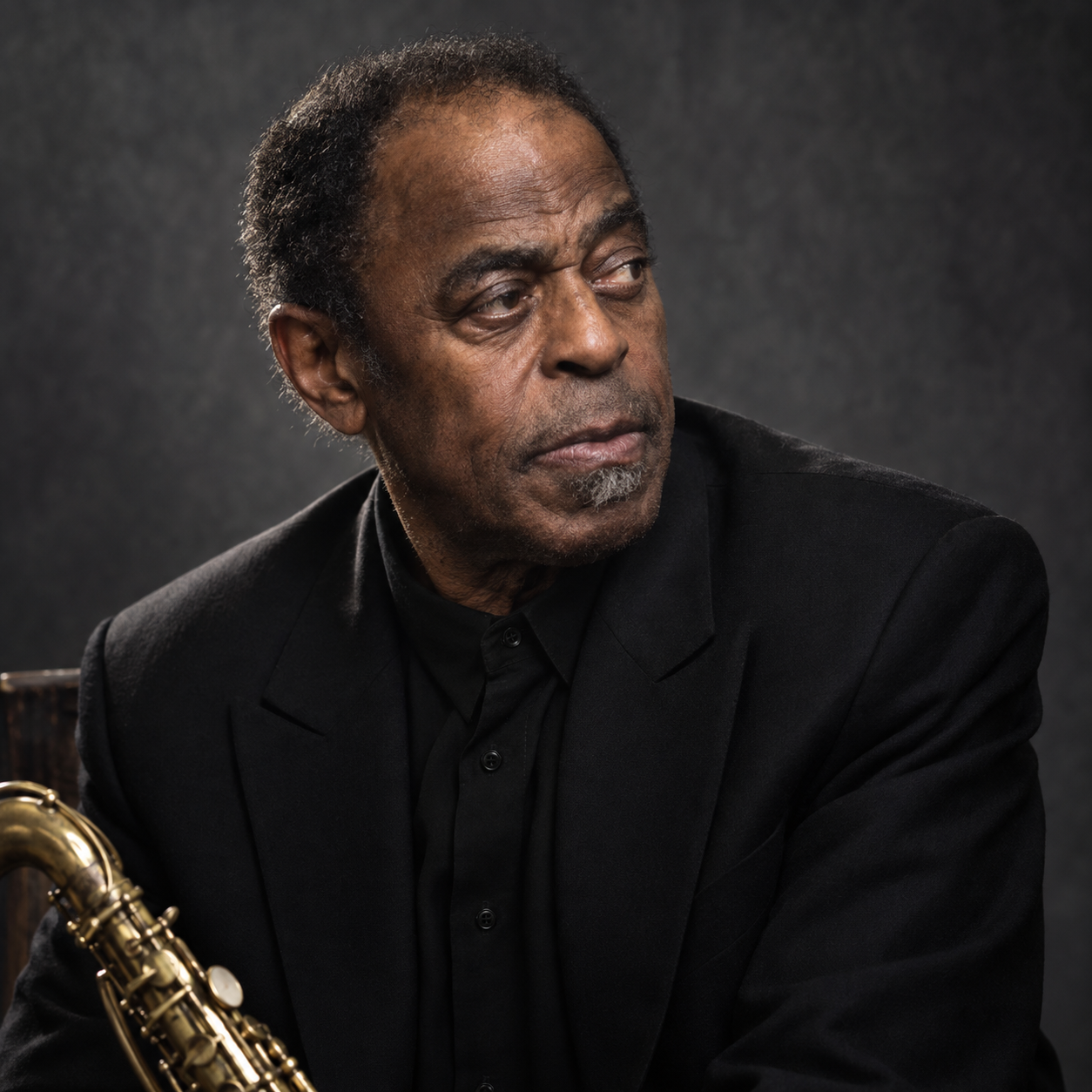
Archie Shepp
GREAT CHOICE: Archie Shepp!
Great music deserves to be discovered, enjoyed and shared.
CAN YOU SPARE A CUP OF COFFEE?
Audiophile-Streaming is a personal passion project, built with countless hours of discovering, selecting and sharing exceptional music.
I personally cover, without sponsors, the ongoing costs of hosting, software and subscriptions to keep the music discoveries coming. If you enjoy my work, your support is always appreciated.
A LITTLE THANK YOU IN RETURN
Just one coffee gives you lifetime access to the Coffee Club and all its playlists.
No subscriptions. No recurring fees.
The first thing I notice with Archie Shepp is the grain of his tenor saxophone. It can sound rough, breathy and almost confrontational, but then he can turn a phrase and suddenly reveal an unexpected tenderness. That contrast is central to the way I hear him. Shepp was born Archie Vernon Shepp on May 24, 1937, in Fort Lauderdale, Florida, and grew up in Philadelphia, where music was already an important part of his surroundings. He studied piano and clarinet before moving to saxophone, eventually making the tenor his main instrument. What makes Archie Shepp especially interesting to me is that the intensity of his playing was never simply about playing louder or freer. Behind that unmistakable sound I hear blues, gospel, spirituals, swing and a very strong awareness of African-American musical history.
Shepp studied drama at Goddard College in Vermont from 1955 to 1959, and I think that background helps explain something about his later musical personality. His performances often have a sense of communication that goes beyond instrumental technique, and spoken word, poetry and social commentary became part of his work. After college he moved into the New York avant-garde scene and worked with pianist Cecil Taylor, whose approach opened Shepp’s ears to possibilities outside conventional harmony, chord structures and fixed tempo. Another decisive figure was John Coltrane. Shepp admired Coltrane deeply, and Coltrane in turn helped him establish a relationship with Impulse! Records. Yet Shepp never became a Coltrane copy. Even when the connection between them is obvious, his phrasing is more abrasive and conversational to my ears, with notes that can crack, growl and bend as if the physical sound of the instrument is part of the message.
Finding his own voice
Four for Trane is one of the best places to hear Shepp defining that identity. Recorded at Rudy Van Gelder’s studio in Englewood Cliffs on August 10, 1964, and issued by Impulse!, the album takes four Coltrane compositions and places them in arrangements by Shepp and trombonist Roswell Rudd, alongside Shepp’s own “Rufus (Swung His Face at Last to the Wind, Then His Neck Snapped).” The sextet also included John Tchicai, Alan Shorter, Reggie Workman and Charles Moffett. Instead of trying to reproduce Coltrane’s versions, Shepp pulls the material apart and gives the horns much more room to rub against one another. I particularly enjoy hearing familiar music such as “Naima” treated this way because it makes clear that Shepp respected Coltrane without surrendering his own personality. On a transparent system, the different colours of tenor, alto, trombone and flugelhorn are easy to follow, and the recording becomes more interesting when I listen into those individual lines rather than expecting a conventional front line.
The connection with Coltrane continued. Shepp participated in the 1965 recording of Coltrane’s Ascension, and the two artists were also represented on New Thing at Newport, drawn from their separate performances at the 1965 Newport Jazz Festival. At the same time Shepp was building his own catalogue for Impulse!, including Fire Music and later The Magic of Ju-Ju. The latter, recorded in 1967, is particularly important in understanding how his interests were expanding toward African rhythms and cultural traditions. By this stage it becomes difficult to describe Shepp simply as a free-jazz saxophonist. His music could be radical in structure and sound, but the blues remained underneath it, and that connection became increasingly clear as his career developed.
That is important when listening to Shepp on good headphones or speakers. His tenor does not always give us the polished, beautifully rounded saxophone tone that audiophile listeners sometimes expect from a demonstration recording. There is air around the reed, hard edges in the attacks and sometimes a deliberately raw quality to sustained notes. I would not want those characteristics cleaned up because they are part of his identity. With good midrange transparency, I can hear the transition from breath to reed to full note, and those little changes in pressure make his phrasing feel remarkably human. A system that concentrates only on smoothness can actually make Archie Shepp less interesting.
From free jazz to Attica Blues
Attica Blues from 1972 shows another side of him and would probably be my first recommendation to somebody who wants to understand Archie Shepp without immediately entering his most uncompromising free-jazz recordings. The album was recorded in New York in January 1972 for Impulse! and responded directly to the 1971 Attica prison uprising and its aftermath. Shepp surrounded his tenor and soprano saxophones with a much broader palette of voices, brass, reeds, strings, electric piano, guitar, bass, drums and percussion. The title track immediately shows how far his music could reach beyond the normal boundaries of a small jazz group. There is rhythm, soul and a strong vocal presence, but underneath it I still hear the same Shepp, using sound as a form of direct communication.
For me, Attica Blues is also one of those recordings where stereo imaging is less important than the relationships between the musicians. There is a lot happening, and I prefer a system that keeps the dense arrangements understandable without making them artificially tidy. “Blues for Brother George Jackson” is a good example. The groove is immediately accessible, while the horns and Shepp’s tenor add tension around it. His saxophone does not float politely above the ensemble. It pushes into it, sometimes almost fighting for space, which gives the music much of its character. Good dynamics and an amplifier with control help here, but musical timing matters more to me than spectacular hi-fi effects.
Shepp continued that broader exploration on The Cry of My People, recorded in 1972 and released by Impulse! in 1973. Gospel voices, strings, African percussion and jazz instrumentation sit alongside one another, with material including Duke Ellington’s “Come Sunday.” I find this period particularly revealing because it demonstrates that the apparent aggression of Shepp’s earlier music was only one part of a much wider musical language. The blues and spiritual tradition were not something he discovered after free jazz. They had been there from the beginning, and during the 1970s he increasingly allowed them to occupy the foreground.
One of the clearest examples came with Goin’ Home, his 1977 collaboration with pianist Horace Parlan for SteepleChase. Recorded at Sweet Silence Studios in Copenhagen, it is built around spirituals and traditional songs rather than large-scale avant-garde structures. The stripped-down combination of saxophone and piano leaves nowhere to hide, and that is precisely why I like it so much. Shepp’s tone remains coarse around the edges, but here that roughness sits next to Parlan’s restrained piano and gives familiar spiritual material an extraordinary sense of personality. Listen to “Sometimes I Feel Like a Motherless Child” and the value of a good DAC or transparent midrange is not about hearing more impressive detail. It is about hearing the breath, pauses, weight of individual notes and the space between two musicians who do not need a large ensemble to create intensity.
More than the avant-garde
Shepp’s career also developed outside the recording studio. He began teaching before the end of the 1960s, including work at the University at Buffalo, and in 1971 joined the University of Massachusetts Amherst, where he spent around three decades teaching in Afro-American Studies. That academic work makes sense alongside the music because Shepp consistently treated jazz as part of a much larger African-American cultural history rather than as an isolated instrumental style. He continued recording extensively in Europe and America, working with musicians including Horace Parlan and revisiting blues, standards, ballads and spirituals alongside freer material. In 2004 he co-founded the ArchieBall label in France, giving him another platform for his later work, and in 2016 he was named an NEA Jazz Master.
That long development is why I would hesitate to introduce Archie Shepp simply as an avant-garde jazz artist. Start with Attica Blues if you want to hear how accessible rhythm, vocals and political expression can coexist with his uncompromising saxophone sound. Move to Four for Trane and you hear the younger musician challenging the language around John Coltrane while already establishing his independence. Then try Goin’ Home with Horace Parlan and much of the noise falls away, leaving melody, spiritual tradition and two musicians listening closely to each other. Those three recordings are very different, yet I recognise Shepp almost immediately in each of them.
For audiophile music lovers, Archie Shepp is also a useful reminder that a great recording does not have to sound polished. His music asks more interesting questions of a high-end audio system: can it reproduce the coarse edge of a tenor saxophone without turning it into harshness, separate a crowded ensemble without pulling it apart, and preserve a quiet breath or fragile note without exaggerating it? More importantly, can it let the recording remain emotionally direct? Across Four for Trane, Attica Blues and Goin’ Home, I hear a musician who could move from abstraction to blues, from large ensembles to intimate spirituals, without losing his identity. After decades of playing, composing, teaching and exploring African-American musical traditions, the quality that best explains my view of Archie Shepp is still the same one I hear in his tenor: an unmistakably human roughness that makes every phrase feel personal.
HiFi’ve, Ronald – Your EarFluencer
