
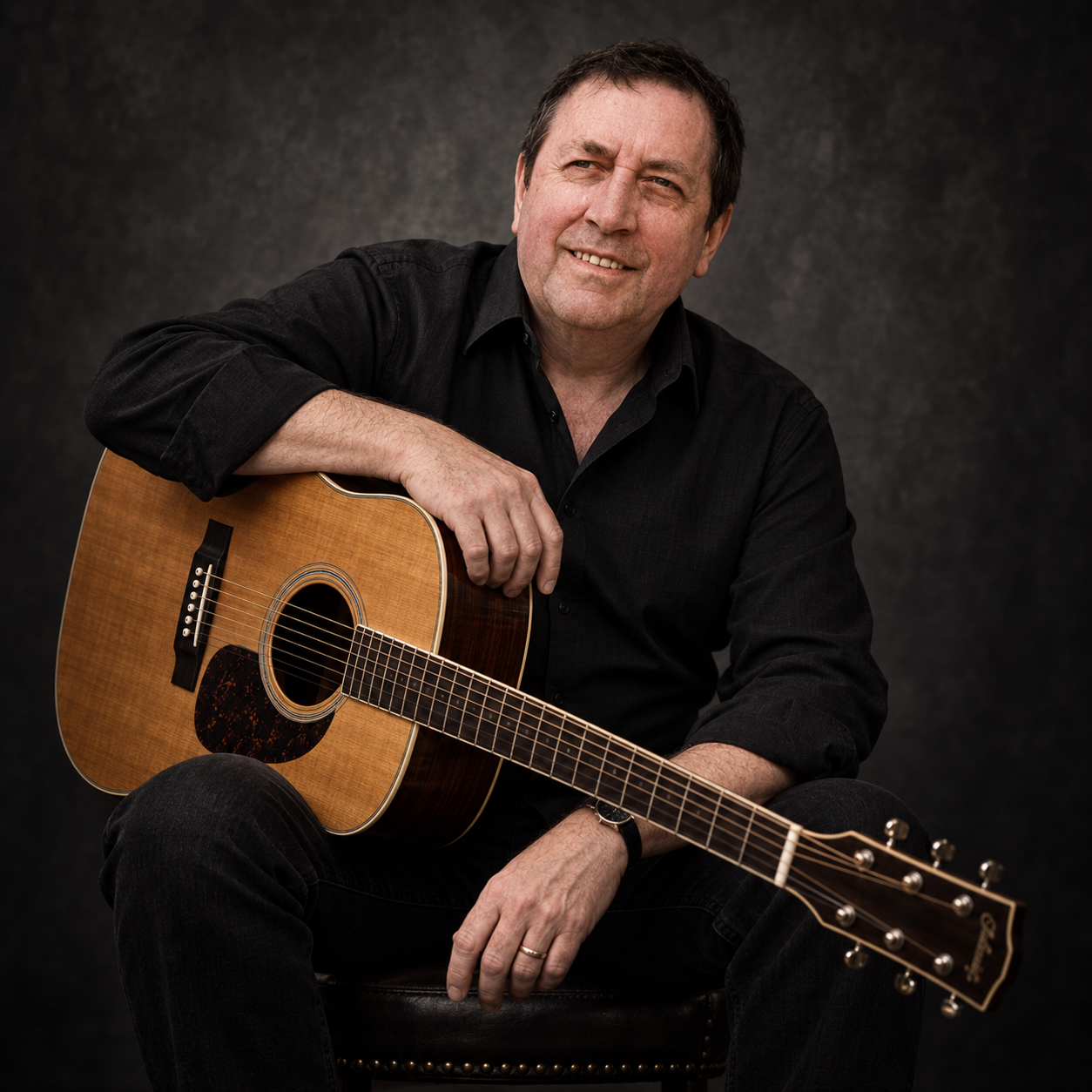
Bert Jansch
GREAT CHOICE: Bert Jansch!
Great music deserves to be discovered, enjoyed and shared.
CAN YOU SPARE A CUP OF COFFEE?
Audiophile-Streaming is a personal passion project, built with countless hours of discovering, selecting and sharing exceptional music.
I personally cover, without sponsors, the ongoing costs of hosting, software and subscriptions to keep the music discoveries coming. If you enjoy my work, your support is always appreciated.
A LITTLE THANK YOU IN RETURN
Just one coffee gives you lifetime access to the Coffee Club and all its playlists.
No subscriptions. No recurring fees.
The first thing I notice with Bert Jansch is that the guitar never sounds like decoration behind a singer. It carries the rhythm, answers the voice, changes direction between phrases and sometimes seems to pull the song forward by itself. Jansch, whose full name was Herbert Jansch, was born on 3 November 1943 in Springburn, Glasgow, and grew up in Edinburgh. By the early 1960s he was developing a style that brought together British folk, blues, jazz and the influence of guitarist Davy Graham, while Scottish singer and guitarist Archie Fisher was another important early influence. He eventually made his way to London, where his playing and songwriting quickly attracted attention in the folk scene.
What makes Bert Jansch particularly interesting to me is that technical ability never seems to be the purpose of the music. His fingerpicking can be complicated, with shifting accents, bent notes and small changes in timing, but it rarely sounds like a demonstration. The guitar has a dry, physical quality, and I often hear the fingers, the attack of the strings and the body of the instrument almost as clearly as the notes themselves. His singing is equally recognisable: restrained, slightly rough around the edges and very different from the polished folk voice some listeners may expect. It can take a little time to adjust to that voice, but for me its lack of polish is one of the reasons the songs feel believable.
A debut that changed the possibilities of acoustic guitar
His first album, *Bert Jansch*, appeared on Transatlantic in April 1965 after being recorded on borrowed guitars using a reel-to-reel tape machine. It contains early originals such as “Strolling Down the Highway,” “Running from Home” and “Needle of Death,” alongside his interpretation of Davy Graham’s “Anji.” “Needle of Death” is especially important because Jansch wrote it after the drug-related death of a friend, giving the album a seriousness that went well beyond instrumental virtuosity. Neil Young later spoke openly about how strongly the song and Jansch’s debut affected him, and Jansch’s influence would extend to musicians including Jimmy Page, Johnny Marr, Donovan and many others.
I also like this album as an example of why audiophile listening does not always mean listening for spectacular production. This is not a recording designed around a huge soundstage or perfectly separated studio layers. Instead, the attraction lies in immediacy: the sharp leading edge of a plucked string, the small changes in pressure from one phrase to another and the contrast between his relatively quiet voice and the restless guitar underneath it. Through transparent speakers or good headphones, those little variations become part of the performance rather than background noise. If somebody has never heard Bert Jansch before, this is still where I would start because his songwriting, guitar language and personality are already remarkably clear.
Only a year later, *Jack Orion* showed how quickly he was developing. Released by Transatlantic in 1966, it concentrated more strongly on traditional material and included “Black Water Side,” “Nottamun Town,” “The First Time Ever I Saw Your Face” and the long title piece. Anne Briggs was a major influence during this period and taught Jansch traditional songs including “Blackwaterside,” which he reshaped through his own blues-influenced guitar approach. John Renbourn also played on the album, and their musical relationship would soon become central to the next stage of Jansch’s career.
*Jack Orion* is where I hear particularly clearly how Jansch could make old material sound personal without trying to modernise it artificially. On “Black Water Side,” the guitar does not simply establish a chord pattern and remain underneath the vocal. It moves around the melody, adds tension and leaves little pockets of space that make the vocal line stronger. On a revealing hi-fi system, the pleasure is in the timing and the changing intensity of each picked figure rather than deep bass or large-scale dynamics. The stereo presentation is modest compared with modern audiophile recordings, but the musical information in the midrange is exceptional.
Pentangle and a wider musical language
Jansch and John Renbourn recorded the collaborative *Bert and John* in 1966, and in 1967 they became founding members of Pentangle with singer Jacqui McShee, bassist Danny Thompson and drummer Terry Cox. That group allowed Jansch’s folk and blues background to interact much more openly with jazz improvisation and a full rhythm section. Pentangle’s first album arrived in 1968, while 1969’s *Basket of Light* included “Light Flight,” a track that helped introduce the group’s unusual mixture of acoustic folk, jazz rhythm and contemporary songwriting to a much wider audience. Jansch continued making solo records during the Pentangle years, and when the original group broke up in 1973 he returned his main attention to his own work.
One of the things I value about this period is that joining a group did not smooth away his individuality. Even surrounded by Danny Thompson’s double bass, Terry Cox’s percussion, Renbourn’s guitar and McShee’s clear voice, Jansch remains easy to recognise. His guitar still has that slightly unpredictable pulse, with notes arriving where they feel natural rather than where a rigid pattern might place them. Pentangle also demonstrates how well his playing works with good stereo imaging: when the instruments are clearly separated, I can follow Jansch without losing the interaction between the musicians. For anyone interested in acoustic reference music, these recordings are rewarding precisely because there is so much communication happening at moderate volume.
His solo career continued through changing musical fashions. *L.A. Turnaround* from 1974, co-produced by Mike Nesmith and partly recorded using Ronnie Lane’s mobile studio, brought Nashville and country-rock colours into Jansch’s music, with musicians including pedal-steel player Red Rhodes and Klaus Voormann. Decades later, albums such as *Crimson Moon* in 2000 and *Edge of a Dream* in 2002 introduced his playing to another generation and included collaborations with musicians such as Johnny Marr, Bernard Butler, Hope Sandoval, Dave Swarbrick and Ralph McTell. The important point for me is that Jansch could work with very different musicians without losing the quiet irregularity that made his playing unmistakable.
The Black Swan and the late years
For a later recording, I strongly recommend *The Black Swan*. Released by Drag City in 2006 and produced by Noah Georgeson, it brought Jansch together with younger musicians including Beth Orton and Devendra Banhart. Instead of trying to recreate his 1960s sound, the album lets his weathered voice and acoustic guitar sit naturally inside a more contemporary production. Tracks such as “The Black Swan,” “High Days,” “Katie Cruel” and “A Woman Like You” show that the essential ingredients had hardly changed: strong fingerpicked guitar, economical singing and arrangements that leave enough space around both.
From an audiophile point of view, *The Black Swan* is also an excellent way to hear Jansch in a more modern recording environment. There is more air around the instruments than on the earliest albums, and the guitar’s body, string texture and transient attack are easier to follow without becoming artificially enlarged. I particularly enjoy how little the production tries to make him sound younger or smoother. His voice carries age, the guitar remains direct and sometimes hard-edged, and the contrast makes the recording feel human rather than polished for effect. It is a good second starting point after the debut for listeners who want to hear what several decades of experience added without removing the qualities that were there in 1965.
Jansch was diagnosed with lung cancer in 2009 but returned to performing after treatment, appearing at Eric Clapton’s Crossroads festival in 2010 and touring the United States as Neil Young’s special guest in 2010 and 2011. After the illness returned in 2011, he continued performing, including appearances with Pentangle, before his final Royal Festival Hall concert. Herbert “Bert” Jansch died in London on 5 October 2011 at the age of 67. His influence can be traced through generations of acoustic and electric guitarists, but I think concentrating only on influence risks missing what is best about the records themselves.
For me, Bert Jansch is ultimately not about guitar virtuosity, folk history or famous musicians who admired him, although all three are part of the story. The debut shows the young songwriter discovering how much one voice and one acoustic guitar could express, *Jack Orion* shows him transforming traditional material through his own musical instincts, and *The Black Swan* proves that the same personality remained intact four decades later. Good speakers, headphones, amplifiers and DACs reveal more of the finger noise, resonance, dynamics and recording space, but the equipment is never the main attraction. What matters most is the way he could make technically sophisticated playing sound spontaneous and completely connected to the song. That natural, slightly unpredictable sense of timing is the musical quality that best explains why I rate Bert Jansch so highly.
HiFi’ve, Ronald – Your EarFluencer
