
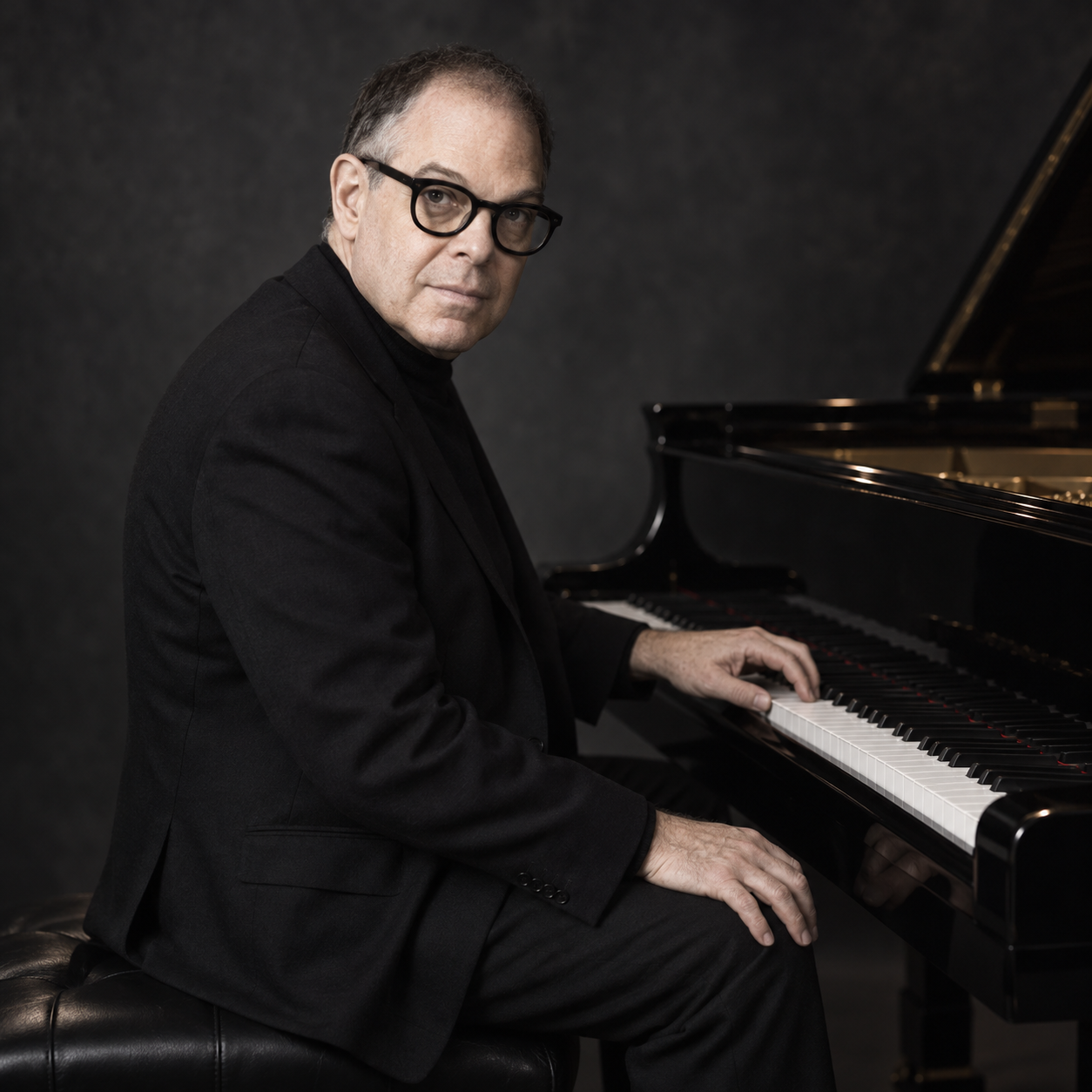
Bill Charlap
GREAT CHOICE: Bill Charlap!
Great music deserves to be discovered, enjoyed and shared.
CAN YOU SPARE A CUP OF COFFEE?
Audiophile-Streaming is a personal passion project, built with countless hours of discovering, selecting and sharing exceptional music.
I personally cover, without sponsors, the ongoing costs of hosting, software and subscriptions to keep the music discoveries coming. If you enjoy my work, your support is always appreciated.
A LITTLE THANK YOU IN RETURN
Just one coffee gives you lifetime access to the Coffee Club and all its playlists.
No subscriptions. No recurring fees.
The first thing I notice with Bill Charlap is how little he needs to do to make a familiar song feel alive. His piano playing is clear, controlled and deeply connected to melody, but never stiff. William Morrison Charlap was born on October 15, 1966, in New York City, into a home where music was part of everyday life. His father, Moose Charlap, was a Broadway composer associated with Peter Pan, while his mother, Sandy Stewart, was a singer who performed with Benny Goodman and became known for her recording of “My Coloring Book.” Charlap started playing piano at the age of three, and that combination of jazz, popular song and musical theatre became a natural foundation for the artist he would become.
The song comes first
Charlap studied at New York’s High School of Performing Arts and developed through listening as much as through formal education. His influences are unusually broad even within jazz piano. He has spoken about pianists including Art Tatum, Teddy Wilson, Earl Hines, Bud Powell, Bill Evans, Hank Jones, Tommy Flanagan and Kenny Barron, but also about learning from Louis Armstrong, Lester Young, Charlie Parker, Miles Davis and John Coltrane. That makes sense when I listen to him, because his playing does not sound like an attempt to reproduce one particular pianist. He seems more interested in absorbing the language of jazz and then using it to serve the song in front of him.
His professional development put him close to musicians who demanded exactly that kind of awareness. Early in his career he worked with Gerry Mulligan and also played with Benny Carter, Clark Terry and Frank Wess, before joining the Phil Woods Quintet in 1995. These were musicians with very individual sounds, but also musicians who understood phrasing, swing and the importance of knowing the material properly. Charlap has said that he learned from virtually everyone he worked with, and I think you can hear the result in the way he accompanies. He rarely fills space simply because space exists. Instead, the harmony, rhythm and touch seem to respond to whoever is playing or singing beside him.
An essential part of the Bill Charlap story began in December 1997, when he first recorded with bassist Peter Washington and drummer Kenny Washington. They are not related, but as a rhythm section they had already developed a strong musical connection, and their partnership with Charlap became one of the defining relationships of his career. The trio’s first session produced All Through the Night for Criss Cross Jazz, and when Charlap moved to Blue Note Records in 2000, the same trio recorded Written in the Stars. This was an important step because it introduced a much wider audience to a group that already sounded less like piano plus accompaniment and more like three musicians thinking together.
Written in the Stars is still one of the albums I would recommend to someone meeting Charlap for the first time. The repertoire includes songs such as “In the Still of the Night,” “Blue Skies,” “Where or When” and “One for My Baby,” but what interests me is not simply his choice of standards. Listen to the way a melody remains understandable even when the harmony becomes richer underneath it. Peter Washington’s bass gives the music weight without making it heavy, while Kenny Washington can move from brushes to stronger rhythmic accents without disturbing the balance. On a transparent pair of speakers or good headphones, the attraction is in the small things: piano attack, note decay, the relationship between bass and left hand, and the tiny rhythmic adjustments that make the trio swing.
Charlap continued exploring composers rather than treating standards as an interchangeable collection of tunes. Stardust in 2002 concentrated on Hoagy Carmichael, while Somewhere: The Songs of Leonard Bernstein followed in 2004 and Bill Charlap Plays George Gershwin: The American Soul in 2005. Somewhere is particularly revealing because Bernstein’s music gives Charlap something more structurally complex to work with. He has explained that Bernstein’s writing contains harmonic, rhythmic and arranging ideas that are already deeply developed, so the challenge is not to remove them but to bring them into a jazz setting without losing their character. I like that attitude. Charlap does not seem interested in proving that he can transform a great song beyond recognition; he finds freedom inside its structure. Somewhere later received a Grammy nomination for Best Jazz Instrumental Album.
Listening as accompaniment
That respect for the song became even more obvious in Charlap’s work with singers. In 2005 he recorded Love Is Here to Stay with his mother Sandy Stewart, and in 2015 he collaborated with Tony Bennett on The Silver Lining: The Songs of Jerome Kern. The Bennett album brought Charlap a Grammy Award for Best Traditional Pop Vocal Album in 2016 and featured several settings, including Bennett with Charlap, performances with Charlap’s trio, and duo-piano contributions from Charlap’s wife, pianist and composer Renee Rosnes. It is an important recording because it shows that accompaniment is not secondary work for Charlap. He listens to the shape of a vocal phrase and places the piano around it rather than competing with it.
For me, The Silver Lining is also useful reference music when I want to hear whether a system handles intimacy properly. Bennett’s voice has age, texture and weight, and the piano must remain articulate without becoming oversized or unnaturally bright. When the reproduction is right, I hear the relationship between voice and piano rather than two separate sound sources fighting for attention. Charlap’s timing is especially important here. A chord can arrive fractionally later than expected, or a short run can answer the vocal line, and suddenly the song breathes differently. This is where midrange transparency and natural dynamics matter much more to me than spectacular bass or an exaggerated soundstage.
Charlap’s musical partnerships have continued to expand. With Renee Rosnes he recorded the two-piano album Double Portrait for Blue Note in 2010, while his trio continued through albums including Live at the Village Vanguard, Notes from New York, Uptown, Downtown and the 2021 Blue Note return Street of Dreams. More recently, he collaborated with Dee Dee Bridgewater on Elemental, released by Mack Avenue in June 2025. The album was nominated for Best Jazz Vocal Album at the 2026 Grammy Awards, showing that Charlap’s ability to work closely with a distinctive singer remains an important part of his music decades into his career.
Three musicians, one language
If Written in the Stars shows the trio establishing its mature identity, the 2024 Blue Note album And Then Again shows what happens after more than a quarter of a century of playing together. Recorded live at New York’s Village Vanguard, it features Charlap with Peter Washington and Kenny Washington working through music by composers including Kenny Barron, Thelonious Monk and Dave Brubeck alongside standards such as “All the Things You Are,” “Darn That Dream” and “The Man I Love.” The important thing for me is the freedom inside the performances. Nobody sounds as though he is waiting for his turn. A bass movement can redirect the piano, a drum accent can change the momentum, and Charlap can alter a phrase without the trio losing its shape.
This is also where I find his musical personality easiest to define. Bill Charlap is not a pianist who needs constant volume, speed or harmonic surprise to establish his identity. His sound comes from touch, timing, knowledge of the song and unusually close listening to the musicians around him. Some jazz piano demands attention immediately; Charlap often becomes more interesting after several listens because the details are smaller. I start noticing how carefully he voices a chord, how long he allows a melody note to remain exposed, or how naturally silence becomes part of a phrase. His long-running work as Director of Jazz Studies at William Paterson University also makes sense in that context, because his career represents a living connection between jazz history, practical musicianship and the next generation of players.
For a new listener, I would begin with Written in the Stars, then move to The Silver Lining to hear Charlap supporting a singer, and finally play And Then Again to hear how far his trio relationship has developed. Together they explain much of his career without reducing it to a list of standards, awards or famous collaborators. I value Bill Charlap because he understands that respecting a melody does not mean playing it safely, and that sophistication does not require making the music complicated for the listener. Whether I hear him through speakers, headphones or a revealing high-end audio system, the strongest impression is always the same: he listens before he plays, and that sense of musical listening is the quality that defines him for me.
HiFi’ve, Ronald – Your EarFluencer
