
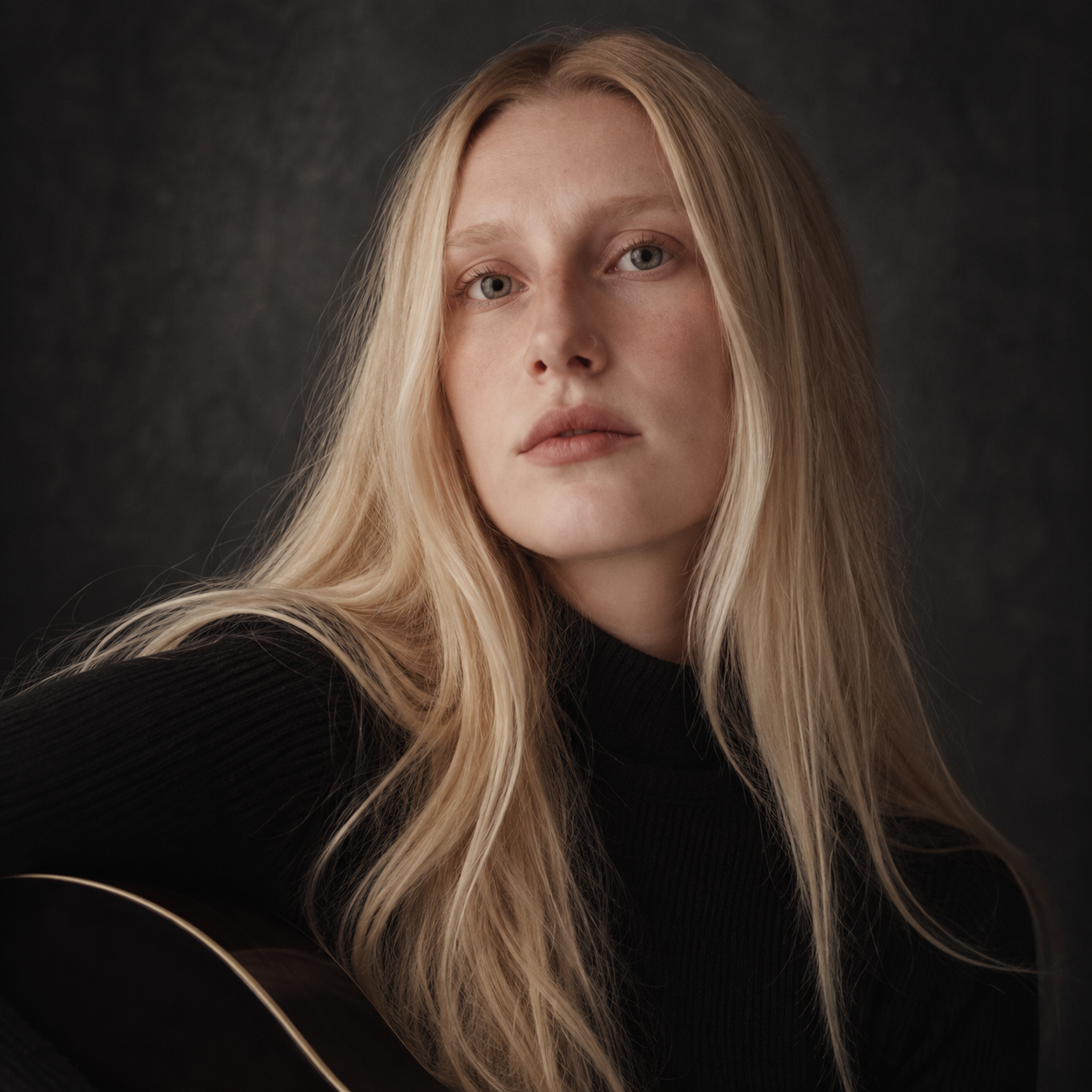
Billie Marten
GREAT CHOICE: Billie Marten!
Great music deserves to be discovered, enjoyed and shared.
CAN YOU SPARE A CUP OF COFFEE?
Audiophile-Streaming is a personal passion project, built with countless hours of discovering, selecting and sharing exceptional music.
I personally cover, without sponsors, the ongoing costs of hosting, software and subscriptions to keep the music discoveries coming. If you enjoy my work, your support is always appreciated.
A LITTLE THANK YOU IN RETURN
Just one coffee gives you lifetime access to the Coffee Club and all its playlists.
No subscriptions. No recurring fees.
The first thing I notice about Billie Marten is how little she needs to do with her voice to hold my attention. She does not push for drama, and she rarely treats volume as a substitute for expression. Instead, small changes in phrasing, breath and timing do most of the work. Marten was born Isabella Sophie Tweddle on 27 May 1999 in Risplith, North Yorkshire, and grew up in the Ripon area. She began attracting attention very young, after a YouTube performance of Lucy Rose’s “Middle of the Bed” spread far beyond the audience she originally expected. By 2014 she had released the Ribbon EP, followed by As Long As in 2015, and she was included in the BBC Sound of 2016 selection before her first album arrived.
What interests me about Billie Marten, though, is not that she started young. Plenty of artists arrive early and spend the rest of their careers trying to escape the version of themselves that first attracted attention. What makes Marten more interesting is that we can actually hear her doing that. Her records gradually move from delicate acoustic songwriting towards something broader, more rhythmic and much more comfortable with imperfection. Her stage name even contains a little piece of her musical upbringing: she has explained that “Marten” came partly from her Doc Martens and partly from John Martyn, one of her father’s favourite singers and an artist she had heard while growing up.
Finding a voice beyond the quiet
Her debut album, Writing of Blues and Yellows, was released on 23 September 2016 through Chess Club and RCA Victor while Marten was still only seventeen. Songs such as “La Lune”, “Bird” and “Heavy Weather” established the qualities that many listeners still associate with her: acoustic guitar, a very close and controlled vocal delivery, restrained arrangements and melodies that seem simple until you start following the details. I still think La Lune is one of the easiest places to understand the young Billie Marten. There is a softness to the recording, but the important thing for me is that her singing never feels weak. She phrases with remarkable patience, allowing silence and decay to become part of the music.
On a transparent system, that style can be very rewarding. The midrange becomes more important than spectacular bass or huge dynamics, because the interest sits in vocal texture, guitar resonance and the small changes in distance between voice and microphone. Good speakers or headphones let you hear how carefully Marten controls consonants and breathing without turning the performance into a clinical exercise. At the same time, her earlier material can occasionally become almost too consistently restrained for me. When several tracks maintain the same hushed emotional temperature, I sometimes want something to disturb the surface.
Her second album, Feeding Seahorses by Hand, arrived in 2019 and was produced by Ethan Johns, with Dom Monks involved in mixing. It deepened the intimate side of her writing rather than radically changing it, but it also marked the end of an important period. Marten has since spoken very openly about being dropped by Sony in 2019 and described the experience as liberating. She signed with Fiction Records, and that change seems crucial when I listen to what happened next.
Rhythm, bass and artistic control
Flora Fauna, released on 21 May 2021 through Fiction Records, is the record where I hear Billie Marten becoming much more physically present in her own music. She worked with producer Rich Cooper in London and began writing around bass guitar, an instrument she had little previous experience with. Marten has explained that this changed her rhythms and encouraged her to sing in a stronger, lower register, while she was listening to artists including Broadcast, Fiona Apple and Can.
That change is obvious on “Garden of Eden” and “Creature of Mine”. The voice is still unmistakably hers, but now there is something underneath it pushing the song forward. Bass lines have weight, drums matter more and the arrangements leave the purely acoustic singer-songwriter world behind. This is where I find her especially interesting for high-end audio. Instead of giving me only a beautiful central vocal, the recordings offer more information across the stereo image. Percussion, guitars and keyboards occupy their own spaces, while Marten’s voice remains clearly defined rather than being swallowed by the arrangement.
For me, Flora Fauna matters because it proved that her intimacy did not depend on quietness. She could increase rhythmic energy without losing the closeness that made the early material distinctive. “Creature of Mine” is a particularly good example. I hear more firmness in the vocal attack, and the surrounding instruments create a larger soundstage while leaving enough air around her voice. It is the kind of track I like using when I want to hear whether a system can separate layers without making a naturally warm recording sound artificially sharp.
Two years later, Drop Cherries pushed her independence further. Released on 7 April 2023 by Fiction Records, it was recorded on tape in Somerset and Wales and marked the first time Marten co-produced one of her albums, working with Dom Monks. I like the record because it feels less concerned with demonstrating change than Flora Fauna. The arrangements breathe more naturally, and “This Is How We Move” shows how effectively she can combine a very simple melodic idea with an unforced performance. She does not oversing the emotion. She leaves enough space for me to find it myself.
Dog Eared and the value of a real band
That development reaches another interesting point on Dog Eared, Marten’s fifth studio album, released on 18 July 2025 through Fiction Records. She made it with producer Phil Weinrobe and musicians including Sam Amidon, Shahzad Ismaily, Sam Evian and Maia Friedman, with much of the music approached as live ensemble performance rather than something assembled piece by piece. That decision suits her extremely well. Her music has always depended on tiny shifts in timing, and allowing musicians to respond to one another gives those shifts more consequence.
“Swing” is the track that makes the change especially clear to me. Marten described wanting something in the territory of the Meat Puppets and the Breeders, while the finished arrangement includes prominent percussion, loud bass and Sam Amidon’s fiddle. The result has movement and texture without becoming crowded. On a revealing DAC and amplifier, I would listen less for spectacular audiophile effects and more for the relationship between the players. The percussion has an irregular human energy, the fiddle cuts through without becoming detached from the band, and Marten’s voice remains recognisable even when the music around her becomes rougher.
That is also why Dog Eared may be my favourite starting point for somebody discovering Billie Marten today. It contains the sensitivity of her early records, but it does not protect that sensitivity behind careful acoustic arrangements. There is more confidence in allowing instruments to rub against one another, more space for rhythm and more willingness to let a performance sound like people playing together. After that, I would go back to Writing of Blues and Yellows to hear where she started, then move through Flora Fauna and Drop Cherries to understand how deliberately she expanded her musical language.
Billie Marten is still young enough that I would hesitate to talk about a finished legacy, but her development already makes her an interesting figure in contemporary British songwriting. She began as a teenage acoustic artist whose quiet voice became part of her identity, then gradually learned how to use bass, rhythm, tape recording, larger arrangements and collaborative musicians without sacrificing that identity. For audiophile listeners, her catalogue gives us something more valuable than permanently polished reference music: recordings that change character as the artist changes. I hear beauty in the early restraint, greater confidence in Flora Fauna, freedom in Drop Cherries and a more complete musical personality on Dog Eared. The quality that finally defines Billie Marten for me is her sense of restraint, not as hesitation, but as knowing exactly how much a song needs.
HiFi’ve, Ronald – Your EarFluencer
