
Bright Eyes
GREAT CHOICE: Bright Eyes!
Great music deserves to be discovered, enjoyed and shared.
CAN YOU SPARE A CUP OF COFFEE?
Audiophile-Streaming is a personal passion project, built with countless hours of discovering, selecting and sharing exceptional music.
I personally cover, without sponsors, the ongoing costs of hosting, software and subscriptions to keep the music discoveries coming. If you enjoy my work, your support is always appreciated.
A LITTLE THANK YOU IN RETURN
Just one coffee gives you lifetime access to the Coffee Club and all its playlists.
No subscriptions. No recurring fees.
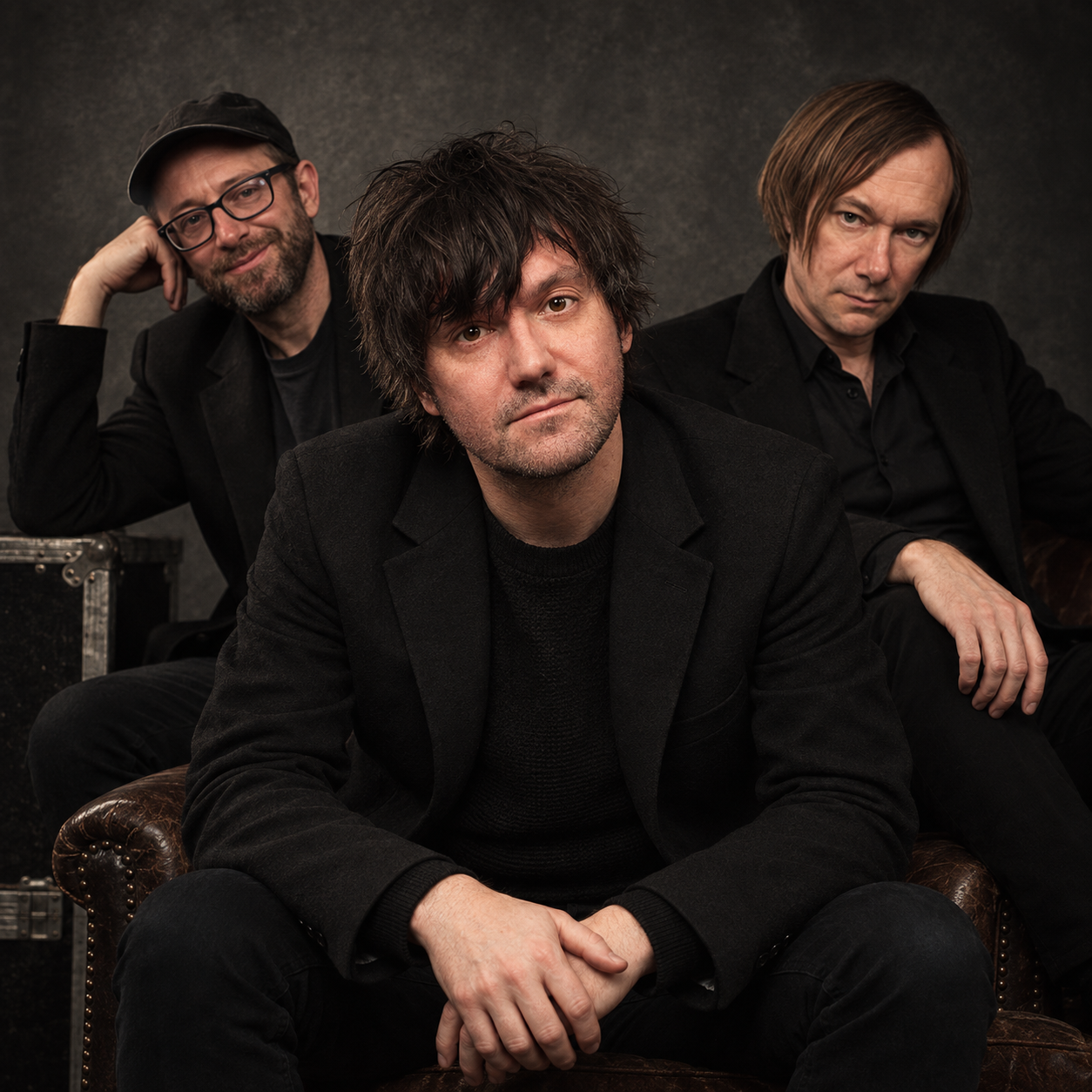
The first thing I notice with Bright Eyes is Conor Oberst’s voice. It is not polished, smooth or designed to disappear neatly into a beautiful recording. It shakes, tightens, breaks open and sometimes sounds as if the words are arriving a fraction faster than he can comfortably sing them. That quality has always divided listeners, but for me it is also the key to understanding Bright Eyes. The project began in an Omaha basement in 1995, when 15-year-old Conor Mullen Oberst started recording with producer and multi-instrumentalist Mike Mogis. Oberst was born on February 15, 1980, in Omaha, Nebraska, and had already been making music from a remarkably young age. What began largely as his recording name gradually became a real band, with Mogis and composer, arranger and multi-instrumentalist Nathaniel “Nate” Walcott becoming full members in 2006.
Oberst grew up hearing bands including The Cure, R.E.M., The Smiths and Fugazi through his older brothers, and I can hear something of that broad musical education in Bright Eyes. The songs can begin with nothing more complicated than acoustic guitar and voice, yet the arrangements are rarely afraid of noise, electronics, brass, strings or strange studio details. Early records were made with a changing group of musicians around Oberst, while Mogis increasingly became essential to shaping the sound. Releases such as Letting Off the Happiness in 1998 and Fevers and Mirrors in 2000 established a style that was intensely personal without being musically narrow. Then Lifted or The Story Is in the Soil, Keep Your Ear to the Ground in 2002 expanded the scale dramatically and brought Bright Eyes to a much wider audience.
From fragile recordings to a much bigger sound
For me, Fevers and Mirrors is one of the most useful records for understanding what made early Bright Eyes different. It is not an audiophile recording in the conventional sense of immaculate surfaces, huge pristine soundstage and luxurious production. What interests me instead is how much information is allowed to remain exposed. Acoustic instruments, piano, accordion and increasingly dense arrangements sit around a vocal that can move from a near whisper to something much more strained, sometimes within the same song. On a revealing pair of speakers or headphones, I hear the contrast between those small, intimate details and the moments when the music deliberately becomes crowded or uncomfortable. The album sometimes pushes its emotional mannerisms very hard, and I can understand listeners finding that excessive, but it is also where Oberst’s timing and phrasing became unmistakably his own.
The major turning point came in 2005, when Bright Eyes released I’m Wide Awake, It’s Morning and Digital Ash in a Digital Urn on the same day through Saddle Creek. I think that decision says a great deal about the band. Instead of choosing between the increasingly confident acoustic songwriting and their interest in electronic production, they made an album for each direction. Digital Ash uses beats, synthesizers and darker electronic textures, while I’m Wide Awake, It’s Morning is the album I would give first to somebody who has never heard Bright Eyes. Mike Mogis produced it, and guests included Emmylou Harris and Jim James, but it never feels like the guest list is the point. Songs such as “Lua,” “First Day of My Life” and “Poison Oak” succeed because the arrangements leave enough room for Oberst’s words and small changes in his delivery to matter.
On a good high-end audio system, I’m Wide Awake, It’s Morning is much more interesting than its apparently simple folk-rock surface suggests. Acoustic guitars have body rather than just string noise, voices sit at different depths in the stereo image, and the restrained sections make the larger dynamic moments feel earned rather than added for effect. I particularly like how Oberst rarely sings as if he is trying to produce a perfect vocal take. Breaths, changes in pressure and that familiar tremble remain part of the performance, which gives the midrange a very human focus. A highly transparent DAC or revealing headphones will expose imperfections, but in this case I would not want those imperfections cleaned away. The realism comes from personality rather than technical perfection.
A band that refused to stay in one style
Bright Eyes continued enlarging the musical frame with Cassadaga in 2007, bringing pedal steel, strings, brass and more elaborate arrangements into the picture, before The People’s Key arrived in 2011. That album was followed by an extended unofficial hiatus, during which Oberst continued working solo and with other projects while Mogis and Walcott remained active musicians and collaborators. The three stayed close, and Bright Eyes eventually resumed work together, releasing Down in the Weeds, Where the World Once Was through Dead Oceans in 2020. What I find important about that period is that the reunion did not simply try to recreate the sound of 2002 or 2005. The writing process became more collaborative, and the arrangements combined orchestral colour, electronic elements and the intimate songwriting that had always been at the centre of the group.
That willingness to keep moving is also why I find 2024’s Five Dice, All Threes worth hearing alongside the older classics. Bright Eyes produced the album themselves and recorded it principally at ARC Studios in Omaha, with Mogis again handling recording and mixing. Cat Power appears on “All Threes,” Matt Berninger of The National joins “The Time I Have Left,” and Alex Orange Drink helped write several songs and appears prominently on “Rainbow Overpass.” The record often feels rougher and more immediate than the carefully constructed Down in the Weeds. Horns, guitars, drums, voices and sudden changes of texture create a busy stereo picture, but there is still enough separation to follow Walcott’s keyboards and arrangements or Mogis’s pedal steel and stringed instruments. I like that Bright Eyes are not trying to sound younger here. The performances have age, fatigue, humour and experience in them, and that makes the record more convincing to me.
The band’s influence is easier to see now than it was during the early Saddle Creek years. Bright Eyes songs have been covered by artists including Phoebe Bridgers, Lorde, The Killers and beabadoobee, while Oberst’s intensely direct songwriting helped establish a vocabulary that later generations of indie singer-songwriters could recognise and build upon. Their own catalogue also keeps resisting a simple label. Folk, indie rock, country, orchestral pop and electronic production all appear, sometimes on neighbouring records and sometimes inside one song. The 2025 Kids Table EP, built partly from material connected to the Five Dice sessions, showed that the group was still actively developing that catalogue rather than treating Bright Eyes as a nostalgia project.
For a new listener, I would start with I’m Wide Awake, It’s Morning, move backwards to Fevers and Mirrors, and then jump forward to Five Dice, All Threes. That route makes the development very clear without turning the experience into a chronological homework assignment. Bright Eyes can sometimes be messy, emotionally exaggerated and deliberately uncomfortable, and Oberst’s voice will never be everybody’s idea of vocal beauty. For me, however, those qualities matter less than the way Oberst, Mogis and Walcott turn them into a recognisable musical language. Across the fragile early recordings, the clarity of the 2005 material and the fuller modern productions, the most important quality remains the same: emotional phrasing that sounds unmistakably human.
HiFi’ve, Ronald – Your EarFluencer
