
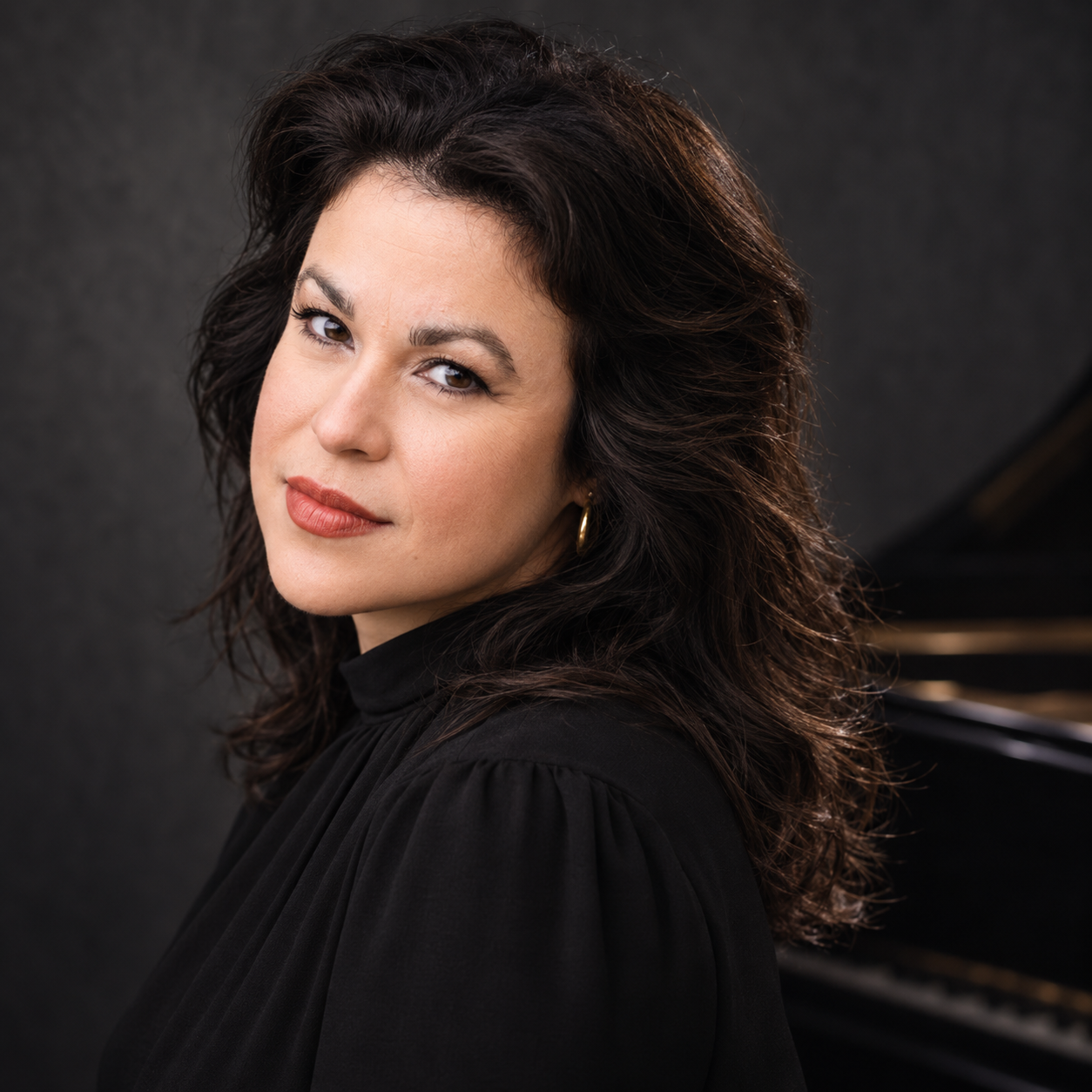
Champian Fultonó
GREAT CHOICE: Champian Fultonó!
Great music deserves to be discovered, enjoyed and shared.
CAN YOU SPARE A CUP OF COFFEE?
Audiophile-Streaming is a personal passion project, built with countless hours of discovering, selecting and sharing exceptional music.
I personally cover, without sponsors, the ongoing costs of hosting, software and subscriptions to keep the music discoveries coming. If you enjoy my work, your support is always appreciated.
A LITTLE THANK YOU IN RETURN
Just one coffee gives you lifetime access to the Coffee Club and all its playlists.
No subscriptions. No recurring fees.
The name on this page reads Champian Fultonó, but the artist behind it is American jazz pianist and vocalist Champian Fulton, and one of the first things I notice when listening to her is how naturally the piano and the voice belong together. She does not sound like a singer who happens to play piano, or a pianist who occasionally sings. The rhythm, phrasing and accents come from the same musical thought, and that gives her performances a relaxed confidence that I find very appealing. Fulton was born on September 12, 1985, in Norman, Oklahoma, into a musical family led by her father, jazz trumpeter and educator Stephen Fulton. She started piano lessons with her grandmother at five and grew up around musicians including Clark Terry, whose 75th birthday celebration became one of her first important performances when she was still a child.
Jazz was therefore not something Fulton discovered later in life. It was already part of the language around her. Her early listening included Dinah Washington, Sarah Vaughan and Nat King Cole, while pianists such as Art Tatum, Red Garland, Wynton Kelly, Bud Powell, Hampton Hawes, Sonny Clark and Thelonious Monk became important references. What interests me is that I can hear this history in her playing without feeling that she is simply copying it. The piano has a strong rhythmic centre, chords are placed with real purpose, and her right hand can become quick and playful without making the music feel crowded. Vocally she often works in a similarly economical way: she does not constantly push for drama, and the timing of a phrase can be more important than its volume.
After finishing high school, Fulton moved to New York in 2003 to study jazz piano and performance at the Conservatory of Music at SUNY Purchase, where trumpeter Jon Faddis was among her teachers. She graduated in 2006 and had already begun establishing herself in New York clubs, especially Birdland, where she became a regular presence. Her first professional recording work included David Berger and the Sultans of Swing, and her own recording career developed through labels including Venus Records, Gut String Records, Sharp Nine, Cellar Live, Posi-Tone and, more recently, Turtle Bay Records. Over the years she has performed with musicians including Lou Donaldson, Frank Wess, Jimmy Cobb, Louis Hayes, Scott Hamilton, Buster Williams and Nicholas Payton. That is an impressive list, but for me the more important point is that Fulton built her career inside the working jazz tradition, playing standards night after night and learning how songs can change when musicians really listen to one another.
When the piano gets the whole stage
One album that really helps me understand Champian Fulton is Speechless from 2017, her first recording for Posi-Tone and her first completely instrumental album. With bassist Adi Meyerson and drummer Ben Zweig, Fulton removed the voice from the equation and made it impossible to overlook what a serious pianist she is. Most of the programme consists of her own compositions, including “Day’s End,” “Dark Blue,” “Tea And Tangerines” and “Happy Camper.”
I particularly like the way Speechless avoids turning into a technical demonstration. There is plenty of speed and dexterity, but Fulton gives the bass and drums room and keeps the pulse easy to follow. On a revealing pair of speakers or good headphones, I listen closely to the attack of the piano notes and to the way the bass sits underneath them rather than fighting for space. “Dark Blue” shows another side of her playing, with more room between the phrases and a sense that she is thinking about the shape of the entire piece rather than filling every available second. For audiophile listening this is useful music because piano is notoriously unforgiving: poor reproduction can turn the instrument hard and mechanical, while a transparent system lets you hear differences in touch, weight and decay.
Bird, Birdland and a living tradition
Birdsong, released on August 28, 2020, is another important album because it shows how Fulton approaches jazz history. The record celebrates Charlie Parker around the centenary of his birth and features her regular musicians Hide Tanaka on bass and Fukushi Tainaka on drums, together with her father Stephen Fulton on flugelhorn and guest tenor saxophonist Scott Hamilton. The programme includes Parker-associated material such as “Yardbird Suite,” “Quasimodo” and “Bluebird,” alongside standards including “Just Friends,” “Star Eyes” and “My Old Flame.”
What I enjoy about Birdsong is that Fulton does not treat Parker’s music like museum material. There is respect, certainly, but the performances move. Scott Hamilton’s warm tenor changes the colour of the recording immediately, while Fulton’s piano keeps the rhythm alert underneath him. Her singing is especially interesting here because she rarely seems interested in showing how much she can do. She shapes the lyric, places words slightly ahead of or behind the beat, and then lets the band answer. On a good high-end audio system, that interaction is more important to me than spectacular sound effects. The pleasure comes from vocal realism, the body of the tenor saxophone, the piano occupying its own space and the small rhythmic cues between bass and drums.
The album I would probably give a new listener first, however, is Meet Me at Birdland, released in 2023 and recorded live at the Birdland Theater in New York in September 2022. Fulton performs with bassist Hide Tanaka and drummer Fukushi Tainaka, and the programme mixes standards with her own “Happy Camper.” Songs such as “Too Marvelous for Words,” “Evenin’,” “Just Friends,” “I’ve Got a Crush on You” and “Spring Can Really Hang You Up the Most” give a very complete picture of her musical personality. Birdland is particularly appropriate because Fulton began performing there soon after arriving in New York and has maintained a relationship with the club for more than two decades.
For me, Meet Me at Birdland also works extremely well as audiophile music because the live setting tells you something a studio recording cannot. You hear the trio reacting in real time, with the piano carrying both harmony and rhythm while Tanaka and Tainaka constantly adjust underneath it. The soundstage does not need exaggerated width to be convincing. What matters is that I can follow each musician and still hear one band rather than three separate audio demonstrations. Fulton’s voice has enough texture to reveal changes in microphone, amplifier, DAC or speaker presentation, but musically I am more interested in her timing. She can stretch a phrase without losing the swing, which is much harder than simply singing louder.
Fulton has continued working in exactly that spirit. Her 2026 album House Party, released by Turtle Bay Records on April 10, was recorded live during an intimate gathering in New York with her longtime trio of Hide Tanaka and Fukushi Tainaka, joined on selected tracks by saxophonists Klas Lindquist and Cory Weeds. The album includes “Stardust,” Wayne Shorter’s “One by One,” Cole Porter’s “Get Out of Town” and Charlie Parker’s “Billie’s Bounce,” again connecting different parts of the jazz tradition without pretending that the music belongs only to the past.
When I put the biography, Speechless, Birdsong, Meet Me at Birdland and the more recent House Party together, I hear an artist with a very clear idea of what jazz should do. Champian Fulton respects the language she inherited, but she understands that swing only works when musicians are actively responding to one another. Her singing is direct and recognisable, her piano playing has far more depth than someone hearing only a vocal track might expect, and her best recordings reward both musical attention and a revealing audio system. I would start with Meet Me at Birdland for the complete picture, then move to Speechless to hear how much of her identity actually comes from the piano. More than anything else, it is her sense of timing, that easy but precise relationship with the beat, that explains why I rate her so highly.
HiFi’ve, Ronald – Your EarFluencer
