
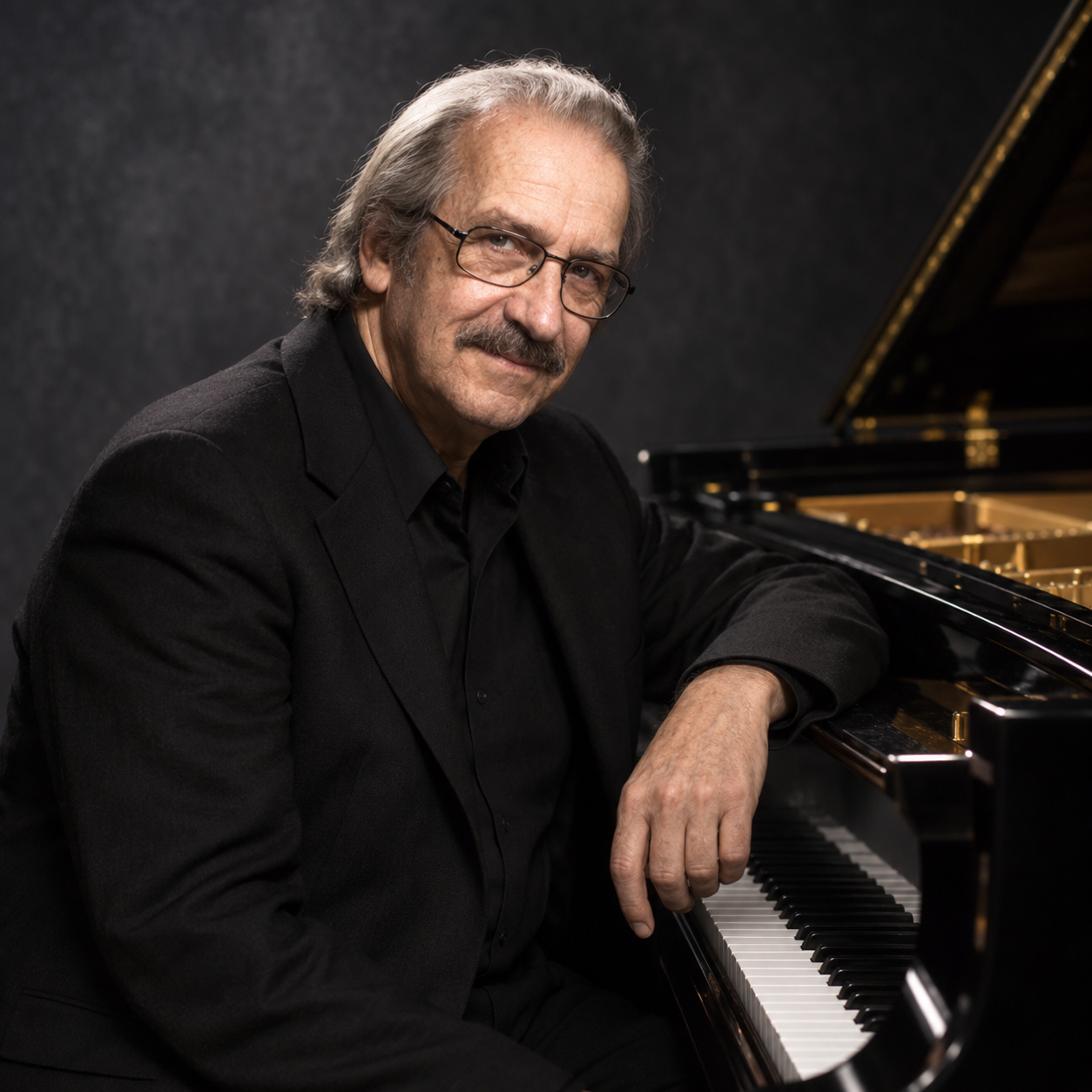
Claude Williamson
GREAT CHOICE: Claude Williamson!
Great music deserves to be discovered, enjoyed and shared.
CAN YOU SPARE A CUP OF COFFEE?
Audiophile-Streaming is a personal passion project, built with countless hours of discovering, selecting and sharing exceptional music.
I personally cover, without sponsors, the ongoing costs of hosting, software and subscriptions to keep the music discoveries coming. If you enjoy my work, your support is always appreciated.
A LITTLE THANK YOU IN RETURN
Just one coffee gives you lifetime access to the Coffee Club and all its playlists.
No subscriptions. No recurring fees.
Claude Williamson could make a bebop piano line move at serious speed without ever letting it sound hurried. That is the first thing I notice when I listen to him. His right hand can fire off long, agile phrases, but underneath all that movement there is control, balance and a very clear sense of swing. The influence of Bud Powell is easy to hear, yet Williamson never sounds like a copy. Claude Berkeley Williamson was born on November 18, 1926, in Brattleboro, Vermont, and began playing piano as a child before receiving years of classical training and studying at the New England Conservatory of Music in Boston. That combination of discipline and bebop instinct became one of the defining features of his playing, especially after he entered the very different world of West Coast jazz.
By the late 1940s Williamson had moved to California and was already working with musicians including Red Norvo and Charlie Barnet. Barnet even featured him on a piece called “Claude Reigns”, an early indication that Williamson was not simply another pianist sitting anonymously inside a big band. He subsequently worked with singer June Christy and became closely associated with Howard Rumsey’s Lighthouse All-Stars in Hermosa Beach, one of the central groups in the development of West Coast jazz. His circle included Bud Shank, Bob Cooper, Conte Candoli, Stan Levey and other musicians who were shaping the Los Angeles jazz scene, while Williamson also recorded or performed with artists such as Art Pepper and Barney Kessel. He later became an important part of Bud Shank’s quartet, but what interests me is that the surroundings never completely softened his playing. Underneath the relaxed California atmosphere there was always that East Coast bebop vocabulary.
Bebop With a West Coast Sense of Space
A very good place to hear the young Williamson is Kenton Jazz Presents Claude Williamson, recorded for Capitol in Los Angeles in June 1954 with bassist Curtis Counce and drummer Stan Levey. Pieces such as “Woody’n You”, “Obsession” and “All God’s Children Got Rhythm” show how naturally he could work inside a piano trio. His right hand has the quick articulation I associate with bebop, but he leaves enough room for Counce and Levey to remain active participants rather than simply providing support. Williamson’s timing is especially attractive to me. He can place a phrase slightly ahead of where I expect it, then relax immediately afterwards, giving the music momentum without making it sound rushed.
This is also a recording where I would concentrate more on musical communication than spectacular audiophile effects. The presentation is compact and direct, as I expect from a mid-1950s jazz session, but a revealing system still lets you hear the character of Williamson’s attack and the separation between piano, bass and drums. Through good speakers or transparent headphones, the attraction is in the small differences between a firmly struck note and a lighter connecting phrase. He does not make every note equally important. That dynamic control is one of the reasons his fast passages remain musical rather than becoming a blur.
The sessions that became ‘Round Midnight were recorded for Bethlehem in Hollywood in December 1956, with Red Mitchell on bass and Mel Lewis on drums. For me, this is one of the strongest introductions to Williamson because the repertoire gives him plenty of familiar material without restricting his personality. “Stella by Starlight”, Horace Silver’s “Hippy” and Thelonious Monk’s “‘Round Midnight” all reveal different sides of his playing. On the title piece I particularly enjoy the contrast between the well-known melody and Williamson’s clean, economical movement around it. He respects the tune, but he does not treat it as something fragile.
Red Mitchell and Mel Lewis are also important to why the album works so well. Mitchell gives the trio a strong melodic bottom end, while Lewis can make the rhythm move with remarkably little apparent effort. Williamson sits comfortably between them, never dominating simply because he is the pianist. When I listen on a transparent system, it is the interaction that holds my attention rather than any attempt at a huge soundstage or exaggerated detail. The recording lets me concentrate on timing, touch and the natural rise and fall of three musicians responding to each other.
The Bud Powell Connection
Bud Powell was one of Williamson’s major influences, and it is impossible to understand his musical personality without hearing that connection. Williamson did not simply copy Powell’s vocabulary, though. His playing often feels more measured, with slightly more air around the phrases and a sense of control that fits naturally with the West Coast musicians around him. I hear Powell in the rapid single-note runs, the rhythmic accents and the way Williamson can suddenly turn a straightforward standard into something much more harmonically active. What makes repeated listening worthwhile is hearing where the influence ends and Williamson’s own sense of proportion begins.
That makes the 1995 album Hallucinations especially revealing. Recorded in Hollywood with bassist Dave Carpenter and drummer Paul Kreibich and released by V.S.O.P. Records, it was devoted to music associated with Bud Powell and included Powell compositions such as “Hallucinations”, “Parisian Thoroughfare” and “Bouncing with Bud”. By this point Williamson had been playing professionally for nearly half a century, yet there is nothing tentative about the performance. The rhythmic confidence is still there, as is the ability to move quickly without losing the shape of a phrase.
I find Hallucinations particularly useful because it removes any suspicion that Williamson’s early energy was simply the product of youth or the excitement surrounding the 1950s West Coast scene. His musical priorities remained remarkably consistent. The later recording also gives the trio more room to breathe, which makes it easier on a good high-end audio system to follow Carpenter’s bass lines and Kreibich’s percussion while Williamson works across the keyboard. It is excellent reference music for timing and midrange clarity, but I would not reduce it to an audiophile demonstration. The real pleasure is hearing an older musician revisit one of his original inspirations without trying to impersonate him.
Williamson spent much of the 1960s and 1970s working in the Los Angeles studio world rather than maintaining the highly visible jazz career he had enjoyed during the previous decade. He returned more actively to jazz recording later, and interest from Japan played an important part in that renewed period of his career. He continued performing and recording well into later life, with labels including Interplay, Venus and Fresh Sound documenting different stages of his playing. Claude Williamson died on July 16, 2016, at the age of 89, in Sunland, California. By then his career connected several very different periods of American jazz, from the big-band years through West Coast cool and into the later rediscovery of straight-ahead piano jazz.
For somebody discovering Claude Williamson today, I would start with ‘Round Midnight, then move backwards to Kenton Jazz Presents Claude Williamson and forwards to Hallucinations. Together they show why I think he deserves more attention than he usually receives. He was not trying to reinvent jazz every few years, and listeners looking for radical changes of style may find his musical world quite consistent. For me that consistency is actually part of the attraction because it allows you to hear how his experience deepened a language he understood extremely well. From his Vermont beginnings and classical studies to Charlie Barnet, the Lighthouse All-Stars, Bud Shank and his later trio recordings, the same musical identity remains recognisable. The quality that finally defines Claude Williamson for me is his rhythmic clarity: fast, swinging piano playing in which every phrase still seems to know exactly where it is going.
HiFi’ve, Ronald – Your EarFluencer
