
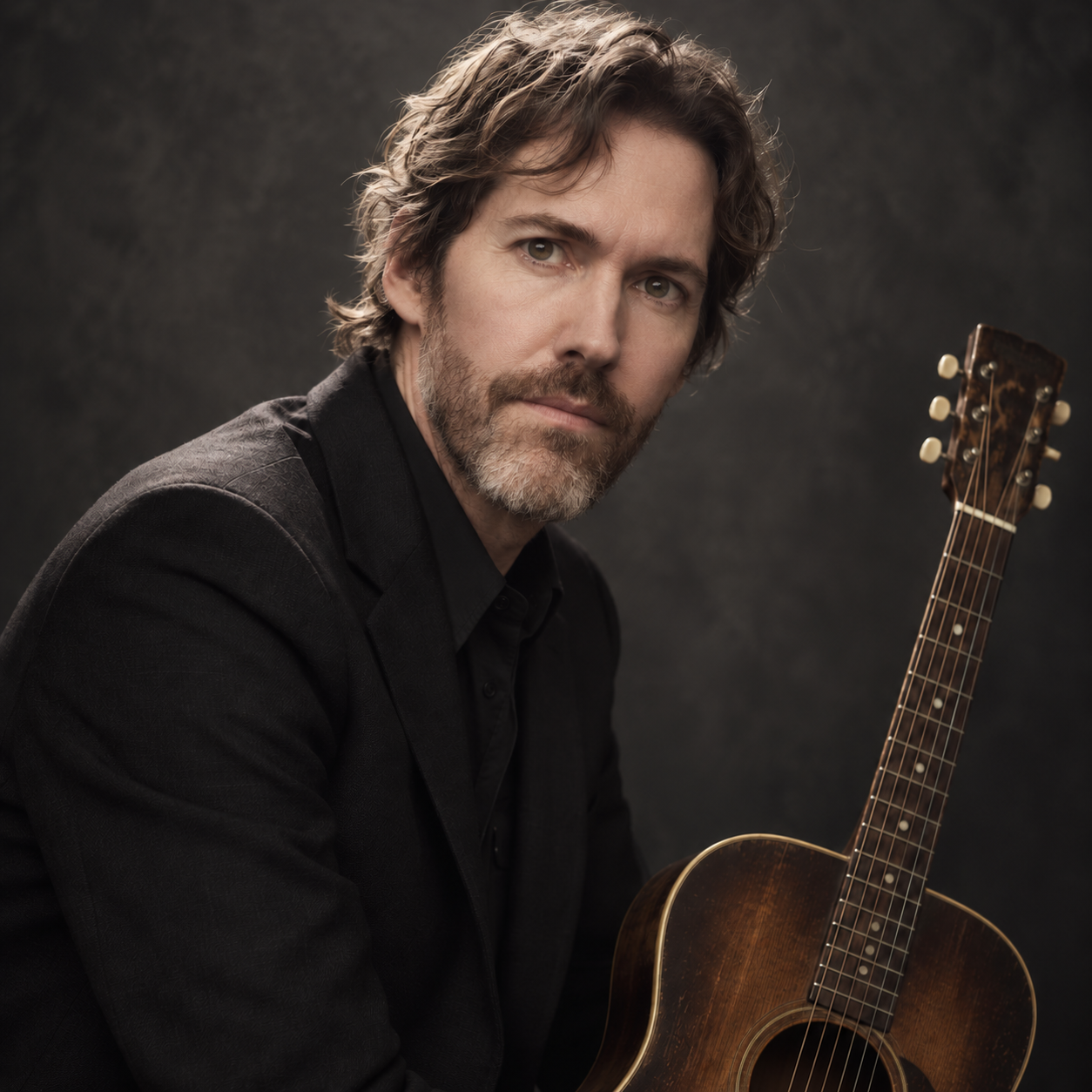
David Rawlings
GREAT CHOICE: David Rawlings!
Great music deserves to be discovered, enjoyed and shared.
CAN YOU SPARE A CUP OF COFFEE?
Audiophile-Streaming is a personal passion project, built with countless hours of discovering, selecting and sharing exceptional music.
I personally cover, without sponsors, the ongoing costs of hosting, software and subscriptions to keep the music discoveries coming. If you enjoy my work, your support is always appreciated.
A LITTLE THANK YOU IN RETURN
Just one coffee gives you lifetime access to the Coffee Club and all its playlists.
No subscriptions. No recurring fees.
David Rawlings has one of those guitar sounds I recognise within seconds. It is lean, woody and slightly wiry, with notes that seem to arrive from somewhere between old-time country, folk and bluegrass without becoming trapped in any of them. Rawlings, born David Todd Rawlings on December 30, 1969, in North Smithfield, Rhode Island, is best known for his long musical partnership with Gillian Welch, but reducing him to somebody standing beside Welch seriously understates his importance. He is a guitarist, singer, songwriter and producer whose playing has helped define their shared sound for more than three decades. For me, the fascinating thing about David Rawlings is how much musical information he can put into a relatively sparse arrangement without making it feel complicated.
Rawlings and Welch met while studying at Berklee College of Music, and the partnership that followed became one of the most distinctive in modern American roots music. Their approach has always interested me because it avoids the polished, oversized production that can make contemporary Americana feel too comfortable. Voices remain human, acoustic instruments retain their edges and the arrangements leave plenty of room between individual notes. Rawlings is particularly important to that character. His guitar does not simply accompany Welch’s voice; it responds to it, interrupts it, supports it and sometimes seems to pull a song in an entirely different direction.
From partner to frontman
Rawlings eventually placed himself more visibly at the centre with Dave Rawlings Machine. The first album, A Friend of a Friend, appeared on Acony Records in 2009 and was produced by Rawlings himself. Gillian Welch was naturally involved, alongside musicians including Willie Watson, Ketch Secor, Benmont Tench, Nate Walcott, Kevin Hayes, Morgan Jahnig and Karl Himmel. It is a very good introduction to the way Rawlings thinks about songs because originals, co-written material and interpretations are treated as parts of the same musical language rather than separate categories.
One of my favourite moments on that album is the pairing of Bright Eyes’ “Method Acting” with Neil Young’s “Cortez the Killer.” On paper it looks like an unusual combination, yet Rawlings makes the transition feel remarkably natural. What I notice first is not virtuosity for its own sake but the conversation between voice and guitar. His phrasing is deliberately unpredictable, with little pauses and sudden runs that keep the performance moving without disturbing its relaxed character. On a revealing system, the guitar sits clearly in its own space, but I never feel that the recording is trying to turn every string vibration into an audiophile demonstration.
To Be Young (Is to Be Sad, Is to Be High) is another useful example. Rawlings had previously co-written the song with Ryan Adams, and here it sounds completely at home within the Dave Rawlings Machine vocabulary. The performance has energy without becoming aggressive, and the acoustic instruments retain enough bite to keep the rhythm alive. This is where I think Rawlings is particularly good. He understands that acoustic music needs attack and movement, not just warmth. Too much softness would take away the tension that makes these performances work.
The second Dave Rawlings Machine album, Nashville Obsolete, followed in 2015. Rawlings produced it, with Welch, Willie Watson, Paul Kowert, Brittany Haas and Jordan Tice among the musicians. The album was recorded on analog tape at Woodland Studios in Nashville, and that recording method suits the music beautifully. There is body around the voices and instruments, but the presentation remains open rather than thick. The later vinyl edition was mastered through Welch and Rawlings’ custom Ortofon amplification and Neumann VMS-80 cutting system, another indication of how closely they are involved with the physical sound of their records.
“The Weekend” is probably the easiest entry point into Nashville Obsolete. I like the way the arrangement feels loose while remaining tightly controlled underneath. Voices spread naturally across the stereo image and the instruments have enough separation for me to follow individual parts without the performance becoming dissected. The much longer “The Trip” is more demanding, but also more revealing of Rawlings’ strengths. Nearly eleven minutes gives the musicians room to develop ideas gradually, and I find myself listening to the tiny changes in guitar phrasing and dynamics as much as to the song itself. It is not background music, and I mean that as a compliment.
Poor David’s Almanack
In 2017 Rawlings released Poor David’s Almanack simply under the name David Rawlings rather than Dave Rawlings Machine. Again released through Acony Records, it brought together Gillian Welch, Willie Watson, Paul Kowert, Brittany Haas, Ketch Secor and Taylor and Griffin Goldsmith. Ken Scott and Matt Andrews recorded the album on analog tape during a week-long session at Woodland Sound Studios in Nashville. That combination of experienced musicians, analog recording and relatively direct arrangements gives the album a wonderfully immediate character.
“Cumberland Gap” is the track I would use to explain David Rawlings to somebody unfamiliar with his music. Rawlings and Welch received a Grammy nomination for Best American Roots Song for it, and I can understand why. The song moves with real urgency, but nothing feels artificially pushed forward. The guitar has a dry, fast attack, the vocal harmonies are easy to distinguish and the rhythm has a physical quality that good speakers reproduce especially well. There is plenty for an audiophile listener to enjoy, but the recording never distracts me from the performance.
“Midnight Train” shows another side of the album. The playing feels almost casually precise, which is one of Rawlings’ great tricks. Listen closely and there is a lot happening, yet the musicians never sound as though they are competing for space. Through headphones, I particularly notice how clearly the different textures separate without becoming unnaturally isolated. Through speakers, the greater pleasure for me is the sense of musicians occupying one believable performance area rather than a collection of individually highlighted tracks.
What also matters is that Rawlings’ musical world has never really been separate from Gillian Welch’s. Their names may alternate at the top of album covers, but the creative partnership runs through both catalogues. Rawlings produced important Welch albums including The Harrow & the Harvest, while their joint releases later made that partnership explicit. All the Good Times won the Grammy for Best Folk Album in 2021, and Woodland, recorded at their own Woodland Sound Studios in Nashville and produced by Rawlings, won the same category at the 2025 Grammy Awards. For me, those awards are less interesting than the consistency behind them. They have built a recognisable musical identity without simply making the same record repeatedly.
The 2024 album Woodland also demonstrates how naturally their roles can shift. On “Empty Trainload of Sky,” the voices and instruments have the kind of breathing space I associate with their best recordings. Nothing feels crowded into the centre, and small changes in vocal level or guitar pressure remain audible without being exaggerated. Rawlings’ production serves the song first, which is exactly what I want from an audiophile recording. Transparency is useful only when there is something worth hearing through it.
David Rawlings interests me because he combines musicianship, songwriting and recording craft without treating any one of them as the main attraction. His 1930s-influenced guitar vocabulary can sound old, but his choices rarely feel nostalgic for nostalgia’s sake. From A Friend of a Friend and Nashville Obsolete to Poor David’s Almanack and the later albums with Gillian Welch, I hear an artist who understands how much character can be created with very little clutter. What I value most is that precision never removes the human element. The guitar can be intricate, the recording can be exceptionally clear and the musicians can be outstanding, but the song always remains the reason for listening.
HiFi’ve, Ronald – Your EarFluencer
