
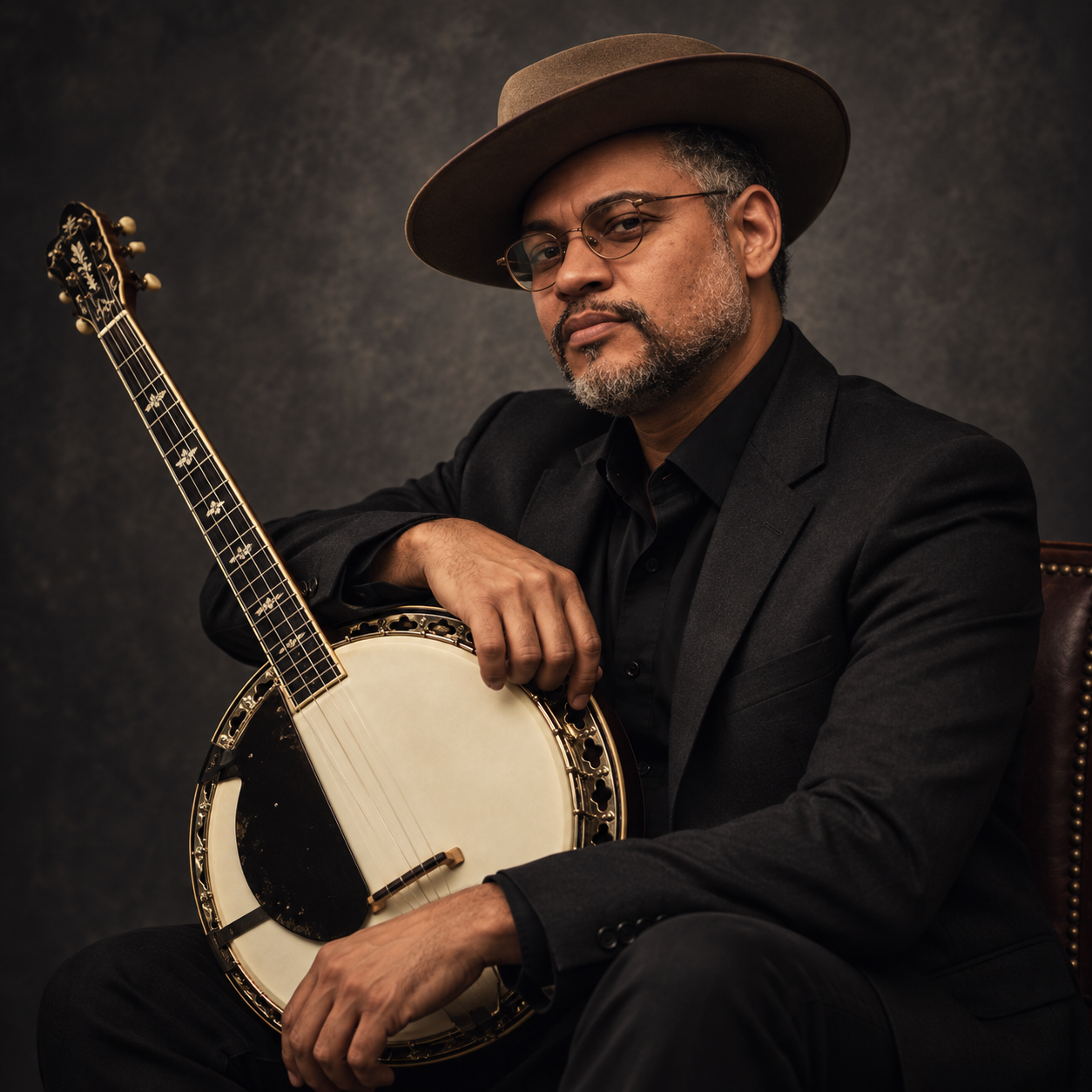
Don Flemons
GREAT CHOICE: Don Flemons!
Great music deserves to be discovered, enjoyed and shared.
CAN YOU SPARE A CUP OF COFFEE?
Audiophile-Streaming is a personal passion project, built with countless hours of discovering, selecting and sharing exceptional music.
I personally cover, without sponsors, the ongoing costs of hosting, software and subscriptions to keep the music discoveries coming. If you enjoy my work, your support is always appreciated.
A LITTLE THANK YOU IN RETURN
Just one coffee gives you lifetime access to the Coffee Club and all its playlists.
No subscriptions. No recurring fees.
Give Dom Flemons a banjo, a guitar, a pair of rhythm bones or simply a strong song, and one thing becomes clear very quickly: he understands rhythm at a level that makes old American music feel completely alive. The WordPress title says Don Flemons, but the artist is Dom Flemons, born Dominique Flemons on August 30, 1982, in Phoenix, Arizona. He sings, plays guitar, banjo, harmonica, percussion, rhythm bones and several less familiar traditional instruments, but I never hear him as a musician showing off a collection of skills. What draws me in is the way he connects blues, folk, country, old-time string-band music and the history of the American West without making any of it sound academic. His voice can be relaxed, dry and conversational, then suddenly more forceful, while his timing keeps everything moving. That combination of historical knowledge, rhythmic instinct and direct musicianship is what makes Flemons such a distinctive artist for me.
From the Carolina Chocolate Drops to the American Songster
A crucial turning point came in 2005 when Flemons co-founded the Carolina Chocolate Drops with Rhiannon Giddens and Justin Robinson. The group developed after musicians connected through the Black Banjo Gathering in North Carolina and studied with veteran African American fiddler Joe Thompson. Their work brought renewed attention to the often overlooked Black history of American string-band music, while refusing to treat that tradition as something frozen in the past. The Carolina Chocolate Drops’ 2010 album Genuine Negro Jig won the Grammy Award for Best Traditional Folk Album, and I think the record remains important because of the energy with which the group approached traditional repertoire. Flemons could be scholarly about the source material, but when the playing began, scholarship never replaced rhythm, timing or entertainment.
That approach also explains the nickname Flemons uses, The American Songster. It suits him better than a narrower label such as blues musician or folk singer because his interests cross so many parts of American roots music. His influences and collaborations have included musicians such as Taj Mahal, Old Crow Medicine Show, Guy Davis and numerous traditional artists associated with the Music Maker Foundation. His work with Music Maker also put him in contact with performers including John Dee Holeman, Boo Hanks and other musicians whose music existed outside the mainstream recording industry. Flemons has described those encounters as an education, and I can hear the result in his solo work. He does not simply imitate an older style. He listens to how those musicians shaped rhythm, phrased a lyric and allowed a performance to breathe, and then uses those ideas in his own way.
His 2014 solo album Prospect Hill, released through Music Maker, is an especially useful bridge between the ensemble musician people knew from the Carolina Chocolate Drops and the independent artist Flemons was becoming. The album draws from blues, folk and older American song traditions while making room for Flemons’ own musical personality. What I enjoy most is the physical quality of the performances. Guitar strings, percussion and voice are not polished into a perfectly smooth surface, and that is a strength. On a transparent system, the small rhythmic accents become part of the pleasure because I can hear how much of Flemons’ music depends on timing rather than sheer instrumental complexity.
Black Cowboys
For me, Dom Flemons Presents Black Cowboys from 2018 is where his combination of musician and researcher becomes particularly powerful. Released by Smithsonian Folkways Recordings, the album explores African American involvement in the history and music of the American West. Instead of simply making a collection of cowboy standards, Flemons connects songs, spoken material and historical research to people whose presence in the story of the West was often minimized or forgotten. The project earned a Grammy nomination for Best Contemporary Folk Album, but its importance goes beyond awards. It showed how historical research could become the starting point for genuinely enjoyable recorded music.
Listen to his version of “Going Down the Road Feelin’ Bad” and the first thing I hear is movement. Flemons does not overload the song. The rhythm carries it forward, his vocal delivery feels relaxed but purposeful, and the arrangement gives each instrument enough space to be heard clearly. This is very good material for an audiophile system because the pleasure comes from texture and timing rather than spectacular production tricks. With good midrange transparency, the voice feels immediate, while the attack of the strings and percussion reveals how carefully the groove is controlled. I particularly like that Flemons never seems to be demonstrating how authentic he can sound. He simply performs the song.
“Steel Pony Blues” is another track from Black Cowboys that helps explain Flemons’ strength. Its subject connects the traditions of the railroad, the West and African American blues, but musically it remains easy to enter. There is an unforced quality to Flemons’ singing that I appreciate increasingly with repeated listening. He can sound conversational one moment and surprisingly forceful the next without dramatically changing volume. On headphones or revealing speakers, that phrasing becomes more obvious because you can hear how he works around the rhythm instead of landing mechanically on every beat.
I also like the way Black Cowboys sounds as a complete album. Smithsonian Folkways recordings generally place the musical information ahead of studio spectacle, and that suits Flemons extremely well. Instruments have recognisable size and character, the stereo image is easy to follow, and there is enough recording-space information to make the performances feel human. This is not the sort of reference music I would use to show somebody an enormous artificial soundstage. I would use it to demonstrate vocal realism, acoustic texture and the difference good equipment can make to seemingly simple arrangements. A revealing DAC or amplifier does not make these recordings more impressive so much as more understandable.
Traveling Wildfire
The 2023 Smithsonian Folkways album Traveling Wildfire shows another important side of Flemons. Here the emphasis moves more clearly toward his own songwriting, with producer Ted Hutt helping him build a broader sound around country, western, blues, folk, Americana and bluegrass influences. The record received another Grammy nomination for Best Contemporary Folk Album, and I hear it as a more personal work than Black Cowboys. Flemons is still aware of history, but he no longer needs history to be the main subject. Songs about love, family, survival and change put the songwriter himself closer to the centre.
The title track, “Traveling Wildfire,” is one of my favourite examples of this development. Flemons sings and plays electric guitar and bass drum, with organ and pedal steel adding colour around him. The six-minute performance is spacious enough to let those parts develop gradually instead of competing for attention. On a good stereo system I enjoy listening to the separation between the solid central vocal, the guitar and the softer instrumental layers around it. The pedal steel is especially effective because it adds atmosphere without turning the song into exaggerated country nostalgia. Flemons sounds completely comfortable inside the arrangement.
“If You Truly Love Me” reveals an even more intimate side. Flemons handles lead vocal, acoustic guitar, electric bass, harmonica and bass drum, with pedal steel and backing vocals supporting him. I like the warmth of the performance and the way his voice remains unmistakably human rather than being polished into something unnaturally perfect. There is texture in the vocal and a slight roughness around certain phrases that improves the emotional connection for me. With high-end audio equipment, the reward is not extreme bass or huge dynamics but the ability to follow those small variations in voice, guitar and harmonica. It is exactly the kind of recording where better midrange reproduction matters.
What I admire most about Dom Flemons is that his respect for history never limits him. His years with the Carolina Chocolate Drops helped bring Black string-band traditions to a much wider audience, Black Cowboys expanded the public conversation about African American music in the West, and Traveling Wildfire demonstrated that he is also a serious songwriter with a voice of his own. For somebody discovering him for the first time, I would begin with Black Cowboys because it brings together his historical curiosity, instrumental skill and natural ability as an entertainer, and then move to Traveling Wildfire to hear how personal his music can become. His recordings also reward good speakers and headphones because so much happens in the small details of timing, acoustic texture and vocal phrasing. Above everything else, it is that relaxed but extremely precise sense of rhythm that defines Dom Flemons for me.
HiFi’ve, Ronald – Your EarFluencer
