
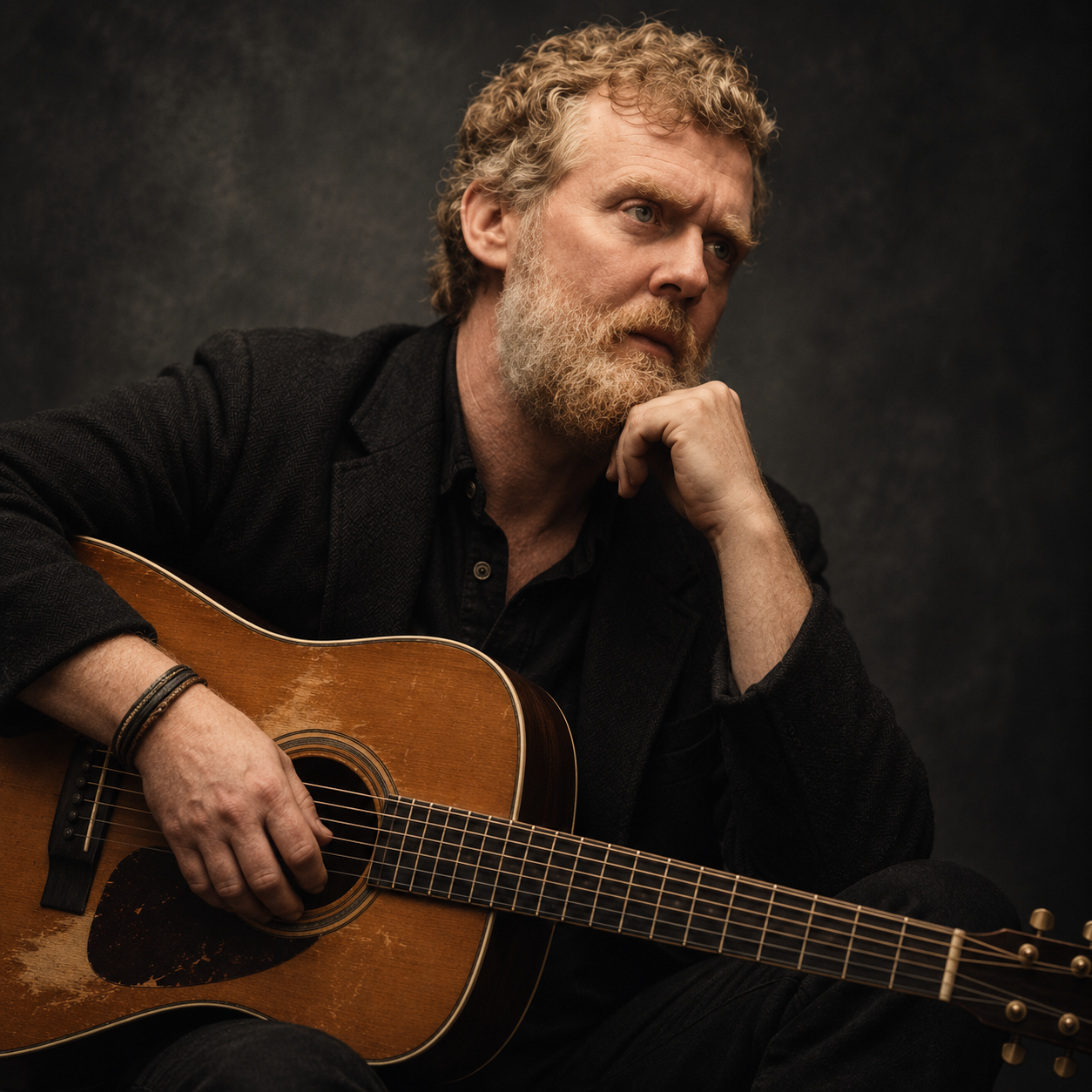
Glen Hansard
GREAT CHOICE: Glen Hansard!
Great music deserves to be discovered, enjoyed and shared.
CAN YOU SPARE A CUP OF COFFEE?
Audiophile-Streaming is a personal passion project, built with countless hours of discovering, selecting and sharing exceptional music.
I personally cover, without sponsors, the ongoing costs of hosting, software and subscriptions to keep the music discoveries coming. If you enjoy my work, your support is always appreciated.
A LITTLE THANK YOU IN RETURN
Just one coffee gives you lifetime access to the Coffee Club and all its playlists.
No subscriptions. No recurring fees.
There is a moment in many Glen Hansard recordings when his voice stops sounding controlled and starts sounding necessary. He can begin almost conversationally, close to the microphone, then push until the grain in his voice becomes part of the rhythm of the song. That contrast is one of the things I value most about his music because it never feels like vocal technique for its own sake. Glen James Hansard was born on 21 April 1970 in Dublin, Ireland, and grew up in Ballymun. He died in Dublin on 29 July 2026, aged 56, following a road traffic accident. His death brought an abrupt end to a career that had moved from Dublin street busking to The Frames, The Swell Season, an Academy Award, a substantial solo catalogue and, right up to his final years, new music made with the same directness that had defined him from the beginning.
Hansard left school at 13 and spent important formative years busking on the streets of Dublin. He learned songs by artists including Leonard Cohen, Bob Dylan and Van Morrison, influences that make sense when I listen to the importance he places on words, phrasing and the gradual build of a performance. After a demo attracted the attention of Denny Cordell, Hansard signed to Island Records and formed The Frames in Dublin in 1990. He also appeared as guitarist Outspan Foster in Alan Parker’s 1991 film The Commitments, but acting never became the centre of his career. The Frames were where he developed as a songwriter and bandleader, moving through alternative rock, folk and quieter singer-songwriter territory while building a particularly strong following in Ireland.
From The Frames to a More Intimate Sound
For me, For the Birds from 2001 is an important point in understanding Hansard. Released through The Frames’ own Plateau Records, it showed a band interested in space and restraint rather than simply pushing everything forward with guitars. Parts of the album were recorded with Steve Albini, alongside work by Craig Ward and David Odlum, yet what catches my attention is how natural and unforced much of it sounds. On a good system, tracks such as “What Happens When the Heart Just Stops” and “Santa Maria” allow guitars, violin, bass and voice to exist separately instead of collapsing into one dense centre image. Hansard’s voice can move from vulnerable to rough within a few seconds, and that change in texture is very revealing through transparent speakers or headphones.
That ability to build intensity without losing the feeling of a real person singing became one of his trademarks. Hansard was never what I would call a perfectly polished vocalist, and I mean that as a strength. You hear breath, strain, changes in distance from the microphone and the point where a quiet line becomes almost a shout. With lesser material that kind of emotional escalation could easily become predictable, but at his best he understands timing remarkably well. He often waits longer than expected before increasing the dynamics, which gives the louder passages their impact.
The next major change came through his collaboration with Czech musician Markéta Irglová. They released The Swell Season in 2006 and subsequently appeared together in John Carney’s 2007 independent film Once, with music becoming as important to the film as the characters themselves. “Falling Slowly,” written by Hansard and Irglová, won the Academy Award for Best Original Song at the 2008 ceremony. The achievement obviously brought Hansard to a much larger international audience, but I think the song deserves attention separately from the Oscar because its construction is so economical. Piano and acoustic guitar create the foundation, the two voices do not compete for attention, and the gradual increase in weight feels earned rather than added simply to create a climax.
“Falling Slowly” is also useful audiophile music because the attraction lies in very ordinary things being reproduced convincingly. I listen to the texture of Hansard’s voice, the softer contrast of Irglová’s vocal, the physical attack of the guitar strings and the way the performance opens as both singers increase their intensity. A good DAC, amplifier and pair of speakers should not turn this into a spectacular recording. They should preserve the differences between the two voices and let the emotional movement happen naturally. If a system makes the opening sound too smooth or the climax too hard, something important in the performance disappears.
Finding His Own Space
After The Swell Season’s second album, Strict Joy, in 2009, Hansard eventually made the move to a solo album. Rhythm and Repose, released by ANTI- Records on 19 June 2012, was his first full solo record and had been recorded in New York in 2011. It is probably the album I would recommend first to someone who knows “Falling Slowly” but wants to understand Hansard beyond Once. The arrangements give his voice plenty of room while adding piano, strings, bass and drums without making the record feel overloaded. Musicians including Thomas Bartlett, Rob Moose and Bryan Devendorf appear on the sessions, with Irglová also contributing backing vocals.
“Bird of Sorrow” is one of the performances on Rhythm and Repose that makes the album particularly valuable to me. Hansard does not reveal everything immediately. The song develops patiently, and his vocal becomes more exposed and forceful as it progresses, so dynamic behaviour matters far more than sheer recording volume. I like listening to whether a system keeps his voice solid and believable as the intensity increases, rather than flattening the louder passages or making the upper midrange aggressive. “Song of Good Hope” takes a different approach, with acoustic guitar, voice and strings creating a more restrained presentation, and it shows that Hansard could be just as convincing when he resisted the urge to push.
His solo career continued to expand rather than settle into one fixed sound. Didn’t He Ramble followed in 2015, Between Two Shores in 2018 was the first solo album he produced himself, and This Wild Willing in 2019 moved between intimate songwriting and more experimental, sometimes rougher textures. His fifth solo album, All That Was East Is West of Me Now, arrived on ANTI- Records on 20 October 2023. It developed from a series of small word-of-mouth performances Hansard gave in a local pub in November 2022 before he and longtime collaborator David Odlum recorded the material near Dublin. I hear in that later work an artist who had become less interested in making every sound comfortable. Electric guitars can become abrasive, arrangements can widen suddenly, and quieter passages are given enough room for the recording space itself to become audible.
Hansard also maintained the musical connection with Irglová. The Swell Season returned with Forward in July 2025, their first full-length album together in sixteen years. What I find significant about that reunion is that it did not attempt to recreate two people from the Once period. Their voices had changed, their lives had changed, and the recordings allowed that maturity to be heard. Hansard’s later voice carried more grain and weight, while Irglová’s presence provided a cleaner contrast, and that difference made their interaction more interesting rather than less.
For audiophile listeners, Hansard’s catalogue offers something more useful than recordings designed merely to demonstrate equipment. The best material exposes vocal realism, midrange transparency, dynamics and the ability of a system to reproduce emotional intensity without exaggerating it. Acoustic guitars should have wood and string rather than just brightness, quieter vocals need body at low level, and when Hansard pushes his voice the system needs to preserve the roughness without turning it into glare. There are recordings in his catalogue that are deliberately dense or raw, so I would not describe everything he made as conventional reference music. That is part of the attraction because high-end audio should also tell us what an artist and producer actually chose to put on the recording.
Glen Hansard’s career makes sense to me when I connect the boy busking in Dublin, the leader of The Frames, the partnership with Markéta Irglová and the increasingly independent solo artist. For the Birds shows how much he understood space and restraint, “Falling Slowly” demonstrates how effectively he could build emotion from very simple ingredients, and Rhythm and Repose proves that his identity remained strong when he finally stepped forward under his own name. His later records kept testing the boundaries of that identity, while Forward showed that an old collaboration could develop instead of simply becoming nostalgic. His death on 29 July 2026 makes the catalogue finite now, but I do not think it needs to be inflated into legend to explain his importance. What convinces me most is something much simpler: Glen Hansard knew exactly how long to hold something back before letting his voice break open.
HiFi’ve, Ronald – Your EarFluencer
