
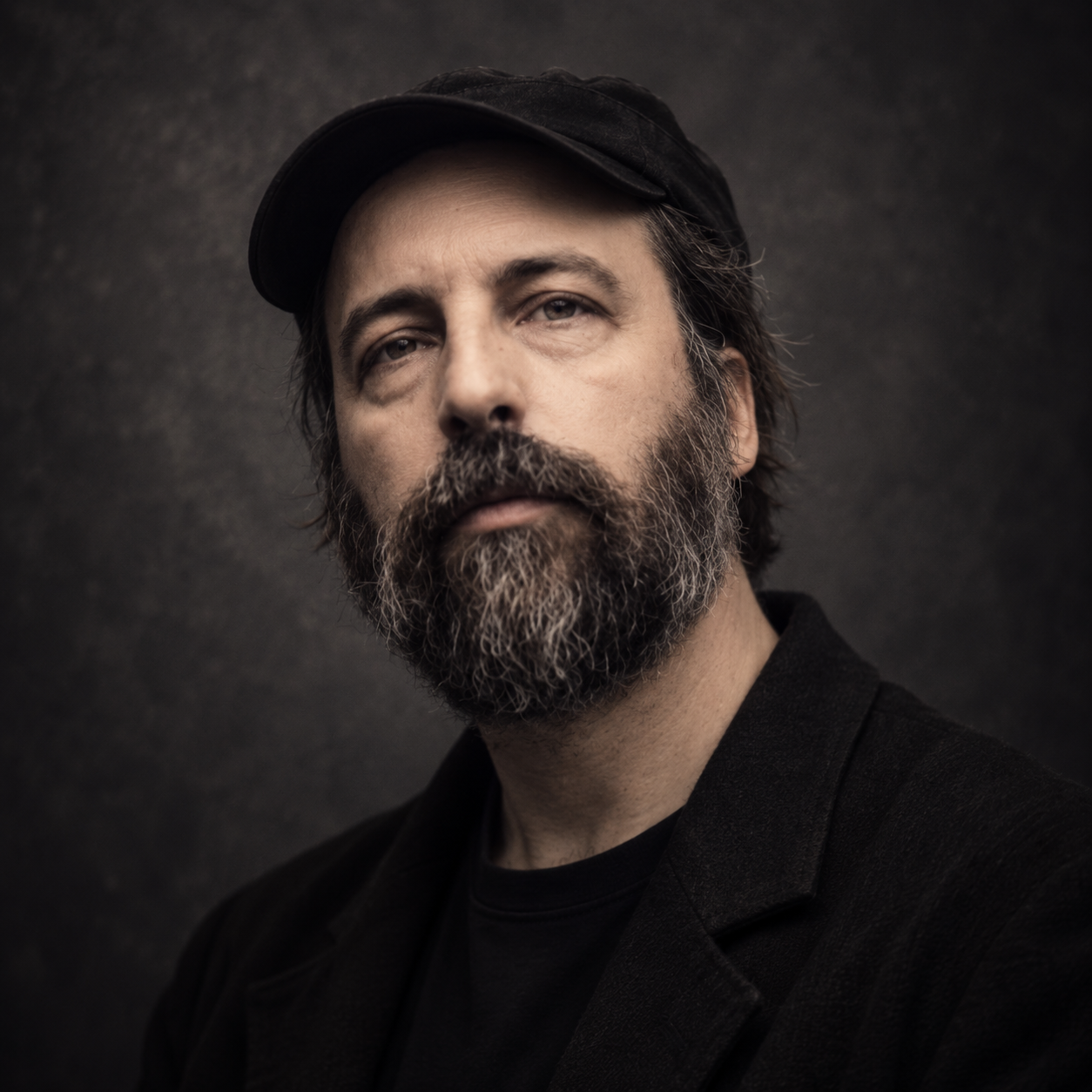
Herman Dune
GREAT CHOICE: Herman Dune!
Great music deserves to be discovered, enjoyed and shared.
CAN YOU SPARE A CUP OF COFFEE?
Audiophile-Streaming is a personal passion project, built with countless hours of discovering, selecting and sharing exceptional music.
I personally cover, without sponsors, the ongoing costs of hosting, software and subscriptions to keep the music discoveries coming. If you enjoy my work, your support is always appreciated.
A LITTLE THANK YOU IN RETURN
Just one coffee gives you lifetime access to the Coffee Club and all its playlists.
No subscriptions. No recurring fees.
Herman Dune started in Paris with the kind of setup that could hardly have been simpler: two brothers writing and singing songs, a drummer, guitars and very little interest in making everything sound polished. Formed in 1999, the original group brought together David-Ivar Herman Düne, his older brother André and drummer Omé, who was later replaced by Néman. David-Ivar was born in Paris in 1976, while André was born in 1973, and the brothers grew up in France with Swedish and Moroccan family roots. A reliably documented full birth date for David-Ivar is difficult to establish, so I prefer not to pretend there is more certainty than there is. What matters musically is that Herman Dune developed a very recognisable identity from modest ingredients: direct songwriting, slightly rough voices, acoustic and electric guitars, uncomplicated rhythms and an instinct for melodies that can sound almost obvious until you realise how difficult they are to forget.
The early Herman Düne, as the name was originally written, belonged to the independent world rather than to a carefully planned music industry career. The group released its first album, Turn Off the Light, through the French label Prohibited in 2000, after years of writing, playing and making their own recordings. John Peel became an important early supporter and invited Herman Düne to record a BBC session in September 2000, followed by several more sessions over the next few years. Albums including They Go to the Woods, Switzerland Heritage, Mas Cambios and Mash Concrete Metal Mushroom gradually established a following outside France. You can hear why Peel responded to them. The music is loose without being careless, melodic without becoming glossy, and full of small imperfections that make the people playing it seem present in the room.
Finding the Herman Dune sound
Not on Top, released by Track & Field in 2005, is where I think many of Herman Dune’s strengths became particularly easy to hear. Canadian singer-songwriter Julie Doiron joined the sessions on bass and vocals, and the album was recorded at Hall Place Studios in Leeds with Herman Düne and Richard Formby producing. One unusual decision was to record the album in mono. That immediately makes Not on Top an interesting record for an audiophile listener because it removes one of the things we normally use to judge a recording: stereo imaging. There is no enormous soundstage to admire and no reason to discuss whether a guitar sits twenty centimetres to the left or right of the singer. Instead, attention moves towards tone, timing, vocal texture and the way the instruments fit together.
The title track, “Not On Top”, is a good example of why that works. It is a remarkably economical song, with the arrangement leaving plenty of room around David-Ivar’s voice and the simple melodic hook. On a transparent system, I notice the texture of the vocal much more than any attempt at vocal perfection. His singing can sound conversational, nasal and slightly awkward, but those qualities are part of the identity of the music rather than defects that need correcting. The song also looks backwards at youth while acknowledging the uncertainty of becoming an adult and an artist, which suits Herman Dune perfectly. There is humour and self-doubt in the writing, but the melody keeps everything accessible.
For high-end audio, Not on Top is also a useful reminder that audiophile music does not need spectacular production. Good speakers or headphones reveal the grain of the voices, the attack of the strings and the character of the recording, but they cannot turn it into a demonstration disc, nor should they. In fact, I find the deliberately narrow presentation quite refreshing. The better the system becomes, the easier it is to hear how much information exists inside what initially seems like a very basic recording. It is musical intimacy rather than sonic fireworks.
From cult band to Giant
The next album changed the scale without throwing away the personality. Giant arrived in 2006 and contains “I Wish That I Could See You Soon”, probably the clearest single-song introduction to Herman Dune. The album retained David-Ivar, André and Néman but expanded the arrangements with percussion, backing vocals, horns and other instrumental colours. It sounds fuller than Not on Top, yet the songs still depend on rhythm and melody rather than studio decoration. For me, that balance is important because Herman Dune becomes less interesting when I concentrate on the deliberately quirky surface and much more interesting when I concentrate on the songwriting underneath it.
“I Wish That I Could See You Soon” proves the point in less than three minutes. The melody is immediate, the rhythm keeps moving and the vocal carries an almost casual urgency. There is no oversized chorus or dramatic production trick needed to tell you where the important part is. Through a revealing DAC and a pair of speakers with good midrange transparency, I enjoy how naturally the individual elements remain audible without the recording becoming clinically separated. The backing voices and instrumental additions give the track colour, but David-Ivar’s delivery remains the centre of gravity.
Giant also marked the end of an important period. André left Herman Düne after the album and continued making music under the name Stanley Brinks. Herman Dune carried on with David-Ivar and Néman, and the umlaut disappeared from the name around the period of Next Year in Zion in 2008. That could easily have changed the character of the project completely, but David-Ivar’s songwriting voice was strong enough to provide continuity. The arrangements could grow, shrink or move towards a more American folk and indie-rock sound, yet his slightly irregular phrasing and direct way of writing remained immediately identifiable.
Another turning point came with Strange Moosic in 2011, released after Herman Dune had established the Strange Moosic label. “Tell Me Something I Don’t Know” shows a cleaner and more immediately accessible version of the same basic strengths. The rhythm is firmer, the hook is unmistakable and the production gives the vocal and instruments more space than some of the earlier recordings. It even received a memorable video featuring actor Jon Hamm and a blue hitchhiking yeti, but the song does not depend on that visual joke. What I like is the contrast between the almost innocent simplicity of the tune and David-Ivar’s unmistakably adult, slightly weary delivery. It sounds friendly on first contact, while repeated listening reveals the precision in the songwriting.
Herman Dune gradually became David-Ivar’s own continuing musical project, and later releases such as Santa Cruz Gold in 2018 and Notes from Vinegar Hill in 2020 showed that the change was more than a matter of personnel. His life and music had increasingly moved towards California, while the American folk, country and rock influences that had always existed in Herman Dune became even more natural within the songs. In 2022 he began The Portable Herman Dune series, revisiting material from across the catalogue rather than simply treating old recordings as untouchable history. The project continued into 2023, followed by Odysseús in 2025. That long perspective makes the earlier songs interesting to compare with their later interpretations because David-Ivar is willing to let them age with him.
For someone discovering Herman Dune, I would begin with Giant, then move backwards to Not on Top. The first gives a newcomer the melodies, energy and broader arrangements in one very approachable package, while the second exposes the more intimate and unconventional side of the group. After that, Strange Moosic makes sense as the next chapter rather than simply another indie-folk album. None of these records would be my first choice for showing somebody how enormous a soundstage can become or how deep a subwoofer can reach, but that is precisely why they belong on an audiophile music website. A good audio system should also make ordinary human-scale recordings more convincing, and Herman Dune gives it plenty to work with in voices, strings, percussion, small dynamic changes and recording texture.
The history of Herman Dune is therefore not quite the history of one fixed band. It begins with David-Ivar and André Herman Düne making music together in Paris, develops through the trio years and the John Peel sessions, reaches a particularly strong point with Not on Top and Giant, and eventually becomes David-Ivar’s own long-running project. I can hear changes in production, personnel and ambition across those years, but I never have much difficulty recognising the musical personality underneath. “Not On Top”, “I Wish That I Could See You Soon” and “Tell Me Something I Don’t Know” each present a different stage of that development, and all three work because the song remains more important than the production surrounding it. For me, that is the quality that best defines Herman Dune: the ability to make simple, slightly imperfect songwriting sound unmistakably personal.
HiFi’ve, Ronald – Your EarFluencer
