
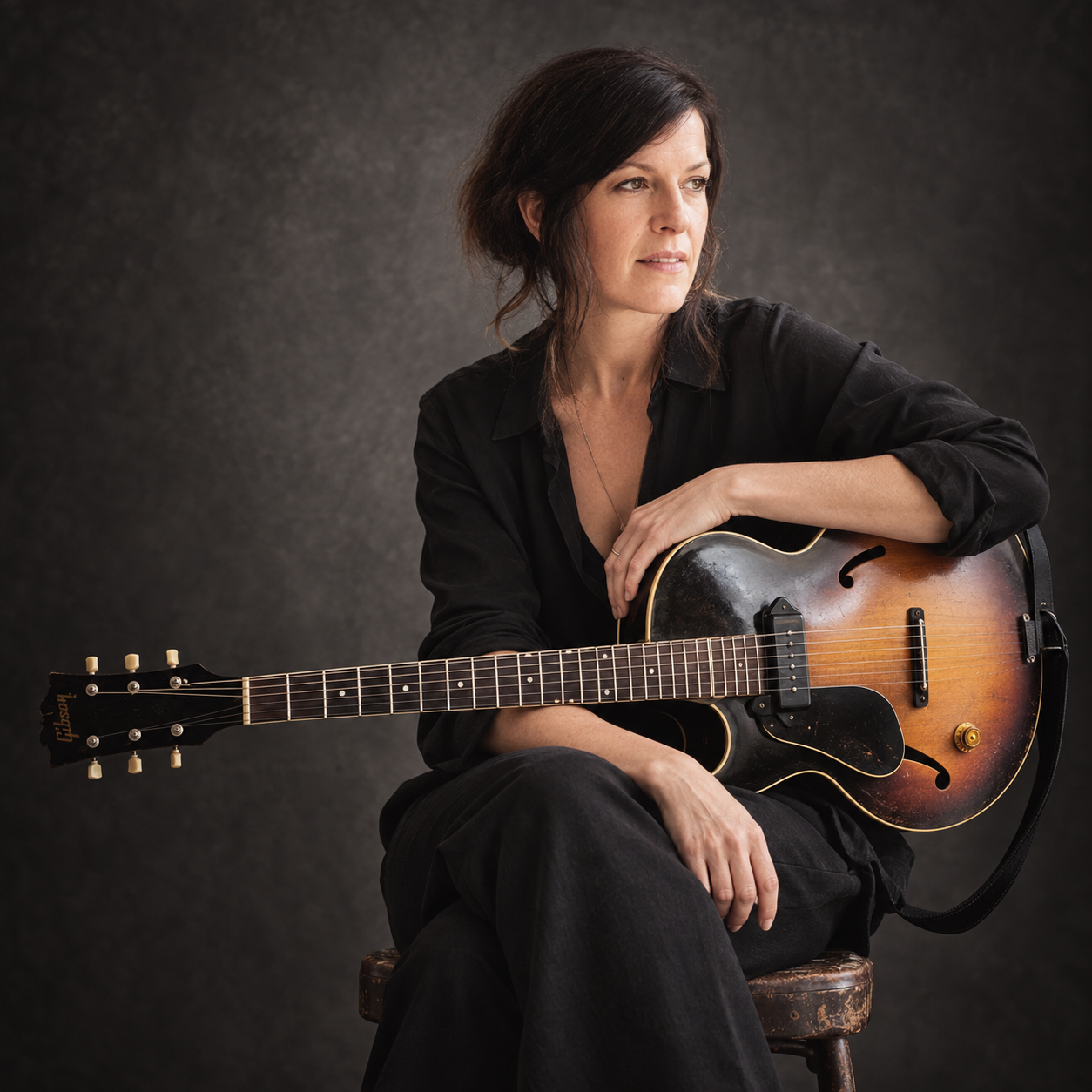
Jesca Hoop
GREAT CHOICE: Jesca Hoop!
Great music deserves to be discovered, enjoyed and shared.
CAN YOU SPARE A CUP OF COFFEE?
Audiophile-Streaming is a personal passion project, built with countless hours of discovering, selecting and sharing exceptional music.
I personally cover, without sponsors, the ongoing costs of hosting, software and subscriptions to keep the music discoveries coming. If you enjoy my work, your support is always appreciated.
A LITTLE THANK YOU IN RETURN
Just one coffee gives you lifetime access to the Coffee Club and all its playlists.
No subscriptions. No recurring fees.
Jesca Hoop has built a career by refusing to make the same record twice. Born Jessica Ada Hoop on April 21, 1975, in Santa Rosa, California, she grew up in a Mormon family where singing was part of everyday life, including four-part harmony with her siblings. That early training matters because harmony remains one of the most recognisable parts of her music, but very little in her later work sounds conventional or obedient to a fixed tradition. Her melodies can turn unexpectedly, her phrasing often shifts around the rhythm, and arrangements regularly leave spaces where another songwriter might add more instruments. For me, Jesca Hoop becomes more interesting the longer I listen because the unusual parts never feel added simply to make the music sound different.
Her route into a professional music career was equally unconventional. After leaving the Mormon faith as a teenager, Hoop spent periods living and working in rural parts of the western United States, including work in a wilderness programme in Arizona. Later she became a nanny for the children of Tom Waits and Kathleen Brennan, both of whom encouraged her songwriting. Waits helped bring attention to her demos, and her music eventually reached Los Angeles radio station KCRW before her debut album appeared. It is a colourful background, but I think it is important not to let the Tom Waits connection dominate the story. By the time Kismet was released through 3 Records and Columbia in 2007, Hoop already had a musical character strong enough to stand on its own.
Kismet introduced many of the elements she would keep reshaping over the following years: acoustic instruments, layered voices, unusual melodic movement and songs that can change direction without warning. Producer Tony Berg played an important role in those early recordings, and the album has a fuller, more decorated sound than some of Hoop’s later work. I enjoy the sense that the arrangements are constantly moving around her voice, but there are moments when the amount of detail can make the songs feel almost crowded. That is part of its charm, yet it also makes the more spacious direction she later developed especially noticeable. Hoop was never going to remain simply an American alternative folk singer with a few eccentric touches.
Finding Her Own Space
A major change in Hoop’s life came through Guy Garvey of Elbow. Garvey became an early supporter after hearing her music, interviewed her for BBC 6 Music and invited her to support Elbow. Hoop subsequently moved to Manchester, which became her long-term base and placed her inside a very different musical environment from California. Her 2009 album Hunting My Dress is one of the records I would recommend to anyone trying to understand why her music is difficult to categorise. Folk is certainly present, but so are art-pop ideas, unusual rhythmic accents and vocal arrangements that can move from intimate to slightly unsettling within a few seconds.
What makes Hunting My Dress particularly rewarding on a good system is the contrast between closeness and space. Hoop’s voice can sit very clearly in the centre while guitars, percussion and backing vocals appear around it without forming the predictable left-right picture of a conventional singer-songwriter recording. I notice small changes in vocal texture, breaths and changes of emphasis much more clearly through transparent speakers or headphones. Her voice is not about flawless smoothness. It has edges, changes of colour and deliberate shifts in pronunciation that give the words personality. That vocal realism is one reason her recordings can work so well as audiophile music, even though they were clearly created as songs first rather than technical demonstrations.
Hoop continued to explore different versions of her material rather than treating an album as something permanently fixed. Undress, released in 2014, revisited songs from Hunting My Dress in stripped-back form. She also found an especially productive musical partner in Sam Beam of Iron & Wine. After touring together, they wrote the 2016 collaborative album Love Letter for Fire, produced, recorded and mixed by Tucker Martine. Their voices are very different, which is precisely why the combination works. Beam’s softer, steadier delivery gives Hoop room to use her more elastic phrasing, while the shared harmonies often make both singers sound different from how they do on their solo recordings.
Less Sound, More Impact
For me, Memories Are Now from 2017 is one of the clearest turning points in Hoop’s catalogue and probably the album I would choose as a starting point for a new listener. Released by Sub Pop and produced by Blake Mills, it removes much of the density heard in some earlier recordings without making the music feel smaller. The title track demonstrates the approach immediately. Voice, rhythm and carefully placed sounds carry more weight because there is less surrounding them, and the recording allows silence to become part of the arrangement.
This is the kind of album that benefits from a transparent DAC, amplifier and speakers because its strengths are not based on spectacular bass or an artificially huge soundstage. Instead, the pleasure comes from hearing how precisely each element occupies its own space. On “The Lost Sky”, Hoop can sound direct and exposed one moment and then slightly distant as the arrangement develops around her. The dynamics are controlled but very effective, and small changes in intensity become important. On a revealing system I find myself listening not only to the melody but to the shape of individual words and the brief gaps between phrases.
The years after Memories Are Now confirmed that this more focused approach was not a temporary simplification. Stonechild followed in 2019, and Order of Romance arrived in 2022, continuing her interest in unusual structures while keeping the voice central. She has never become easier to classify, but I think she has become better at deciding exactly how much a song needs. That restraint is important. Some artists gradually add polish as their careers develop; Hoop has often moved in the opposite direction, becoming more willing to expose the construction of a song.
Her latest full album, Long Wave Home, released on May 1, 2026, marks another important step because Hoop took on the role of producer herself. Rather than recording everything in one fixed location, she travelled through England gathering performances at several studios, working with musicians including drummer Sebastian Rochford, bassist Jon Thorne and multi-instrumentalist Sam Amidon. Hoop has described the project as a deliberate decision to take greater authority over her own record-making, and that independence can be heard in the finished result. The arrangements feel carefully organised without losing their human irregularities.
Long Wave Home also shows how far she has travelled from the young songwriter who made Kismet. The sound is mature without becoming safe, and the title track deals with the distance and isolation that modern technology can create between people. I particularly like the way instrumental colours enter and leave rather than remaining in place simply to fill the mix. On a high-end audio system, the separation between voice, percussion, strings and lower-frequency instruments is easy to follow, but the music never feels like a collection of audiophile effects. The recording serves the songs, which for me is always the more important achievement.
Jesca Hoop’s influence is less about creating a school of imitators than demonstrating how flexible the singer-songwriter format can still be. Across releases for Columbia, Bella Union, Sub Pop and her more independent recent work, she has kept questioning how a voice, a guitar and a song can be arranged. Hunting My Dress shows the adventurous complexity of her earlier period, Memories Are Now captures the power she found through reduction, and Long Wave Home presents an artist taking even greater control of the recording process. Her work can occasionally demand more concentration than casual background listening, but I see that as part of its value rather than a weakness. The quality that finally defines Jesca Hoop for me is her ability to make an unusual musical decision sound completely natural once you have heard it.
HiFi’ve, Ronald – Your EarFluencer
