
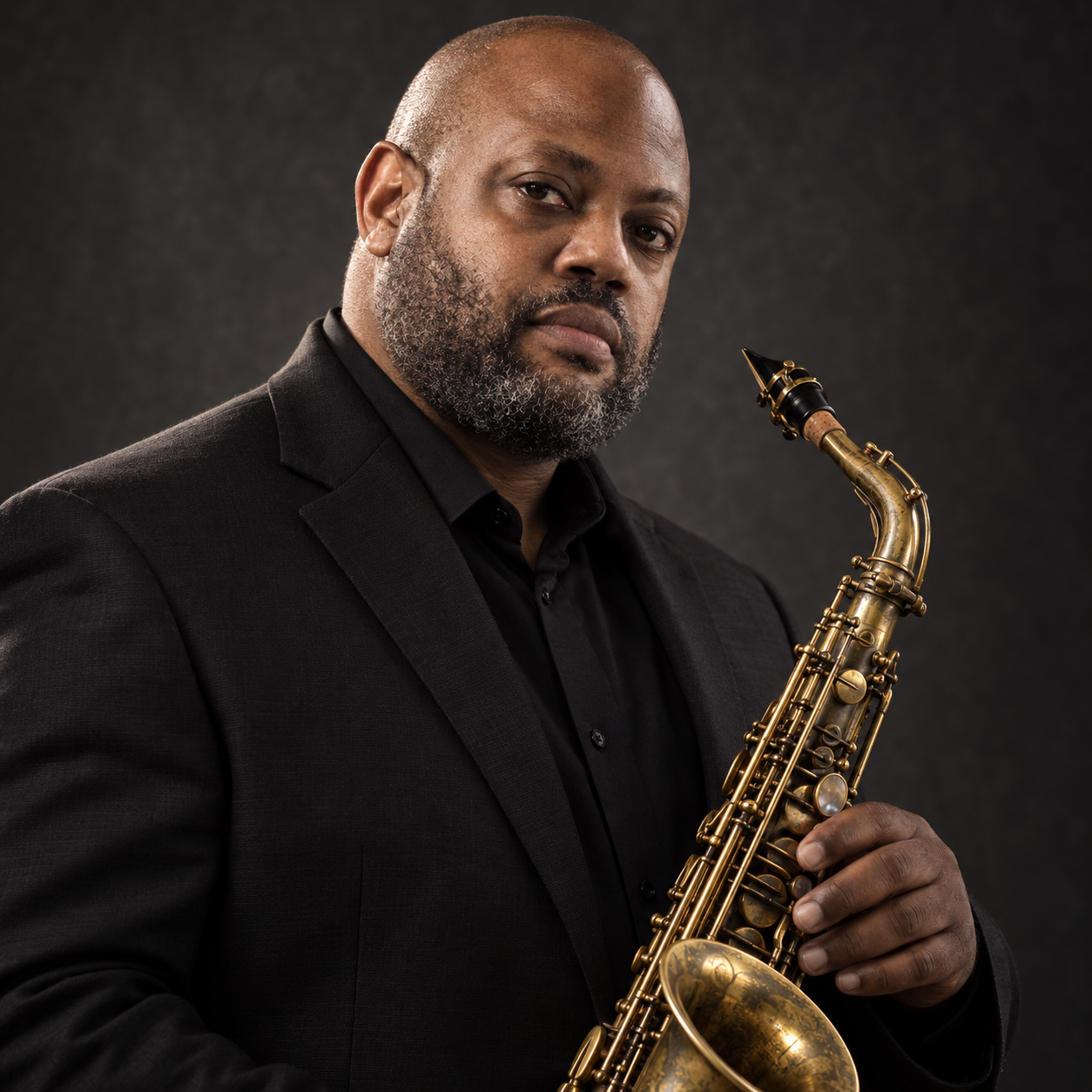
Justin Robinson
GREAT CHOICE: Justin Robinson!
Great music deserves to be discovered, enjoyed and shared.
CAN YOU SPARE A CUP OF COFFEE?
Audiophile-Streaming is a personal passion project, built with countless hours of discovering, selecting and sharing exceptional music.
I personally cover, without sponsors, the ongoing costs of hosting, software and subscriptions to keep the music discoveries coming. If you enjoy my work, your support is always appreciated.
A LITTLE THANK YOU IN RETURN
Just one coffee gives you lifetime access to the Coffee Club and all its playlists.
No subscriptions. No recurring fees.
What interests me most about Justin Robinson is the way he treats the fiddle as both a melodic and rhythmic instrument. There is nothing showy about his approach, yet there is always plenty happening in the way he shapes a phrase, attacks a note or pushes the rhythm forward. Robinson grew up in Gastonia, North Carolina, and began learning violin as a child, but classical music failed to keep his attention and he stopped playing at around thirteen. His interest returned years later while he was studying linguistics at the University of North Carolina at Chapel Hill, where encounters with old-time and blues music encouraged him to pick up the instrument again. This time he approached it as a fiddler, a decision that eventually made him part of a remarkable rediscovery of the Black string-band traditions of the American South.
In 2005, Robinson met Rhiannon Giddens and Dom Flemons through the Black Banjo Gathering in Boone, North Carolina, and the three musicians went on to form the Carolina Chocolate Drops. Their relationship with North Carolina fiddler Joe Thompson became especially important, giving them direct access to music that had been passed down through generations of Black musicians in the Piedmont. Knowing that background changes the way I hear Robinson’s playing. He is not trying to imitate an old recording or make traditional music sound artificially historic. His fiddle playing feels immediate and physical, with the bow often providing almost as much rhythm as the other instruments around him. There can be grit and a sharp percussive edge to his sound, but underneath it is a relaxed control that keeps the music lively without making it feel overly polished.
From Tradition to Genuine Negro Jig
That combination became known to a much larger audience through the Carolina Chocolate Drops album Genuine Negro Jig, released by Nonesuch Records in 2010 and produced by Joe Henry. It went on to win the Grammy Award for Best Traditional Folk Album, although I think its real significance is found in the music rather than the trophy. Giddens, Flemons and Robinson helped correct the common idea that old-time American string-band music belonged almost exclusively to white musicians. Black musicians had played a fundamental role in that history, and the Carolina Chocolate Drops presented that fact through performances that sounded alive and contemporary. They respected the tradition without making the listener feel as though the music had been placed behind glass.
“Kissin’ and Cussin’,” written by Robinson, is one of the tracks I particularly enjoy when I want to focus on his individual musical personality. He sings and plays autoharp, accompanied by Giddens on banjo and Flemons on bass drum, and there is very little excess in the arrangement. His voice has an appealing natural character, while the banjo and drum give the song a firm but uncomplicated rhythmic base. Played through a transparent system, I enjoy how clearly the individual parts occupy their own space without losing their connection to each other. You can concentrate on one instrument at a time, but the performance still feels like three musicians playing together rather than three separate sounds placed across the stereo image.
“Cindy Gal” shows another side of Robinson and is a good track for concentrating on his fiddle technique. Fiddle, banjo and percussion interact so closely that rhythm becomes one of the most important elements of the performance. I especially notice how Robinson’s bow contributes to that movement instead of merely carrying the tune above it. Notes have different weights and attacks, and those small variations continually push the music forward. Good speakers or headphones make these details very easy to hear. For me, they reveal much more about Robinson as a musician than a display of speed or obvious virtuosity would.
A Very Different Direction
Robinson eventually left the Carolina Chocolate Drops and also continued his academic education, earning a master’s degree in Forestry and Environmental Science from North Carolina State University. His own music showed an equally strong desire not to follow the most obvious route. With Justin Robinson and the Mary Annettes, he recorded Bones for Tinder, moving well beyond the traditional old-time framework associated with the Chocolate Drops. Folk and country elements remained present, but they were mixed with influences from soul, hip-hop and other styles. I like that willingness to take risks because it makes clear that Robinson’s interest in tradition has never meant accepting fixed musical boundaries.
Anyone expecting Bones for Tinder to sound like another Carolina Chocolate Drops album may need some time to adjust. That unpredictability is also what makes the record interesting to me. Robinson works with a wide range of instrumental textures, including violin, viola, banjo, autoharp, cello, bass, keyboards and drums, and the arrangements are often much less conventional than his earlier work might suggest. On a system with strong midrange transparency, there is plenty to explore because several acoustic and electric textures can occupy the recording at once. Some passages are more immediately convincing to me than others, but I find that the unusual combinations make more sense after several listens. I would rather have that kind of challenge than an album whose complete character is obvious before the first track has finished.
Music is also only part of Robinson’s connection with Southern Black history. His interests have included African American foodways, environmentalism and the preservation of Black Southern culture, and he is a founding member of the Earthseed Land Cooperative in North Carolina. I think that broader perspective helps explain his approach to traditional music. The songs and tunes are not simply old material waiting to be rediscovered and rearranged. They are connected with particular people, places and communities. Hearing Robinson’s work from that perspective makes his respect for tradition feel much more substantial than simply choosing vintage instruments and playing old repertoire.
Back to the Fiddle
A particularly interesting new chapter arrived in 2025 when Robinson reunited with Rhiannon Giddens for What Did the Blackbird Say to the Crow, released by Nonesuch Records. The album presents eighteen fiddle-and-banjo tunes from North Carolina, including music connected with the repertoire they had learned from Joe Thompson. Robinson plays fiddle and Giddens banjo, but one of the most distinctive choices was where and how the music was captured. Instead of isolating themselves inside a conventional recording studio, they recorded outdoors at historically important North Carolina locations, including the homes of Thompson and Etta Baker. Birds, insects and other sounds of the surrounding landscape were allowed to remain, making the environment part of what we hear.
From an audiophile perspective, I find this album particularly enjoyable because it challenges the idea that a great recording needs a completely silent background. “Rain Crow” is a wonderful example. Robinson’s fiddle has texture, weight and a slightly raw edge, while Giddens’ banjo answers it with an immediate rhythmic clarity. Around them, the outdoor sounds provide a natural sense of depth and distance that no artificial studio ambience needs to recreate. Through a transparent DAC and revealing headphones, the soundstage seems to extend beyond the instruments themselves, giving me a convincing impression of the location in which the musicians were actually playing. It demonstrates that recording realism can sometimes be strengthened by leaving the world around the musicians intact.
I would also spend some time with “Going to Raleigh.” Robinson learned this version from North Carolina fiddler Evelyn Shaw, and it contains many of the qualities I admire in his playing. The melody itself is easy to follow, but underneath it his bow constantly creates little shifts in rhythm, emphasis and momentum. Changes in pressure and attack give individual notes their own character without interrupting the flow of the tune. Nothing sounds unnecessarily decorated or technically exaggerated. Robinson and Giddens simply understand how their instruments fit together, and what initially appears straightforward becomes increasingly interesting when I concentrate on the details.
For someone discovering Justin Robinson for the first time, Genuine Negro Jig remains my preferred starting point because it establishes the musical and historical context that brought the Carolina Chocolate Drops international attention. From there I would move to Bones for Tinder, which shows just how far Robinson was willing to move beyond the expectations created by that success, and then to What Did the Blackbird Say to the Crow, where he and Giddens reconnect with North Carolina fiddle-and-banjo music in a remarkably natural setting. Taken together, these recordings show a musician who can preserve tradition, question it and take it somewhere unexpected without treating those approaches as contradictions. His biography and his music are closely connected by an interest in culture, place and the people who carried these traditions forward. Above everything else, what defines Justin Robinson for me is his rhythmic instinct, especially the way his fiddle can establish melody and pulse at exactly the same time.
HiFi’ve, Ronald – Your EarFluencer
