
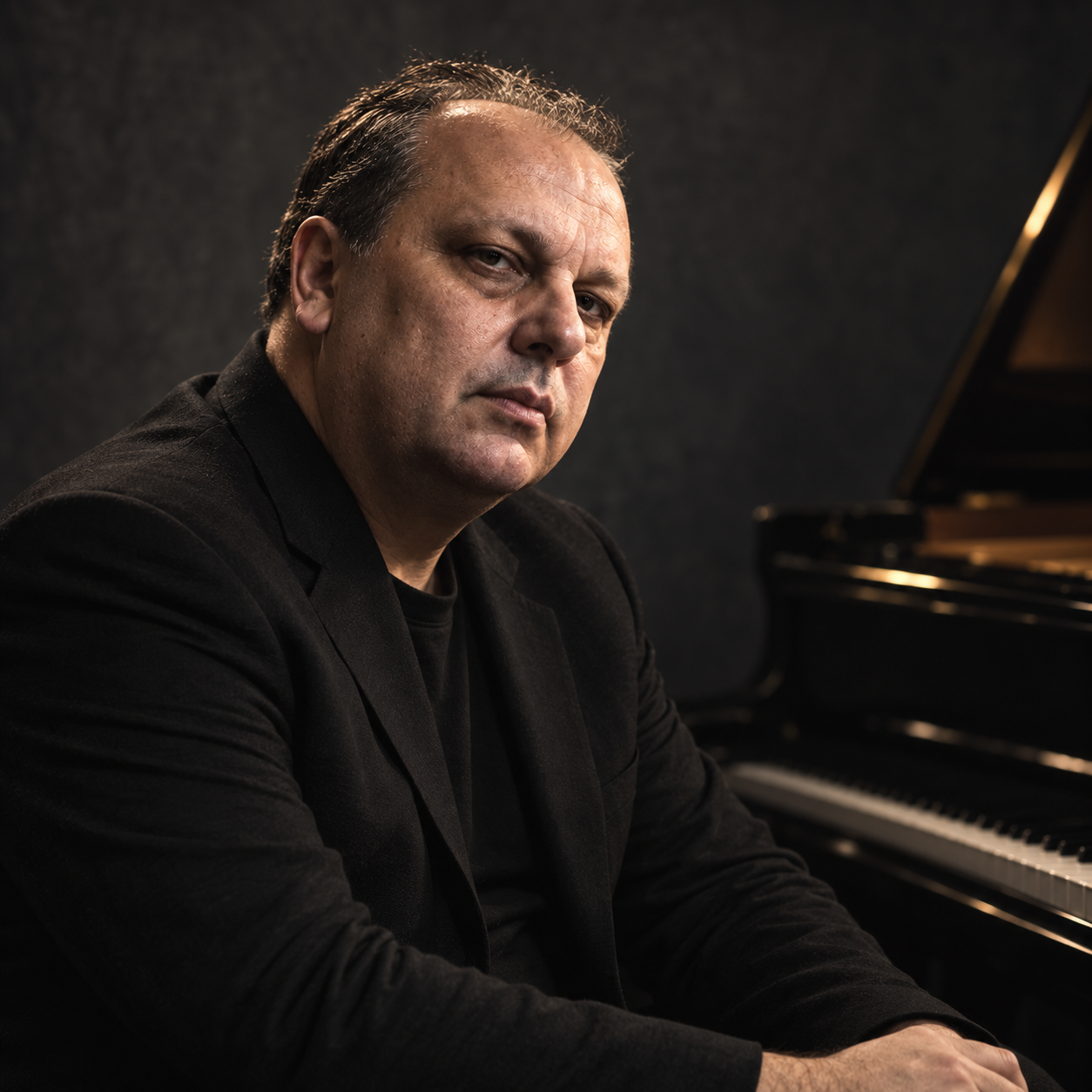
Massimo Faraò
GREAT CHOICE: Massimo Faraò!
Great music deserves to be discovered, enjoyed and shared.
CAN YOU SPARE A CUP OF COFFEE?
Audiophile-Streaming is a personal passion project, built with countless hours of discovering, selecting and sharing exceptional music.
I personally cover, without sponsors, the ongoing costs of hosting, software and subscriptions to keep the music discoveries coming. If you enjoy my work, your support is always appreciated.
A LITTLE THANK YOU IN RETURN
Just one coffee gives you lifetime access to the Coffee Club and all its playlists.
No subscriptions. No recurring fees.
Massimo Faraò is one of those pianists who makes me think less about nationality and more about jazz language. His playing is firmly rooted in swing, blues and the American piano tradition, yet there is a directness and warmth in his phrasing that keeps it from sounding like imitation. Faraò was born on 16 May 1965 in Genoa, Italy, and studied piano with Flavio Crivelli before establishing himself among musicians around the Genoa jazz scene, particularly bassist Piero Leveratto. What interests me most is how naturally he eventually moved between that Italian background and collaborations with some very experienced American jazz players. When I listen to his recordings, I hear a pianist who clearly understands the tradition but is more interested in making it move than in proving how much of it he knows.
From Genoa to American jazz
An important change came in 1993, when Faraò travelled to the United States and performed on the West Coast with saxophonist Red Holloway and drummer Albert “Tootie” Heath. The following year he signed with New York’s Monad Records and worked as pianist and musical director for singer Shawnn Monteiro, in a band that included bassist Keter Betts and drummer Bobby Durham. Those names matter because Faraò was not simply visiting American jazz from a distance. He was playing alongside musicians who had spent their lives inside it, and I think that experience can be heard in the confidence of his timing. He also toured Europe with Nat Adderley’s quintet alongside musicians including Antonio Hart, Walter Booker and Jimmy Cobb, and in 2001 he became part of Archie Shepp’s Just in Time Quartet with Wayne Dockery and Bobby Durham.
His early album For Me gives a useful picture of where this musical personality came from. The recording was made in Milan in December 1990 for Splasc(h) Records, with Faraò working in a small-group setting that included bassist Aldo Zunino and drummer Gianni Cazzola, with Flavio Boltro appearing on trumpet on part of the session. The programme mixes Faraò’s own material with standards and compositions associated with musicians such as Ray Brown, Ron Carter and Tommy Flanagan. I like that balance because it immediately places him inside a tradition without making the album feel like an exercise in preservation. His touch is clear and rhythmically alert, but he rarely crowds the music. Even when the lines become busy, I hear a strong awareness of where the beat sits and how much space the other players need.
That sense of proportion became one of Faraò’s strengths. He can play with considerable force, but he does not rely on volume or speed to create momentum. His left hand often gives the music weight while the right hand shapes compact phrases that stay connected to the rhythm section. On a revealing system, especially through speakers with convincing piano body and good midrange transparency, I like the way the attack of the notes remains separate from their decay. You hear the hammer strike, but also the resonance that follows it. That matters with Faraò because so much of his character lies in the difference between the note he hits and the way he allows it to settle.
Standards, Morricone and Joey DeFrancesco
By the 2000s Faraò had developed an unusually broad recorded catalogue, moving easily between standards, film music and straight-ahead jazz. From 2001 to 2005 he served as artistic director of the jazz division at Azzurra Music, and in 2006 the Massimo Faraò Trio released Ennio Morricone, a substantial collection of Morricone compositions on that label. This is an interesting album for me because film themes can easily become polite background music when transferred to jazz. Faraò generally avoids that trap. He keeps the melodies recognisable, but the piano phrasing and trio interplay give them enough rhythmic life to function outside their original cinematic setting.
Listening to pieces such as “C’era una volta il West” or “C’era una volta in America”, I am reminded that Faraò is at his best when he does not over-arrange familiar material. He trusts the melody, then works around it. The attraction is in the small changes of timing, the altered harmony and the way the rhythm section leaves room around the piano. I would not call every interpretation equally essential, because a large collection of famous themes inevitably contains moments where the original composition carries more emotional weight than the improvisation. Still, the project shows something important about Faraò: he is comfortable making accessible music without simplifying his basic jazz vocabulary.
A very different side of his playing appears on Estate, recorded in Livorno in 2008 with Joey DeFrancesco, bassist Aldo Zunino and drummer Byron Landham. DeFrancesco plays organ and also contributes trumpet, flugelhorn and vocals, while Faraò remains at the piano. The combination works because piano and Hammond organ can easily compete for the same musical space, yet here they often feel like two contrasting voices pushing the group forward. The title track stretches beyond thirteen minutes, giving the musicians time to develop ideas without rushing from theme to solo and back again.
This is probably where I would send someone who wants to understand Faraò as a jazz player rather than simply sample his enormous catalogue. On Estate, his rhythmic character is exposed very clearly. DeFrancesco brings the weight, colour and sustained power of the organ, while Faraò’s piano supplies a more percussive edge. Byron Landham keeps the music mobile, and Zunino provides a firm centre underneath it. Through good headphones or a properly set up stereo image, it becomes easier to follow how the instruments occupy their own areas while still reacting constantly to each other. The pleasure is not spectacular audiophile effect. It is hearing four musicians leave enough room for the groove to breathe.
A musician built around swing
Faraò continued to record prolifically and has worked with an extraordinary range of musicians, including Jimmy Cobb, George Cables, Jerry Weldon, Ron Carter and many others. He has also recorded extensively for Venus Records, the Japanese jazz label strongly associated with modern recordings of mainstream and hard-bop-oriented jazz. His catalogue can therefore look almost intimidating at first. There are standards, ballads, tributes, trio sessions, larger collaborations and multiple interpretations of familiar American repertoire. I would not suggest trying to understand him chronologically. For Me, Estate and one of the Morricone projects give a much clearer introduction to the different parts of his musical personality.
What links those recordings for me is his relationship with swing. Even in a ballad, he seems to feel the underlying pulse very strongly. His phrases tend to arrive with purpose, and he rarely lets technical ability become the main event. That may also explain why musicians with such strong individual identities have been comfortable working with him. Faraò can lead, accompany or simply become part of the rhythm section without losing his own sound. After listening across different periods of his career, that is the quality I value most: a firm, blues-aware piano touch combined with timing that keeps the music moving without ever sounding forced.
HiFi’ve, Ronald – Your EarFluencer
