
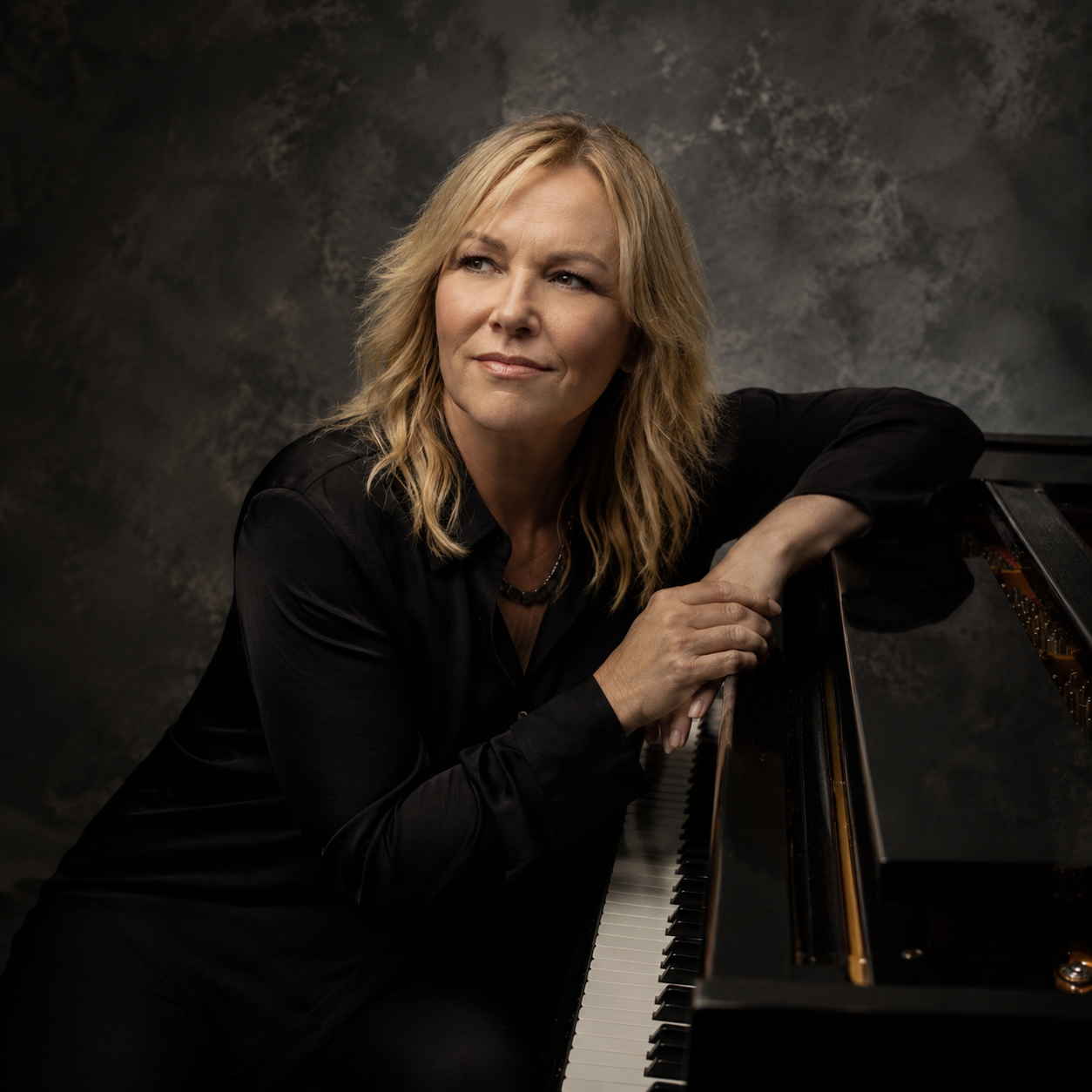
Anne Bisson
GREAT CHOICE: Anne Bisson!
Great music deserves to be discovered, enjoyed and shared.
CAN YOU SPARE A CUP OF COFFEE?
Audiophile-Streaming is a personal passion project, built with countless hours of discovering, selecting and sharing exceptional music.
I personally cover, without sponsors, the ongoing costs of hosting, software and subscriptions to keep the music discoveries coming. If you enjoy my work, your support is always appreciated.
A LITTLE THANK YOU IN RETURN
Just one coffee gives you lifetime access to the Coffee Club and all its playlists.
No subscriptions. No recurring fees.
Anne Bisson has built a remarkable career by following several different paths before making jazz the centre of her musical life. Born in 1961 in Trois-Rivières, Quebec, Canada, she is a singer, pianist, songwriter and producer whose work has become particularly familiar to lovers of audiophile recordings. Her music combines jazz, acoustic pop and carefully arranged interpretations of well-known songs, usually with her piano playing at the heart of the performance. I find her especially interesting because she understands two things that do not always come together: how to communicate a song naturally and how to make a recording sound convincing on a good audio system. Her albums offer plenty of detail for serious listening, but the music never feels as though it exists simply to demonstrate expensive equipment.
From Classical Piano to Jazz
Anne Bisson began studying classical piano at the age of six and started composing her own music while still a child. She continued her musical education at Cégep Saint-Laurent and the Université de Montréal, where she completed a bachelor’s degree in classical piano in 1984. During her studies, hearing the university’s big band opened her ears to jazz harmony and encouraged her to explore a different musical direction. That discovery helps explain something I appreciate in her playing today. She has the control and musical understanding of a classically trained pianist, but she is also comfortable with the freedom and rhythmic flexibility of jazz. Her accompaniment rarely demands unnecessary attention, yet it provides much of the character behind her singing.
The year 1984 also brought an important career breakthrough when she gained recognition in the Étoiles Du Maurier talent competition with two original compositions. In 1986, she played the role of Cristal in a production of the French-language rock opera Starmania, created for Quebec’s Festival d’été de Lanaudière. She subsequently developed a successful career in Canadian television, presenting programmes including Coup de Foudre, Vazimolo and La Marmaille. Music remained an important part of her life, however, and she continued teaching piano while developing her abilities as a singer. Between 2001 and 2004, she returned to university to study classical singing, adding another dimension to her musical background. I think this combination of formal training, songwriting and experience communicating with an audience explains why her singing feels so direct and assured.
Her move back towards jazz recordings became the defining change in her career. Rather than concentrating on commercial pop or using her television recognition to produce an obvious crossover album, she chose relatively intimate music built around piano, voice and acoustic instruments. That decision gave her the opportunity to establish a musical identity based on her own compositions and interpretations. It also suited the sort of production where small details in a performance can be heard without being exaggerated. For me, this is where Anne Bisson’s career becomes particularly relevant to an audiophile music collection.
Blue Mind: The Album That Changed Everything
Blue Mind, released in 2009, is the natural starting point for anyone discovering Anne Bisson. Recorded on July 21 and 22, 2008, at Reference Studio in Saint-Calixte, Quebec, the album features Bisson on piano and vocals, Normand Guilbeault on double bass and Paul Brochu on drums. It was produced in collaboration with Guy St-Onge and recorded with the involvement of René Laflamme of Fidelio. Almost the entire programme consists of Bisson’s own compositions, with Steve Hackett’s “Hoping Love Will Last” providing the exception. The album was originally associated with Fidelio and later appeared in additional audiophile editions, including a deluxe release in 2013. It established her reputation internationally among listeners interested in both vocal jazz and high-quality recordings.
What makes Blue Mind special to me is the natural balance between the three musicians. On “September in Montreal”, the piano provides a clear harmonic foundation while the double bass and drums contribute movement without crowding the vocal. Bisson’s voice has a warm, rounded character, with clear diction and a slightly conversational approach to phrasing. She does not force every emotional moment, and I appreciate the way she allows a melody to develop at its own pace. “Little Black Lake” is another important recording because it introduces the personal storytelling that would continue through her later compositions. These are songs that benefit from attention, but they do not require the listener to analyse every note.
From an audiophile perspective, Blue Mind is particularly rewarding. The performances were recorded with very few overdubs, with “Dragonfly” being the only track identified as using them. This helps preserve the interaction between the musicians, something I consider far more valuable than artificial studio perfection. The piano has a recognisable body and attack, the double bass occupies its own place in the arrangement, and the drums have enough space to sound like a real instrument rather than a collection of isolated effects. On a revealing pair of speakers or headphones, the relationship between the voice and accompanying instruments becomes easy to follow. The recording offers excellent midrange transparency, natural dynamics and convincing stereo imaging without sacrificing the intimate character of the performance.
The album also demonstrates that good audiophile music does not need to be technically complicated. A relatively small ensemble can reveal more about an audio system than a much larger production when the recording preserves the musicians’ timing and tonal relationships. The quiet passages are particularly useful for judging vocal realism and the way a system handles low-level detail. I also like that Bisson’s piano remains a genuine musical partner rather than simply filling the space behind her voice. For a new listener who wants to understand both her songwriting and her appeal within high-end audio, Blue Mind remains my first recommendation.
Portraits & Perfumes and the Freedom to Interpret
With Portraits & Perfumes in 2011, Anne Bisson moved beyond the intimate trio format and explored a wider selection of songs and arrangements. Produced by Guy St-Onge and recorded at his Reference Studio in Quebec, the album combines original compositions with jazz standards and interpretations of popular music. The repertoire includes “How Insensitive”, “The Nearness of You”, The Beatles’ “With a Little Help from My Friends” and Pink Floyd’s “Us and Them”. Additional musicians include saxophonist and woodwind player André Leroux, trumpeter Ron Di Lauro and a string ensemble, alongside familiar collaborators such as Normand Guilbeault and Paul Brochu. The result is a fuller and more varied production that reveals another side of her musical personality.
Her interpretation of “Us and Them” is particularly interesting because it shows how comfortably she can take a song from outside traditional jazz and make it work within her own style. Instead of trying to reproduce Pink Floyd’s original atmosphere, she allows the melody and arrangement to establish a different perspective. “The Nearness of You” offers a more familiar setting, where her phrasing and vocal tone become the main attractions. I enjoy the way she approaches these pieces as songs worth reconsidering rather than simply as well-known melodies that need a new arrangement. She is not the most adventurous jazz improviser, and that is not really the point of her work. Her strength lies in giving familiar material a consistent, recognisable musical personality.
The broader instrumentation also makes Portraits & Perfumes interesting for evaluating a hi-fi system. Brass, strings, piano and percussion introduce different textures, allowing the listener to hear how well an amplifier and speakers maintain separation when the arrangement becomes more complex. I particularly value recordings where individual instruments can be identified without the soundstage becoming unnaturally wide or disconnected. Bisson’s voice remains central to the performance, but the supporting musicians have enough presence to contribute their own character. Compared with Blue Mind, this album is less minimal and sometimes more arranged than I personally prefer. Nevertheless, that additional variety demonstrates her confidence as an interpreter and her willingness to move beyond a successful formula.
In 2011, she also founded Camilio Records, an important development that gave her greater involvement in the production and international distribution of her music. The label became closely associated with her subsequent releases and their presentation to audiophile audiences. For an independent artist, that level of control can be significant, particularly when sound quality and physical editions form part of the artistic identity. Bisson has remained active in the specialist hi-fi community, where her recordings have been presented in formats including high-resolution digital audio, vinyl and reel-to-reel tape. I see that commitment as part of her musical approach rather than merely a marketing exercise. It reflects an interest in preserving the qualities that make small acoustic performances convincing.
Her songwriting remained important as her career progressed. Tales from the Treetops, released in 2014, continued ideas introduced on Blue Mind and developed them into a collection of connected stories. With Paul Brochu on drums, Frédéric Alarie on bass and Vincent Bélanger on cello, the music moved towards a more varied acoustic sound. Soprano Suzie LeBlanc also joined her for a duet, adding another vocal colour to the project. Songs including “I Live in a Treehouse”, “Dry My Tears” and “Winter’s Coming” demonstrate her continuing interest in personal themes and storytelling. I appreciate this side of her career because it shows that her reputation for recording quality has not replaced her identity as a songwriter.
Another important collaboration followed with cellist Vincent Bélanger on Conversations in 2016. Combining her piano and voice with the expressive sound of the cello provided a different musical setting and further strengthened her connection with the audiophile recording world. This combination is particularly appealing to me because the cello occupies a tonal range that can complement a human voice beautifully. It also asks something different of an audio system, especially when reproducing the texture, resonance and dynamics of bowed strings. The collaboration was a logical extension of her preference for intimate performances and carefully balanced acoustic instruments.
Her later albums continued to explore familiar songs through her own musical language. Keys to My Heart in 2019 and Be My Lover expanded her repertoire while retaining the voice-and-piano identity that had become her trademark. She has never seemed particularly interested in changing style simply to follow commercial trends. Instead, her development has been gradual, with different combinations of musicians, arrangements and repertoire providing new possibilities. That consistency is one of the reasons I find her catalogue rewarding. There is a clear relationship between her early jazz recordings and her later interpretations, even when the original songs come from very different musical backgrounds.
Guilty Pleasures: A Personal Choice of Songs
Her 2025 album Guilty Pleasures brings that approach into particularly clear focus. Recorded and mixed by Jacques Roy at Studio Opus in May 2025, it includes interpretations of Neil Young’s “Harvest Moon”, The Rolling Stones’ “Wild Horses”, Pink Floyd’s “Comfortably Numb” and “In the Ghetto”, a song strongly associated with Elvis Presley. The album also features two original compositions and a duet with Canadian singer Bruno Pelletier on “Autumn Leaves / Les feuilles mortes”. Bisson performs on piano, Fender Rhodes and vocals, supported by musicians including Jacques Roy on bass and acoustic guitar and Guillaume Picard on drums. The record was also prepared for a limited one-step vinyl edition mastered by Bernie Grundman and pressed at RTI, demonstrating her continued attention to premium audio production.
What interests me most about Guilty Pleasures is the freedom of the song selection. These pieces come from different periods and styles, yet Bisson approaches them through a largely acoustic setting that gives the album a coherent sound. “Harvest Moon” works especially well with her relaxed vocal delivery because the melody does not require unnecessary ornamentation. “Comfortably Numb” is a more difficult song to reinterpret, partly because the original recording has such a distinctive character. Here, I find it more useful to listen to the phrasing, harmonic support and instrumental balance than to compare the result directly with Pink Floyd. Her interpretation succeeds for me when it feels like a performance made on its own terms.
The recording also gives me plenty to appreciate as a hi-fi listener. The sound of the piano and Fender Rhodes provides contrasting keyboard textures, while the acoustic bass and drums help establish a clear rhythmic foundation. The duet with Bruno Pelletier introduces another voice, making vocal balance and tonal differences especially interesting. I value the fact that Bisson continues to work with musicians and engineers who understand the importance of preserving the character of the performance. High-resolution formats and carefully mastered vinyl can certainly be attractive, but they only become worthwhile when the underlying recording contains something musically convincing. With Anne Bisson, the emphasis on sound quality generally supports the music rather than distracting from it.
After more than four decades of work across music, theatre, television and education, Anne Bisson has established a distinctive position as a Canadian jazz vocalist, pianist and independent recording artist. Her importance is especially clear within the audiophile community, where Blue Mind has become a familiar reference recording and her later albums have continued to receive specialist releases. I would not describe her as a revolutionary jazz musician, nor do I think she needs to be one. Her contribution is more personal: she brings classical training, accessible songwriting and a natural approach to singing together in recordings that reward careful listening. From the original compositions of Blue Mind to the broader arrangements of Portraits & Perfumes and the personal interpretations of Guilty Pleasures, she has maintained a clear musical identity. For me, the quality that best explains her appeal is the natural, unforced phrasing of her voice.