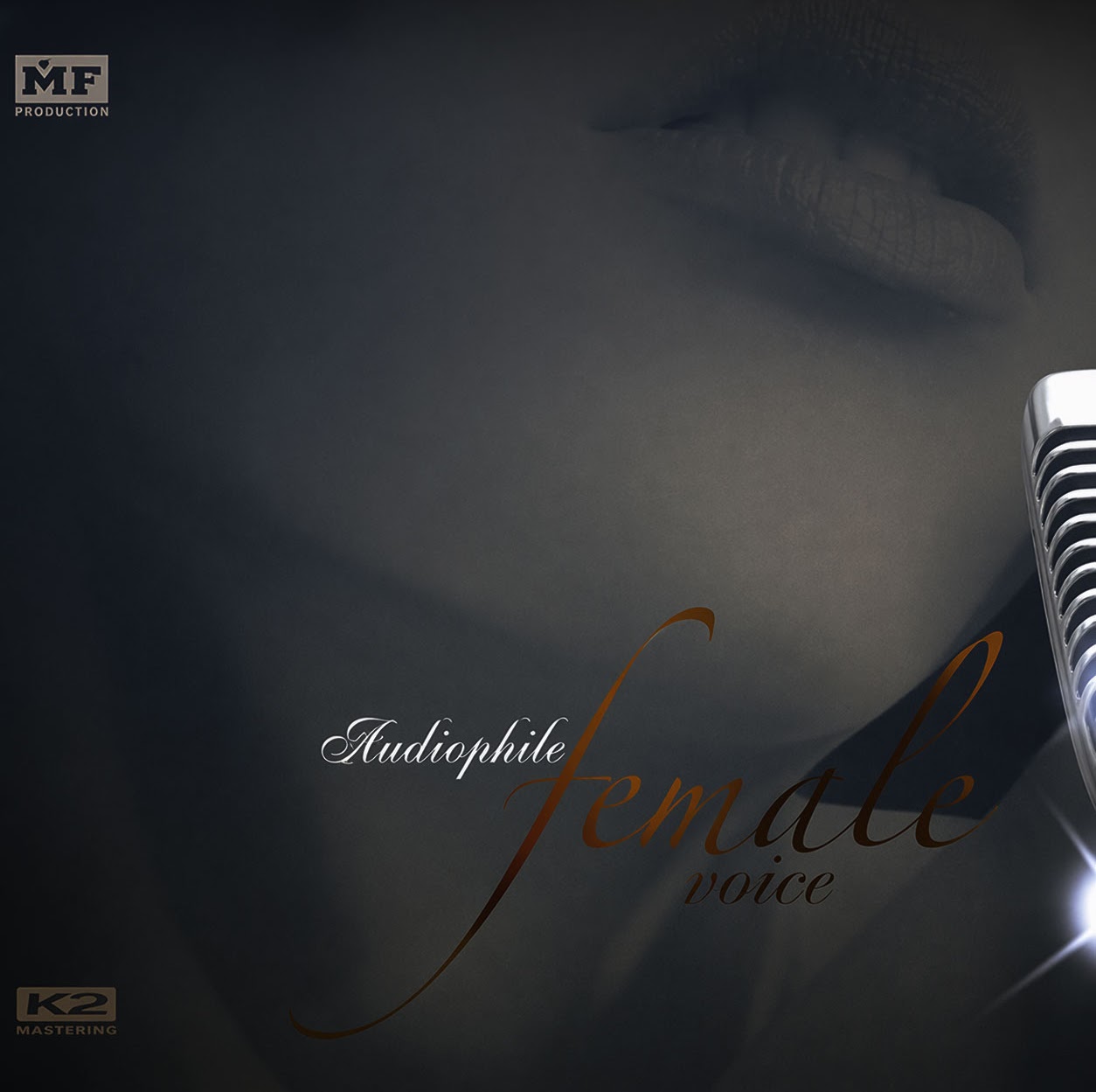
Audiophile Female Voice

MF Records Audiophile Female Voice – When the Human Voice Reveals Everything

There is a reason why the human voice has become one of the most trusted references in high-end audio. You don’t need years of technical experience to recognize when a singer sounds convincing. We hear voices every day, know instinctively how breath, warmth and emotion should feel, and can often recognize within seconds when something sounds unnatural. MF Records Audiophile Female Voice takes that familiarity and turns it into a beautifully focused listening experience, built around female vocals, intimate arrangements and the kind of musical detail that can make a carefully assembled stereo system disappear from attention.

Released on the MF label in 2007, Audiophile Female Voice belongs to a tradition of Asian audiophile compilations created for listeners who appreciate the combination of beautiful music and revealing sound quality. Rather than relying on spectacular bass or enormous orchestral dynamics, the collection places its emphasis where our hearing is particularly sensitive: the midrange, where the character and emotion of a voice live. That makes the album immediately attractive for anyone searching for audiophile female vocals, high-quality vocal recordings and reference music for a high-end audio system, but its real charm lies in how easily technical listening can turn into simple musical enjoyment.

The atmosphere is established through familiar songs and expressive female performances. Material such as “Tennessee Waltz,” “I Cover the Waterfront,” “As Time Goes By,” “Fly Me to the Moon,” “Rainy Days and Mondays,” “Triste,” “Smoke Gets in Your Eyes,” “If You Leave Me Now,” “There’s a Kind of Hush” and “Teach Me Tonight” creates a musical landscape built around melodies that many listeners already know. Performers associated with the collection include Rosanne Lui, Tania Hancheroff, Susan Wong, Camay Ng and Michelle, giving the album a mixture of jazz standards, popular songs and relaxed vocal interpretations.

Familiarity is particularly valuable in an audiophile recording because the listener already has an idea of how a song should flow. Instead of concentrating on melody and structure, attention naturally shifts towards interpretation and sound. A singer may delay a phrase slightly, soften the end of a line or introduce a different emotional character into words that have been heard countless times before. Through a transparent system, these differences become easier to appreciate without needing to sound exaggerated.

That is especially true with a song such as “Tennessee Waltz.” It is a melody that has travelled through generations and countless interpretations, yet a good vocal performance can still make it feel personal. The important audiophile qualities aren’t spectacular effects but smaller things: whether the singer has believable body, whether the voice remains stable between the loudspeakers and whether the surrounding instruments create enough space for the performance to breathe. When these elements come together, the center image stops feeling like sound produced by two separate speakers and begins to resemble a person occupying the space between them.

The same principle applies to “I Cover the Waterfront,” a standard that naturally encourages a slower, more intimate kind of listening. The voice becomes the emotional center while the arrangement provides atmosphere around it. On a revealing audio system, it is worth listening not only to the singer but also to what happens immediately after a phrase. The decay of an instrument, the subtle reverberation surrounding the voice and the quiet spaces between notes all contribute to the illusion of depth.

This is where MF Records Audiophile Female Voice becomes particularly useful as reference material. Stereo imaging is often described in terms of left, center and right, but a convincing recording should create something more complex. A singer needs a believable position and scale, while accompanying instruments should occupy their own spaces without appearing artificially separated. More importantly, there should be a sense of depth behind the performance, allowing the recording to extend beyond the physical line of the loudspeakers.

Songs such as “As Time Goes By” and “Fly Me to the Moon” are ideal for this kind of listening because their melodies are so deeply familiar that differences in vocal character become immediately apparent. A good audio system should preserve those differences rather than imposing its own personality on every singer. One voice may have more warmth and body, another may sound lighter and more delicate, while differences in microphone technique and recording environment can change how close the performer appears to the listener.

For this reason, female vocal recordings have long been used to evaluate midrange transparency and tonal balance. An overly bright system can make sibilants and upper vocal harmonics unnecessarily prominent, creating an impressive sense of detail at first but becoming tiring over longer listening sessions. An excessively warm system can produce the opposite problem, giving voices plenty of body while removing openness and individuality. The difficult part is finding the balance where detail is present without being pushed forward.

Susan Wong’s “Rainy Days and Mondays” fits naturally into this world of relaxed audiophile listening. Wong is a familiar name among listeners who enjoy Asian audiophile vocal recordings, and the combination of a recognizable song with an intimate female voice provides exactly the kind of material that can reveal the tonal character of a system. Yet the best listening experience occurs when those technical observations gradually become irrelevant and the song simply takes over.

The collection’s interpretations of “Triste” and “Smoke Gets in Your Eyes” continue that transition between critical and emotional listening. These are songs with enough history behind them that the performance matters more than novelty. The question isn’t whether the listener has heard the melody before, but whether this particular voice can make it worth hearing again. That is one of the pleasures of audiophile vocal compilations: familiar material becomes a way of comparing not only recording quality, but personality.

As the collection moves through “If You Leave Me Now,” “There’s a Kind of Hush” and “Teach Me Tonight,” another quality becomes increasingly apparent. Great vocal reproduction does not require high volume. In fact, this kind of album can become even more convincing late at night, when the listening level is reduced and the room itself becomes quieter. A capable system should preserve vocal presence, instrumental texture and stereo depth even at modest volume, without needing exaggerated bass or treble to maintain interest.

That makes Audiophile Female Voice particularly suitable for evaluating speakers and headphones, but also amplifiers and DACs. Listen for the stability of the vocal image and whether a singer remains centered when the arrangement becomes busier. Pay attention to the smoothness of the upper frequencies, the amount of natural body in the lower midrange and whether instruments have sufficient separation without becoming detached from the performance. With headphones, vocal texture and low-level information can become especially obvious, while loudspeakers add the challenge of recreating a believable acoustic space in front of the listener.

Tube amplifier enthusiasts may find this kind of material especially seductive because the combination of female vocals and acoustic arrangements can highlight the qualities often associated with good tube reproduction: dimensionality, harmonic richness and a fluid midrange. Yet warmth alone isn’t enough. A system that adds too much character of its own can make every recording sound attractive in exactly the same way, whereas true transparency allows each singer to retain her individual tonal identity.

That distinction lies at the heart of serious audiophile vocal listening. The objective isn’t to create the most beautiful possible version of every voice. It is to preserve what makes each voice different. Texture, phrasing, dynamics and even imperfections contribute to the sense that there is a real performer behind the recording.

There is also a broader reason albums like MF Records Audiophile Female Voice continue to appeal in an age of virtually unlimited streaming. Modern listeners can move between millions of songs within seconds, but an audiophile compilation encourages a different habit. Instead of endlessly searching for the next track, it invites you to sit down, listen carefully and allow one musical atmosphere to develop over time. The quality of the recording becomes part of that experience, not because every second needs to demonstrate the capabilities of expensive equipment, but because better reproduction can make listening feel more intimate.

Perhaps this explains why vocal albums remain such a permanent part of audiophile culture. Loudspeakers become more advanced, DAC technology changes and new high-resolution formats arrive, yet the fundamental test remains remarkably simple. Close your eyes and listen to the person singing. Does the voice have natural size and weight? Can you hear emotion without the recording becoming artificially intimate? Do the accompanying instruments create a believable space, and can you forget where the loudspeakers are standing?

When the answer is yes, specifications begin to matter considerably less.

Audiophile Female Voice is therefore more than a convenient selection of female vocal test tracks. It represents a style of listening in which technical quality and musical intimacy meet. The album can help reveal midrange coloration, stereo imaging, soundstage depth, treble smoothness and low-level detail, but none of those qualities is the final objective.

The real test comes later, when you stop analysing the voice and simply start listening to the singer.

For anyone who loves female audiophile vocals, jazz standards, intimate voices and warm high-end sound, MF Records Audiophile Female Voice is exactly the kind of collection that can turn an evening of equipment testing into several hours of music.

And when that happens, the system has already passed the most important test.

Hi-Fi(ve),

Ronald – Your EarFluencer 🎧