
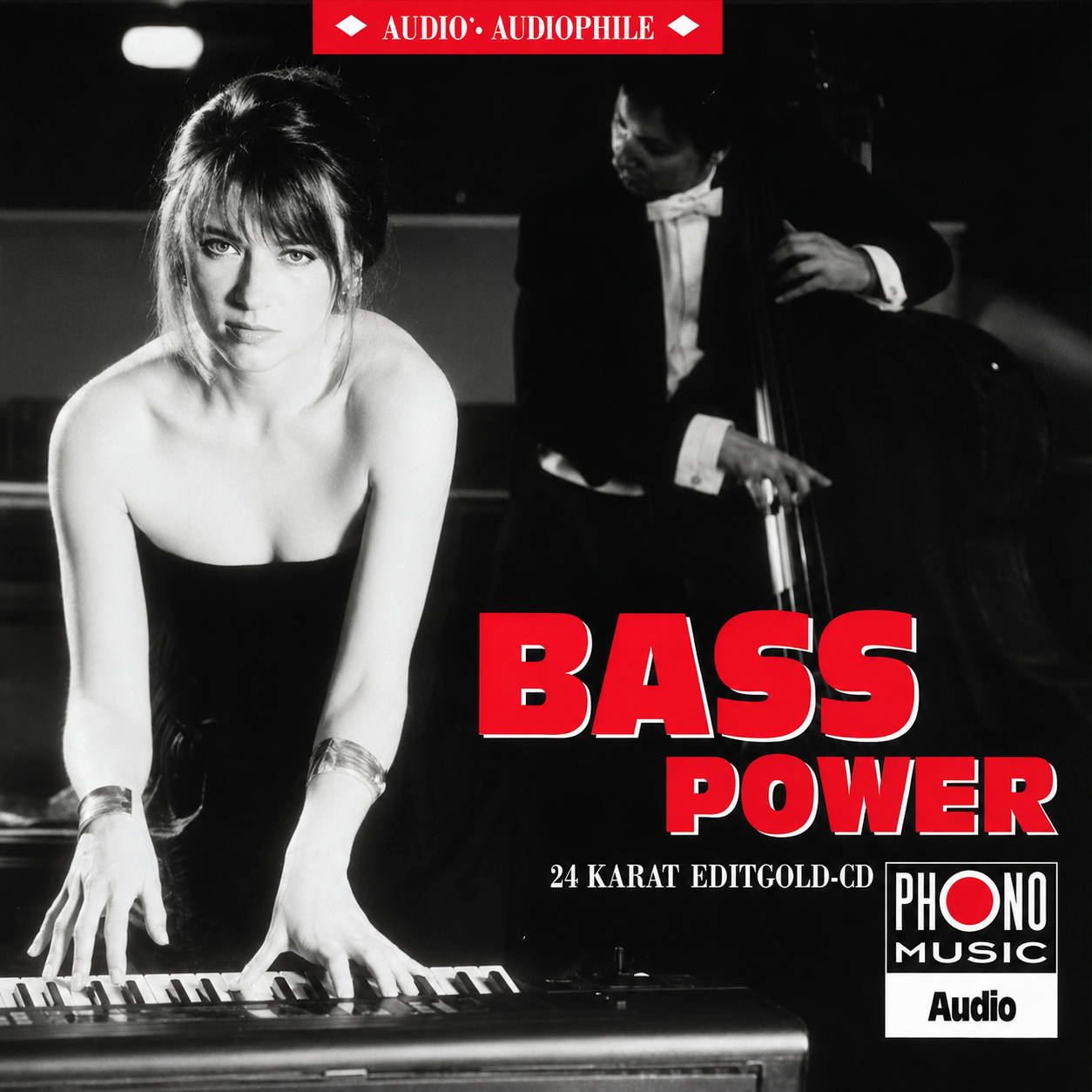
Audio’s Audiophile Vol 2
Bass Power
GREAT CHOICE: Audio’s Audiophile Vol 2 Bass Power!
Great music deserves to be discovered, enjoyed and shared.
CAN YOU SPARE A CUP OF COFFEE?
Audiophile-Streaming is a personal passion project, built with countless hours of discovering, selecting and sharing exceptional music.
I personally cover, without sponsors, the ongoing costs of hosting, software and subscriptions to keep the music discoveries coming. If you enjoy my work, your support is always appreciated.
A LITTLE THANK YOU IN RETURN
Just one coffee gives you lifetime access to the Coffee Club and all its playlists.
No subscriptions. No recurring fees.
The title Audio’s Audiophile Vol 2 – Bass Power makes its purpose very clear. This is a compilation for listeners who want to discover what bass can really contribute to music. But I think there is more to it than powerful low frequencies and impressive demonstrations. Released in 1994 by the German label Phono Music Audio, this second volume in the AUDIO’s Audiophile series brings together 20 recordings from jazz, rock, pop, electronic music and classical music. What interests me most is how differently these recordings use bass. Sometimes it provides the rhythm, sometimes it carries the melody, and sometimes it gives an entire orchestra its physical weight. That variety makes this a much more interesting collection than a simple loudspeaker test disc.
The compilation was created in cooperation with the German hi-fi magazine AUDIO, at a time when carefully selected demonstration CDs were particularly popular among serious hi-fi enthusiasts. Phono Music Audio brought together recordings from different labels rather than relying on one recording company or a single musical style. That was an excellent decision in my opinion, because bass reproduction cannot be judged properly with just one type of instrument. An electric bass guitar, an acoustic double bass, a synthesizer and a large orchestral drum all produce very different sounds. They also demand different things from a recording and a playback system. With approximately 73 minutes of music, Bass Power offers plenty of opportunities to hear those differences.
Bass That Makes Music Move
One of my favourite selections on paper is “Panther” by Marcus Miller. Miller is one of the great electric bass players, known for his powerful groove, remarkable technique and distinctive playing style. His music is especially suitable for this compilation because the bass is not simply supporting the other musicians. It becomes a leading instrument with its own rhythmic and melodic character. In “Panther”, the combination of bass guitar, drums and funk rhythms gives me exactly the kind of musical material I want from a collection called Bass Power. I want to hear the individual notes clearly, the movement of the bass line and the relationship between the bass and percussion. A heavy bass sound alone is not enough if the rhythm loses its precision.
Another interesting choice is “Funhouse” by Flim & the BB’s. This American jazz fusion group became well known among audiophiles for its recordings and its use of digital recording technology during the 1980s. Their music combines jazz improvisation with carefully arranged instrumental passages, making it particularly useful for critical listening. “Funhouse” brings a different musical character to the compilation, with a lively interaction between rhythm and melody. I particularly appreciate recordings of this kind because they encourage me to listen beyond the lowest frequencies. The important question is whether the bass and drums remain distinct while the other instruments retain their natural presence. That balance is far more revealing than simply producing the loudest possible bass.
The inclusion of “Wes Bound” by Lee Ritenour is another reason I find this selection attractive. Ritenour is an accomplished jazz guitarist whose work frequently combines jazz with funk, soul and contemporary production. The track offers a smoother musical atmosphere than the more aggressive bass demonstrations elsewhere on the disc. For me, that contrast is important. A good bass line should support the musical arrangement without making every recording sound equally heavy. I like hearing how the guitar and rhythm section work together, with bass providing a foundation rather than constantly demanding attention. It is also a useful reminder that bass quality involves timing and tonal definition, not just extension into the lowest frequencies.
From Electronic Bass to Acoustic Instruments
The compilation becomes more adventurous with “Plastic Dreams (Radio Edit)” by Jaydee. This electronic dance recording, originally released in 1992, represents a completely different approach to bass. Instead of the natural resonance of strings or drums, the low frequencies are produced electronically and integrated into a repeating dance rhythm. I find this kind of material particularly interesting because electronic bass can sustain notes and create patterns that acoustic instruments cannot reproduce in quite the same way. It also demonstrates why bass control matters so much. When the low frequencies become too dominant, the rhythm loses its definition and the music can become tiring. When everything is properly balanced, the repeating patterns have a strong sense of movement.
I also appreciate the inclusion of musicians such as Ray Brown and Laurindo Almeida. Their interpretation of “‘Round Midnight” brings acoustic instruments into a collection that could otherwise become dominated by electronic effects and powerful percussion. Brown was one of jazz’s most respected double bass players, while Almeida was a remarkable guitarist whose work crossed the boundaries between jazz and classical music. Their musical partnership offers a different perspective on the lower registers. An acoustic double bass has a physical character that is very different from an electric bass guitar. The body of the instrument, the attack of the strings and the decay of individual notes all contribute to its identity. For my taste, these quieter and more intimate recordings are just as valuable as the spectacular ones.
This is where I think Bass Power becomes a genuinely useful audiophile compilation. It does not concentrate exclusively on bass-heavy electronic recordings or impressive percussion effects. Instead, it allows the listener to compare very different ways of producing low-frequency energy. That comparison is musically interesting because it reveals how important bass is to the identity of an arrangement. A double bass can make a jazz performance feel relaxed and intimate, while an electronic bass line can give dance music its driving rhythm. Both belong on this album, even though their musical purposes are completely different.
The Power of Classical Percussion
The final part of the compilation moves into some particularly demanding musical territory. The Japanese percussion ensemble Kodō appears with “O-Daiko (Big Drum)”, a recording that highlights the physical impact of traditional Japanese drumming. This is a very different kind of bass experience from anything produced by an electric instrument. A large drum combines a sudden impact with a lower resonance that continues after the initial strike. I find that relationship fascinating because the force of the performance is not determined by bass quantity alone. The timing of each strike, the surrounding acoustic space and the way the drum resonates are equally important. It is the kind of recording that can make the physical nature of percussion easier to appreciate.
The compilation also includes the finale from Maurice Ravel’s “Boléro”, performed by the Orchestre National de France, and Aaron Copland’s “Fanfare for the Common Man” performed by the Atlanta Symphony Orchestra. These recordings bring orchestral weight into the picture. In Copland’s famous work, brass and percussion play a central role, giving the music its imposing character. I like this choice because orchestral bass is never entirely separate from the rest of the musical spectrum. The lower instruments establish scale and power, while the brass and upper frequencies provide definition and musical tension. The result should feel substantial without sacrificing the individual instruments.
For me, these classical selections also explain why good bass reproduction is about much more than the presence of a subwoofer. A powerful orchestral passage needs room to develop, and the relationship between quiet and loud sections is part of the composition. Dynamics matter just as much as the frequency range. If a recording is played too loudly simply to demonstrate bass output, the musical balance can be lost. I prefer to hear the natural contrast between the instruments and the way their individual contributions come together. That tells me much more about the music than an exaggerated low-frequency effect.
What makes this 1994 compilation distinctive is its unusually broad selection of recordings. Marcus Miller, Flim & the BB’s, Lee Ritenour, Jaydee, Ray Brown, Kodō and major classical orchestras are hardly obvious neighbours on one album. Yet the shared interest in bass gives the collection a convincing connection. I would not necessarily play all 20 tracks as a continuous musical journey, because the changes in style can be quite abrupt. I see it more as a carefully assembled listening collection, where individual selections invite closer attention. That is not a weakness for a release with such a specific purpose. In fact, it is part of what makes the album useful.
Audio’s Audiophile Vol 2 – Bass Power is an excellent example of how a demonstration compilation can offer genuine musical variety. Phono Music Audio’s selection brings together established musicians, electronic producers and orchestral performers, each showing a different side of the low-frequency spectrum. What I value most is the contrast between the precision of an electric bass, the natural character of an acoustic double bass and the physical impact of large percussion instruments. These are not interchangeable sounds, and they should never be treated as if they were. For me, the real pleasure of Bass Power lies in hearing how bass changes its role from one piece of music to another, always contributing something essential to the performance.
HiFi’ve, Ronald – Your EarFluencer