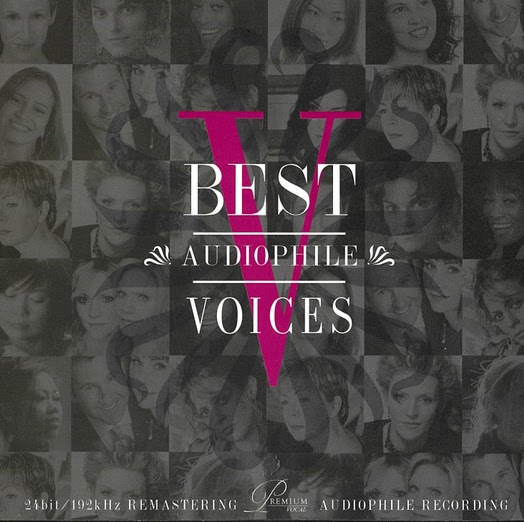
Best Audiophile Voices V
Best Audiophile Voices V – When the Room Disappears and Only the Voice Remains
It usually starts the same way.
You sit down in your favorite listening position. The room is quiet. The lights are a little lower than usual. Maybe there is a glass on the table, maybe a cup of coffee slowly getting cold beside you.
You press play.
And then a voice appears.
Not from the left speaker. Not from the right.
From somewhere in between.
That is the moment every audiophile knows. The moment when you stop listening to your equipment and start listening to the person standing—almost impossibly—in front of you.
Best Audiophile Voices V is filled with those moments.
Released by Premium Records in 2007, the fifth volume in the celebrated Best Audiophile Voices series brings together a remarkable collection of intimate female vocals, acoustic instruments and beautifully produced recordings. Presented in XRCD2, it is exactly the kind of album that can make a carefully assembled high-end audio system disappear. (Audiophile Streaming)
The first voice enters the room
The journey begins with Alison Krauss and Natalie MacMaster performing “Get Me Through December.”
There is no need for spectacle.
The beauty is in the restraint.
Krauss’s unmistakable voice floats above the acoustic arrangement while Natalie MacMaster’s fiddle adds texture and melancholy. On a revealing stereo system, listen to what happens behind the obvious melody—the tiny acoustic details, the space around the instruments and the natural decay after each note.
Already, Best Audiophile Voices V has told you what kind of evening this is going to be.
Then comes Noon with “500 Miles.”
The atmosphere changes.
The voice moves closer. The presentation becomes intimate, almost private. It is one of those recordings where turning the volume up isn’t necessarily the answer. Sometimes turning it down makes the illusion even stronger.
The room gets quieter.
And you lean forward.
Then comes The Rose
Some songs seem almost destined to become audiophile vocal reference tracks.
Emi Fujita’s “The Rose” is one of them.
The arrangement leaves room for her voice to breathe, and that space is where a good audio system begins to show what it can really do.
Listen to the center image.
Fujita shouldn’t sound as though she is coming from two loudspeakers simultaneously. Her voice should occupy its own place in the soundstage: focused, dimensional and separate from the instruments surrounding her.
Close your eyes.
If the system is working properly, the loudspeakers begin to lose their importance.
There is simply a woman singing in the room.
And isn’t that ultimately what we have spent all that money on cables, DACs, amplifiers and loudspeakers trying to achieve?
Familiar songs suddenly sound different
One of the pleasures of Best Audiophile Voices V is its collection of familiar melodies.
Stacey Kent gives us “You’ve Got a Friend.” Salena Jones takes on “I Don’t Want to Miss a Thing.” Janet Seidel performs “You Belong to Me,” while Emilie-Claire Barlow brings her elegant jazz phrasing to “Blame It on My Youth.” (MusicBrainz)
You’ve probably heard some of these songs many times before.
But that’s precisely what makes them interesting.
A great audiophile recording can make a familiar song feel unfamiliar again.
You suddenly notice the intake of breath before a phrase. Fingers moving across strings. The body of a piano note instead of merely its attack. The small pocket of silence surrounding a singer.
These aren’t spectacular effects.
They’re tiny pieces of information.
Yet together they create something much bigger:
Believability.
And then Eva Cassidy starts singing
Halfway through the album comes one of those tracks where analysing the equipment becomes difficult.
Eva Cassidy – “Bridge Over Troubled Water.”
Cassidy’s performance was recorded live at Blues Alley in Washington, D.C., and there is something about the combination of her voice, the performance and the acoustic space that refuses to remain merely technical. (MusicBrainz)
Yes, you can use it to evaluate your system.
Listen to vocal realism.
Listen to dynamics.
Listen to the depth of the soundstage and the ambience surrounding the performance.
But somewhere along the way, you may forget to listen for any of those things.
That’s the problem with Eva Cassidy.
She tends to make you forget you’re an audiophile.
And perhaps that’s the highest compliment we can give an audiophile reference recording.
A journey through voices
The album continues its journey through very different interpretations and vocal characters.
There is “The Look of Love” by Lee Lessack & Susan Egan, Marianna Leporace’s interpretation of “Bizarre Love Triangle,” and Roberta Gambarini taking us deeper into jazz territory.
Then Jheena Lodwick arrives with “A Groovy Kind of Love.”
Again, the mood changes.
That is one of the strengths of this compilation. It doesn’t feel like fifteen recordings selected simply because somebody decided they sounded good on expensive speakers.
Every new voice creates another atmosphere.
Every recording asks something slightly different from your system.
Some expose the midrange.
Others reveal stereo imaging.
Some make you notice treble smoothness, acoustic detail or the amount of air surrounding the singer.
And occasionally a track simply makes you stop thinking altogether.
Why audiophiles keep returning to the human voice
There are recordings with deeper bass.
There are albums with more explosive dynamics.
There are demonstration discs capable of making visitors stare at your loudspeakers and say, “Wow.”
But the human voice does something different.
We have been listening to voices since the day we were born. We don’t need technical training to recognize when one sounds wrong.
If the upper frequencies are too aggressive, we hear it.
If the midrange is colored, we hear it.
If stereo imaging isn’t convincing, the singer becomes too large, too vague or seems attached to the loudspeakers.
But when everything comes together, the effect can be uncanny.
A beautifully recorded voice gains a body.
A position.
A presence.
This is why female vocal audiophile recordings remain such powerful tools for evaluating loudspeakers, headphones, amplifiers and DACs—and why albums such as Best Audiophile Voices V have remained favorites among serious listeners.
Fifteen reasons to stay seated
By the time Kimber Manning begins “What a Wonderful World,” the journey is approaching its end.
Then comes Ilona Knopfler with “Alfie.”
The final voice enters the room.
And eventually there is silence again.
Fifteen tracks have taken us from Alison Krauss to Noon, Emi Fujita, Stacey Kent, Salena Jones, Janet Seidel, Emilie-Claire Barlow, Eva Cassidy, Jheena Lodwick and several other distinctive performers. (Audiophile Music)
But something interesting has happened along the way.
You started by listening to your stereo.
Perhaps you were checking the soundstage. Maybe you wanted to hear what your new DAC could do. Perhaps you moved your loudspeakers five centimeters and wanted to know whether it made any difference.
Then the music took over.
And that’s where Best Audiophile Voices V succeeds.
When high-end audio becomes invisible
We audiophiles spend an extraordinary amount of time talking about equipment.
DACs. Amplifiers. Cables. Streamers. Loudspeakers. Frequency response. Resolution. Imaging.
But none of those things are the destination.
They’re the road.
The destination is that moment when a recording becomes convincing enough that the technology seems to disappear.
Best Audiophile Voices V is a wonderful collection of audiophile female vocals, but more importantly, it is an album capable of creating those moments.
Warm voices.
Natural acoustic detail.
Beautiful stereo imaging.
Smooth, refined sound.
And performances that can make you forget there are loudspeakers in front of you.
So don’t start with a test track.
Don’t stare at your equipment.
Dim the lights.
Sit down.
Press play.
And wait for the first voice to enter the room.
That is what audiophile music is supposed to do.
Hi-Fi(ve),
Ronald – Your EarFluencer 🎧
Deze storytelling-stijl vind ik eigenlijk sterker voor jouw albums dan de vorige, meer technische aanpak. De belangrijke SEO-termen zoals Best Audiophile Voices V, audiophile music, audiophile female vocals, audiophile recordings, high-end audio, reference recording, XRCD2, Premium Records en vocal reference tracks zitten erin, maar de bezoeker krijgt niet het gevoel een SEO-tekst te lezen.


