
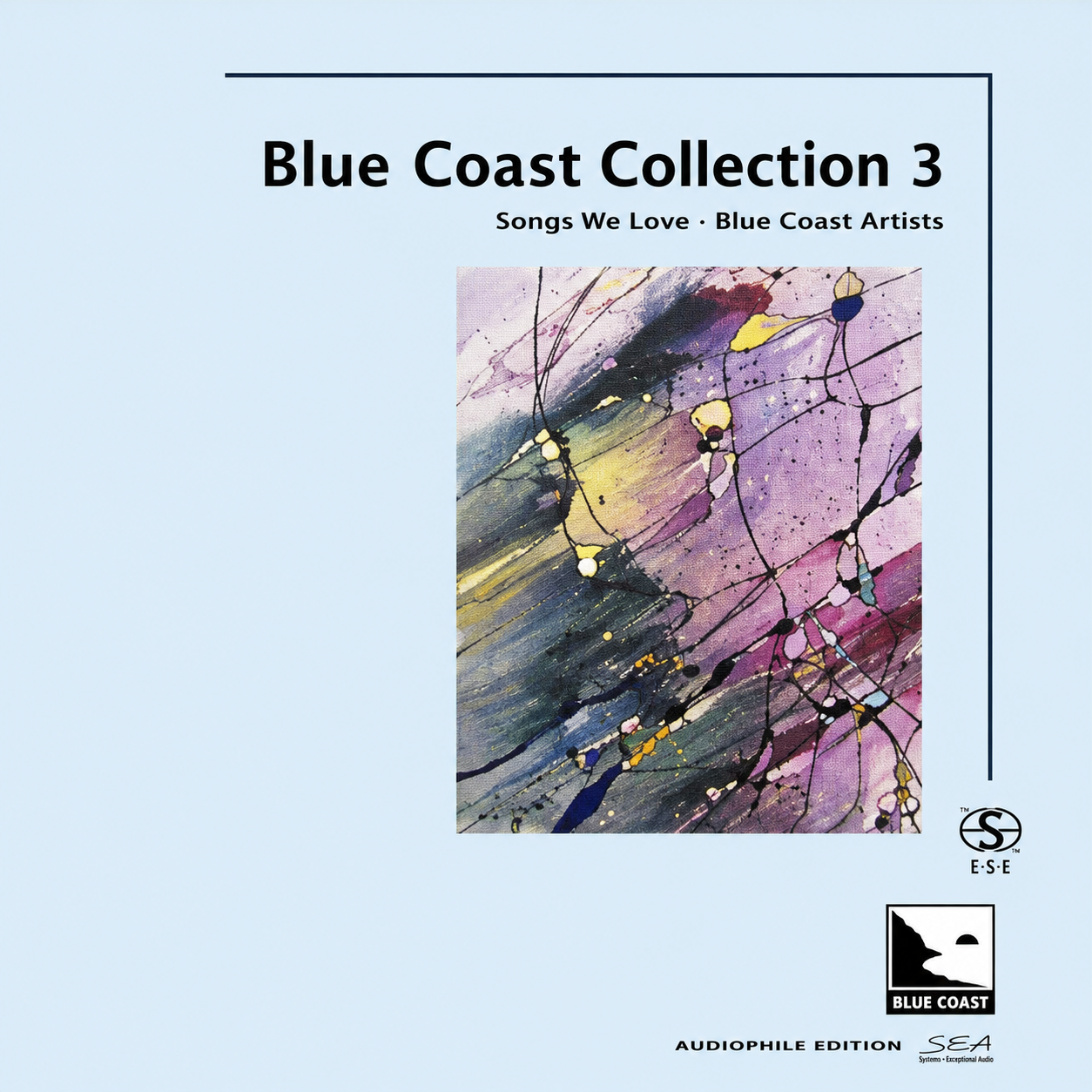
Blue Coast Collection 3
GREAT CHOICE: Blue Coast Collection 3!
Great music deserves to be discovered, enjoyed and shared.
CAN YOU SPARE A CUP OF COFFEE?
Audiophile-Streaming is a personal passion project, built with countless hours of discovering, selecting and sharing exceptional music.
I personally cover, without sponsors, the ongoing costs of hosting, software and subscriptions to keep the music discoveries coming. If you enjoy my work, your support is always appreciated.
A LITTLE THANK YOU IN RETURN
Just one coffee gives you lifetime access to the Coffee Club and all its playlists.
No subscriptions. No recurring fees.
There are albums that impress the audiophile mind, and there are albums that quietly disarm the heart. Blue Coast Collection 3 – Songs We Love belongs to the second category. This is not simply another high-end demonstration disc designed to show off detail retrieval or pinpoint imaging. It is an album that seduces through warmth, intimacy, and emotional honesty — while simultaneously delivering some of the most natural recorded sound modern audiophile recording has produced.
By the time Blue Coast Collection 3 arrived, Blue Coast Records had already become a cult name among serious hi-fi enthusiasts. Founded by recording engineer and producer Cookie Marenco, the label built its reputation around the E.S.E. philosophy — Extended Sound Environment — a minimalist recording approach centered on live performance interaction, real acoustic spaces, and minimal processing. On this third volume, that philosophy feels fully realized.
Everything about this album sounds alive.
The first thing that strikes the listener is the astonishing sense of space. Instruments are not trapped between speakers; they occupy physical air. Acoustic guitars bloom with woody resonance and delicate harmonic decay. Voices emerge naturally from silent backgrounds with uncanny dimensionality. Percussion breathes with transient speed and realism, never sounding compressed or artificially sharpened.
Unlike many modern “audiophile” productions that chase exaggerated clarity, Songs We Love achieves realism through restraint. There is no etched treble, no overblown bass, no hyper-spotlit detail screaming for attention. Instead, the recording simply allows the performance to exist naturally. The result is profoundly immersive.
The DSD mastering contributes enormously to the experience. There is an almost analog liquidity to the presentation — smooth yet transparent, detailed yet relaxed. Long listening sessions become addictive because the sound never fatigues the ear. On tube amplification especially, the album can sound breathtakingly organic.
What truly elevates Blue Coast Collection 3 beyond technical excellence is the emotional atmosphere running throughout the entire record. These performances feel personal, almost fragile at times, captured with a level of honesty that modern studio production rarely allows.
Two tracks stand out as exceptional highlights.
“Woodstock” by Jenna Mammina is simply mesmerizing. Mammina’s voice floats in space with extraordinary delicacy and realism, surrounded by a beautifully layered acoustic environment. The microdynamic nuance here is astonishing — every breath, every subtle vocal inflection feels tangible and emotionally exposed. On a revealing system, the track becomes almost holographic. The sense of depth and air around the voice is pure audiophile magic.
Equally remarkable is “Summertime” by Keith Greeninger and Dayan Kai. This performance captures everything Blue Coast Records does so brilliantly: natural interplay between musicians, effortless tonal realism, and a recording chain transparent enough to preserve every emotional detail. The acoustic guitars shimmer with harmonic richness while the vocals possess a haunting intimacy that draws the listener completely into the room.
What makes Blue Coast Collection 3 so enduring is that it never feels like a laboratory experiment in sound quality. Too many high-end recordings prioritize technical perfection over musical engagement. Blue Coast understands that the purpose of great engineering is not to impress the listener with technology — it is to eliminate the sensation of technology altogether.
And that is exactly what happens here.
On truly capable systems — electrostatic speakers, ribbon tweeters, planar magnetic headphones, single-ended tube amplifiers — this album can become almost startling in its realism. The recording reveals not just instruments, but textures, movement, and physical space. You begin to hear the room itself breathing around the musicians.
Nearly two decades after its release, Blue Coast Collection 3 – Songs We Love remains one of the finest examples of audiophile recording done with taste, humanity, and artistic sensitivity. It is not merely a showcase for expensive equipment. It is a reminder of why people fall in love with music reproduction in the first place.
Late at night, lights dimmed, volume slightly elevated, this album does something increasingly rare in modern audio:
It disappears completely, leaving only the performance behind.
