
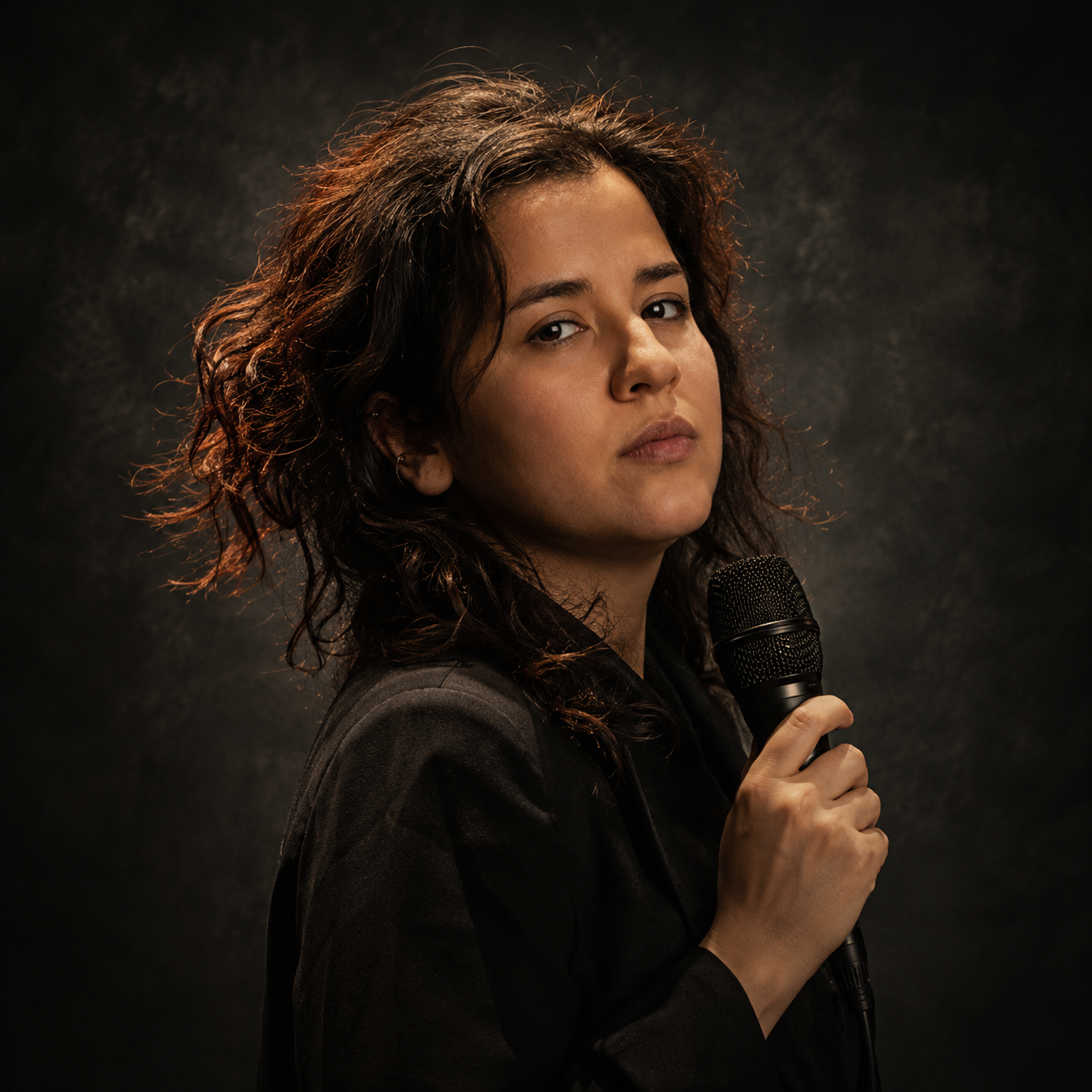
Cansu Tanrikulu
GREAT CHOICE: Cansu Tanrikulu!
Great music deserves to be discovered, enjoyed and shared.
CAN YOU SPARE A CUP OF COFFEE?
Audiophile-Streaming is a personal passion project, built with countless hours of discovering, selecting and sharing exceptional music.
I personally cover, without sponsors, the ongoing costs of hosting, software and subscriptions to keep the music discoveries coming. If you enjoy my work, your support is always appreciated.
A LITTLE THANK YOU IN RETURN
Just one coffee gives you lifetime access to the Coffee Club and all its playlists.
No subscriptions. No recurring fees.
Cansu Tanrıkulu is one of those rare contemporary vocal artists whose work refuses to sit comfortably inside a single genre box. She operates at the edge of contemporary jazz, free improvisation, experimental vocal music, and avant-garde composition, and that alone already sets the tone for why her recordings matter in a high-fidelity context. This is not music built for background listening or algorithmic playlists. It is music that demands attention, space, and a system capable of revealing micro-detail.
What makes her work especially compelling from a hi-fi perspective is the way she treats the voice as a full acoustic instrument rather than a lyrical delivery tool. In her performances and recordings, the voice is stretched, fragmented, whispered, pushed into texture and rhythm rather than melody alone. You hear breath, pressure, distance, and sudden dynamic shifts that feel almost physical. On a resolving system, this becomes striking: the recording stops sounding like “produced music” and starts behaving like a captured live acoustic event in real space.
Her most important recorded work is strongly tied to collaborative and improvisational settings rather than traditional studio albums. The release Kantoj de Fermiteco (with Greg Cohen and Tobias Delius on LowSwing Records) is often referenced as a defining statement. It is recorded fully analogue, directly to tape, without digital intervention, which immediately places it in a category that audiophiles care about: minimal compression, natural room acoustics, and an almost documentary-style realism in sound capture. In that record, you can clearly hear how the musicians interact in real time, with no safety net of overdubs or heavy post-production.
Another important dimension of her output is her work in ensemble-based improvisation projects across Berlin’s experimental jazz scene. She frequently appears in configurations with musicians like Nick Dunston, Jim Black, Elias Stemeseder, and Marc Ribot. These collaborations are not “features” in a pop sense; they are full collective improvisations where structure is built in real time. This approach produces recordings where dynamics are unpredictable, which is exactly what makes them rewarding on a high-end audio system: the contrast between silence, voice, and instrumental bursts is preserved rather than flattened.
From a listening perspective, the positives are very clear. First, there is an extreme level of spatial realism: you can often place the voice in a physical acoustic environment rather than a stereo “mix image.” Second, the dynamic range is unusually intact for modern releases, especially in live or analogue-recorded material. Third, there is a rawness in timbre that avoids over-processing, meaning the natural imperfections of breath and articulation remain audible. For audiophiles, this is not a flaw but a signal of authenticity.
Biographically, Cansu Tanrıkulu was born in Ankara in 1991 and later moved into the European experimental music scene, establishing herself in Berlin, which has become one of the central hubs for free improvisation and contemporary jazz. She originally studied psychology before shifting into formal music training, eventually focusing on jazz and contemporary vocal practice. That academic and artistic dual background is important because it explains her analytical approach to sound: her work often feels concept-driven rather than purely emotional.
She has been active in a wide range of projects, including improvisation ensembles, contemporary jazz collectives, and interdisciplinary collaborations. One of her most internationally recognized recordings remains Kantoj de Fermiteco, which brought her into collaboration with highly respected figures in the European creative music scene. She has also contributed to projects that blend free jazz, experimental composition, and electro-acoustic performance, often blurring the line between vocalist, instrumentalist, and sound sculptor.
Her recognition comes less from mainstream chart success and more from the European avant-garde and creative jazz ecosystem, where she is valued as a highly flexible and technically fearless voice. Within that space, she is known for pushing vocal expression beyond traditional singing into extended techniques, text fragmentation, and sonic abstraction.
In terms of audiophile relevance, there are no confirmed DSD-native recordings in her catalog, but her strongest works—especially analogue-recorded sessions and live improvisations—behave like high-resolution material in practice. The best listening experiences come from recordings with minimal mastering intervention, where natural ambience, instrument bleed, and vocal proximity are preserved. Those are the versions that reveal her true artistic impact.
Ultimately, listening to Cansu Tanrıkulu is less about following songs and more about entering a recorded acoustic space where voice becomes texture and interaction becomes composition. For a high-end system, that is exactly the kind of material that reveals what the hardware can really do.
