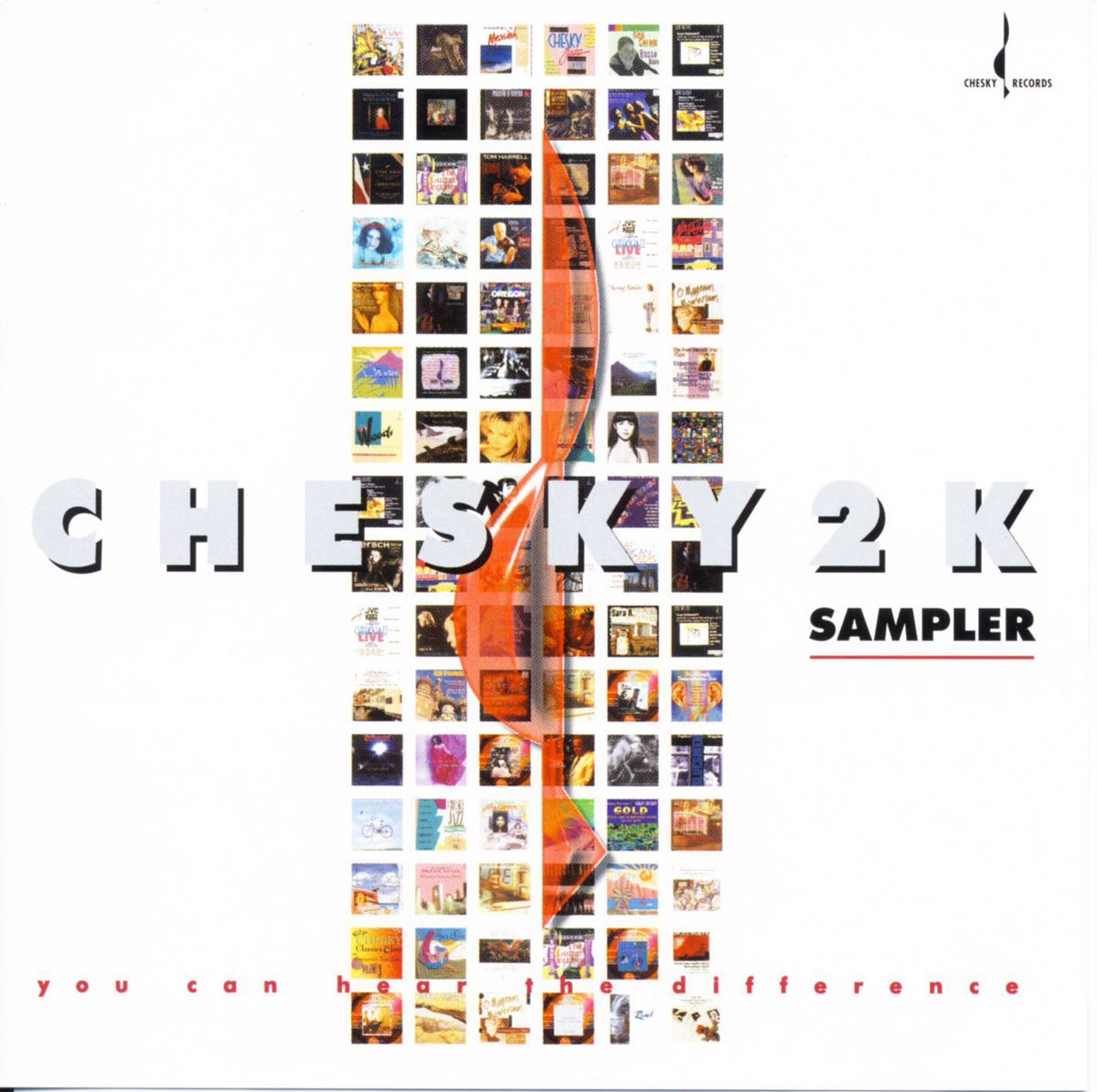
Chesky Records
2K Sampler

Chesky Records 2K Sampler – A Snapshot of the Chesky Sound at the Turn of a New Millennium

The arrival of a new millennium felt like a natural moment to look forward. Digital recording was evolving rapidly, high-resolution audio was becoming increasingly important to serious listeners and the possibilities of digital reproduction seemed greater than ever before. Yet when Chesky Records released the 2K Sampler, the philosophy behind the music remained refreshingly traditional: record talented musicians naturally, preserve the acoustic space around them and interfere as little as possible with the path between performance and listener.

The Chesky 2K Sampler brings together eleven tracks from artists including Christy Baron, The Coryells, Jon Faddis, Dave’s True Story, Paquito D’Rivera, Ana Caram, Chuck Mangione, Carla Lother, Allison Brewster Franzetti, Rebecca Pidgeon and Sara K. Across approximately 48 minutes, jazz, vocals, Latin music, acoustic performances and piano provide a wonderfully varied introduction to the distinctive Chesky Records audiophile sound. It is the sort of compilation that can reveal plenty about a high-end audio system, but it is equally capable of making you forget that you intended to test anything in the first place.

The journey opens with Christy Baron’s interpretation of “Got to Get You into My Life.” Taking on a Lennon and McCartney composition immediately gives the listener something familiar to hold onto, but the attraction lies in hearing how the song changes when removed from its famous original setting. Baron’s voice takes centre stage while the arrangement provides enough space for the recording to breathe. Through a transparent stereo system, the vocal image should feel focused and naturally proportioned, with the accompanying musicians occupying their own positions rather than forming a flat background behind the singer.

From there, The Coryells move into Charles Mingus territory with “Goodbye Pork Pie Hat,” one of jazz’s most enduring compositions. The transition illustrates one of the strengths of the 2K Sampler: it doesn’t attempt to create a collection where every track shares the same mood. Instead, each recording opens another window onto the Chesky catalogue. The music changes, the musicians change and the scale of the recording changes, allowing the listener to hear whether the audio system is capable of preserving those differences.

Trumpeter Jon Faddis follows with “Riverside Park,” the longest performance on the collection and a track that allows the soundstage to develop more expansively. Brass can be particularly revealing through high-end loudspeakers because reproducing a trumpet naturally requires both energy and restraint. The instrument needs brilliance and bite without becoming painfully bright, while its harmonic richness must remain intact. When the balance is right, you hear not simply a bright sound coming from a speaker but the physical character of an instrument being played in an acoustic environment.

That sense of environment has always been central to the appeal of Chesky audiophile recordings. Rather than treating the studio as a place where performances are endlessly reconstructed after the musicians have finished playing, Chesky became known for recording techniques designed to preserve the relationships between musicians and the space around them. The resulting sound can feel less manufactured than many conventional studio productions, with ambience and natural decay becoming an important part of the musical picture.

Dave’s True Story with “Dear Miss Lucy” changes the atmosphere again before Paquito D’Rivera arrives with “Chucho.” D’Rivera’s performance introduces a strong Latin jazz character and provides an excellent opportunity to listen to speed, timing and instrumental separation. Percussion in particular can reveal whether a system has sufficient transient response to reproduce the initial impact of a strike without losing the smaller details that follow it. On a capable setup, rhythmic complexity remains exciting without becoming confused.

The Latin influence continues naturally with Ana Caram’s “Africando.” Caram has long been associated with the Chesky catalogue, and her recordings demonstrate beautifully why Brazilian and Latin music work so well in an audiophile context. Rhythm, acoustic instrumentation and voice combine without needing exaggerated production, allowing the natural warmth of the performance to carry the music. For listeners interested in audiophile female vocals, her contribution provides another opportunity to evaluate midrange transparency and vocal presence without turning the experience into a clinical listening exercise.

Then Chuck Mangione’s “Consuelo’s Love Theme” opens the soundstage in a different direction. At more than seven minutes, the piece has time to develop gradually, and that sense of musical space is particularly rewarding through a system capable of reproducing depth as convincingly as width. Audiophiles often talk about soundstage as though it were simply a question of how far sound extends to the left and right of the loudspeakers, but a convincing recording also contains layers. Some instruments appear closer, others further away, and the acoustic information surrounding them helps create the illusion of a three-dimensional performance.

Carla Lother’s “The Lake” brings the human voice back into focus before Allison Brewster Franzetti’s performance from Suite No. 2 places the piano almost entirely on its own. That transition is especially revealing. A solo piano has nowhere to hide and presents an audio system with a surprisingly difficult combination of requirements. The initial strike of each note must have speed, the body of the instrument needs weight and harmonic richness, and the decay should fade naturally rather than disappearing abruptly. When reproduced convincingly, a piano can give a listening room an extraordinary sense of scale.

The final part of the collection brings two names that will be instantly familiar to many longtime Chesky listeners. Rebecca Pidgeon performs “Underground,” followed by Sara K. with “Stop Those Bells.” Both artists became closely associated with audiophile listening, and their appearances provide an appropriately intimate conclusion after the broader instrumental performances earlier in the album. These are recordings where the smallest details can become surprisingly important: the texture of a voice, the resonance of an acoustic instrument and the silence surrounding a phrase all contribute to the sense that a real performance exists beyond the loudspeakers.

For anyone interested in evaluating high-end speakers, headphones, amplifiers or DACs, the variety of the Chesky 2K Sampler makes it particularly useful. Vocals reveal midrange character and tonal balance, piano exposes transient response and harmonic accuracy, jazz ensembles test instrument separation, while percussion and Latin rhythms reveal timing and dynamics. The different recording scales also make it possible to listen for stereo imaging, soundstage width and, perhaps more importantly, soundstage depth.

Yet concentrating entirely on those qualities would overlook what made Chesky Records important to audiophile music in the first place. Exceptional recording quality works best when it doesn’t constantly call attention to itself. Transparency isn’t simply the ability to hear increasingly tiny details; it is the ability to hear enough of the original performance that the technology reproducing it gradually becomes less noticeable.

That philosophy gives Chesky Records 2K Sampler an interesting character more than two decades after its release. The title may forever associate it with the beginning of a new millennium, but the qualities it celebrates haven’t become obsolete. Natural voices still matter. Acoustic instruments still need believable timbre. Dynamics, timing and spatial information remain essential to convincing reproduction, regardless of whether the music reaches the listener from a compact disc, a high-resolution download or a modern streaming service.

Perhaps that is the best way to hear this collection today. Start with Christy Baron and allow the album to move naturally through The Coryells, Jon Faddis, Paquito D’Rivera, Ana Caram and Chuck Mangione before reaching Rebecca Pidgeon and Sara K. Listen to the differences between the recordings rather than searching for a single spectacular demonstration track, and notice how each performance asks something slightly different from the system.

By the time Stop Those Bells reaches its final notes, the Chesky 2K Sampler has provided an impressive tour of jazz, vocals, Latin music and acoustic performance. More importantly, it has demonstrated the quality that lies at the heart of the best audiophile recordings: not the ability to make you hear the equipment more clearly, but the ability to make you forget about it.

More than a snapshot of Chesky Records at the turn of the millennium, Chesky 2K Sampler remains a beautifully varied introduction to natural recording, musical transparency and the unmistakable Chesky sound.

Hi-Fi(ve),

Ronald – Your EarFluencer 🎧