
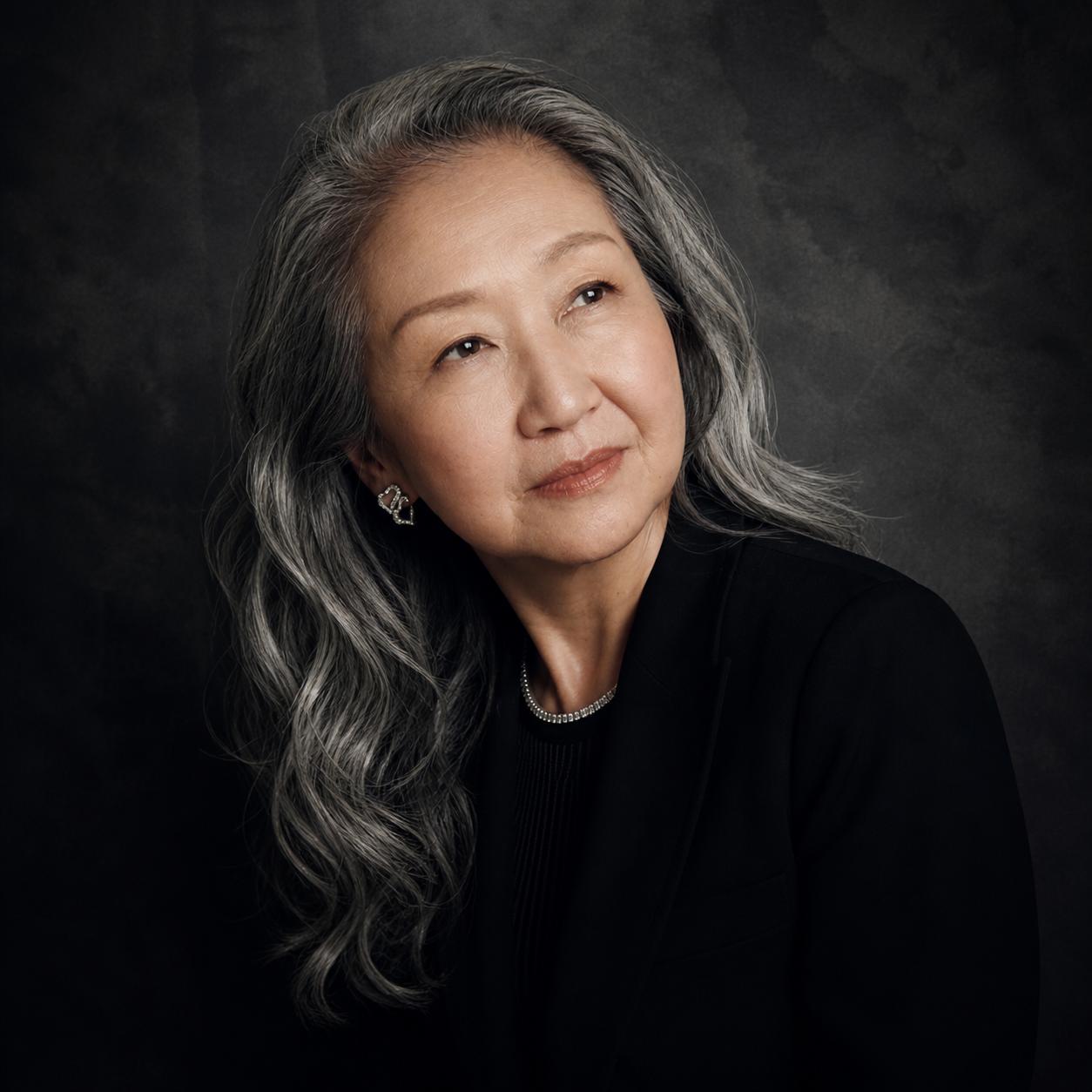
Chie Ayado
GREAT CHOICE: Chie Ayado!
Great music deserves to be discovered, enjoyed and shared.
CAN YOU SPARE A CUP OF COFFEE?
Audiophile-Streaming is a personal passion project, built with countless hours of discovering, selecting and sharing exceptional music.
I personally cover, without sponsors, the ongoing costs of hosting, software and subscriptions to keep the music discoveries coming. If you enjoy my work, your support is always appreciated.
A LITTLE THANK YOU IN RETURN
Just one coffee gives you lifetime access to the Coffee Club and all its playlists.
No subscriptions. No recurring fees.
There is something wonderfully direct about the way Chie Ayado sings. She has a powerful, slightly rough voice, a natural sense of rhythm and a habit of making familiar songs sound surprisingly personal. She can move from a quiet jazz ballad to an energetic gospel performance without losing her identity. What I particularly enjoy is that she never seems overly concerned with making everything sound beautiful or technically perfect. Her singing has character, and for me, that is far more interesting than another polished interpretation of a familiar jazz standard.
Born on September 10, 1957, in Osaka, Japan, Chie Ayado grew up surrounded by jazz and Hollywood films, thanks to her parents. She started classical piano lessons at the age of three and was already playing piano in nightclubs during her early teens. At seventeen, she travelled alone to the United States, where she experienced American music firsthand and became involved in gospel singing. Her time in America helped develop the mixture of jazz, blues, soul and gospel that would later define her music. When she returned to Japan in 1991, she began performing in Osaka jazz clubs, gradually establishing herself as a singer with an unusually direct and energetic approach.
What makes her career particularly interesting is that her professional breakthrough came relatively late. After recording several independently produced albums, she released For All We Know nationally in 1998, when she was forty years old. The album appeared on East Works Entertainment’s EWE label and introduced a wider Japanese audience to a singer who was already comfortable performing in front of people. Rather than following the traditional route of a young jazz vocalist gradually building a recording career, Ayado arrived with considerable musical and personal experience. I think you can hear that immediately in her singing. There is confidence in her phrasing, but also a willingness to take risks and put her own personality into every performance.
From jazz clubs to a national audience
For All We Know, released on June 21, 1998, remains an excellent introduction to her early recording career. Working with musicians including drummer Motohiko Hino, Ayado delivers an energetic collection of jazz standards and familiar songs that already demonstrates her unusually broad musical interests. Her version of “I Only Have Eyes for You” has an enjoyable swing, while “Bridge Over Troubled Water” reveals her affection for gospel. On “Oleo”, her scat singing brings out a completely different side of her musical personality. I particularly like the contrast between these performances because they demonstrate that she was never interested in being restricted to one particular jazz style.
For audiophile listening, this album offers something more interesting than a collection of technically impressive recordings. The real attraction is the interaction between Ayado and the musicians accompanying her. Listen to how her voice changes in intensity, how she plays with the rhythm and how confidently she moves between a relaxed phrase and a much stronger delivery. Through a transparent midrange, the texture of her voice becomes particularly engaging. I also appreciate recordings in which the musicians sound like an actual group rather than a collection of separate instruments, and this is exactly the kind of musical interaction I look for when listening to jazz.
Her second album, Your Songs, followed on November 21, 1998, and expanded her repertoire even further. With interpretations of Elton John’s “Your Song”, “Over the Rainbow” and the Beatles’ “Can’t Buy Me Love”, Ayado demonstrated that her musical interests extended well beyond traditional jazz. This willingness to combine different genres would become one of her most recognisable characteristics. She approaches popular songs with the same freedom that she brings to jazz standards, often changing their rhythmic character and emotional emphasis. I enjoy this side of her work because the arrangements feel like genuine reinterpretations rather than attempts to reproduce the original recordings.
The voice and piano of Life
If I had to choose one album that best explains why Chie Ayado became such a distinctive artist, it would be Life, released on May 21, 1999. Her third album places particular emphasis on her voice and piano, although some tracks also feature gospel backing vocals. It includes two songs that became closely associated with her career, “Tennessee Waltz” and “Amazing Grace”, alongside material such as “You’ve Got a Friend” and “Let It Be”. The combination of jazz, gospel and popular music gives the album an unusually personal character. More importantly, it shows how effectively Ayado can communicate with relatively simple musical arrangements.
“Tennessee Waltz” is especially revealing because it gives her plenty of room to work with the melody. She understands that a familiar song does not need constant embellishment to become interesting. Instead, she uses changes in volume, carefully placed pauses and subtle variations in timing to communicate the emotion behind the lyrics. Her voice can sound almost conversational one moment and surprisingly powerful the next. For me, this contrast is one of the most enjoyable aspects of her singing, especially when listening through headphones that reproduce the natural texture of a human voice without making it unnecessarily smooth.
“Amazing Grace” reveals another important influence on her musical development. Gospel is not simply an occasional addition to her repertoire; it is an essential part of her musical identity. She brings considerable emotional intensity to the song, allowing her voice to become rougher and more forceful when the music demands it. Some listeners may prefer a more restrained interpretation, but I find her willingness to sing without excessive refinement particularly refreshing. Her performance reminds me that vocal realism is not necessarily about hearing a perfectly controlled voice. Sometimes it is the rough edges, changes in breath and unexpected shifts in intensity that make a singer sound genuinely human.
The success of Life helped establish Ayado as a major concert performer in Japan. Her energetic stage presence and ability to communicate with audiences attracted listeners from outside the traditional jazz community. In 2003, she performed “Tennessee Waltz” on NHK’s Kōhaku Uta Gassen, one of Japan’s most prominent annual television music programmes. Her career also brought opportunities to work with established jazz musicians, including American pianist Junior Mance and Japanese bandleader Nobuo Hara with his Sharps & Flats big band. These collaborations demonstrated that her exuberant musical personality could work equally well in intimate jazz settings and alongside much larger ensembles.
Finding new freedom
Ayado continued exploring different musical directions throughout the following decade. Albums such as Shine in 2003 brought together jazz, funk, reggae and bossa nova influences, while her performances with Junior Mance highlighted her connection with traditional jazz and blues. In 2014, she made another significant decision by leaving her management company and record label to establish her own MYDO label. Her first release on the new label, Picture in a Frame, appeared on July 23, 2014. I find this period interesting because it shows an artist continuing to experiment rather than relying entirely on the repertoire that originally made her successful.
Picture in a Frame is an excellent example of that musical curiosity. The album includes a New Orleans-style interpretation of Amy Winehouse’s “Rehab”, performed with the Black Bottom Brass Band, alongside material such as “Moanin'”, “California Dreamin'” and the title track. Its fifteen songs cover a wide range of moods and arrangements, from energetic brass-driven performances to much quieter, more intimate singing. I particularly appreciate the contrast between the lively ensemble arrangements and the moments when Ayado accompanies herself at the piano. Those quieter performances give me the opportunity to concentrate on her phrasing and the relationship between her singing and playing.
Her later career also included DO JAZZ, recorded in Los Angeles and released in 2015, followed by DO JAZZ Gokko in 2017. The latter marked both her sixtieth birthday and approximately twenty years since her national recording debut. These projects reflected her continuing interest in the American musical traditions that had influenced her since childhood. Although her repertoire had expanded considerably, jazz, gospel and blues remained fundamental to her identity. She had also developed a recognisable position within Japanese popular music by showing that a jazz singer could successfully reach audiences beyond the usual jazz circuit without abandoning the genre’s musical foundations.
For someone discovering Chie Ayado today, I would begin with Life and then explore For All We Know and Picture in a Frame. Together, these three albums offer a useful picture of her development, from an experienced Osaka club singer making her national debut to an established artist confidently directing her own musical career. I particularly value the way she combines her piano playing with a voice that can be warm, rough, intimate and extremely powerful, sometimes within the same song. Not every performance is subtle, and listeners who prefer consistently restrained jazz vocals may find her more energetic interpretations a little excessive. But that expressive freedom is also what makes her music so enjoyable to me, whether I am concentrating on the smallest vocal details through headphones or simply enjoying the performance through my speakers. Ultimately, the quality that best explains my appreciation of Chie Ayado is her unmistakably natural sense of musical expression.
HiFi’ve, Ronald – Your EarFluencer
