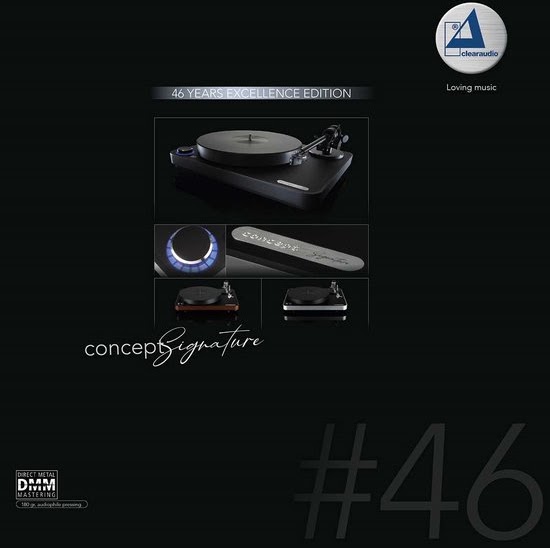
Clearaudio: 46 Years Excellence Edition
Clearaudio 46 Years Excellence Edition – Nearly Half a Century in Pursuit of Perfect Sound
There are companies that manufacture audio equipment, and there are companies whose name gradually becomes inseparable from a particular way of listening to music. Clearaudio belongs firmly to the latter category. For almost half a century, the German manufacturer has pursued the possibilities of analog reproduction through turntables, tonearms, cartridges and phono electronics, driven by the deceptively simple ambition of extracting as much music as possible from the grooves of a record. Clearaudio 46 Years Excellence Edition celebrates that history not with technical specifications or a catalogue of equipment, but with the one thing all that engineering ultimately exists to serve: music.
Created to mark 46 years of Clearaudio, this carefully curated audiophile collection brings together fifteen recordings that move naturally through jazz, blues, soul, pop and world music. Artists including Nautilus, Magnus Lindgren, Hattler, Dominique Fils-Aimé, Ronnie Earl & The Broadcasters, Yelena Eckemoff, Sophie Zelmani, Wolfgang Bernreuther, Mop Mop, Raphael Gualazzi, Tokunbo, Anne Bisson, Lou Pomanti and Malene Mortensen create a musical journey with enough variety to challenge almost every part of a high-end audio system. Rather than constructing an album around one particular audiophile sound, Clearaudio has chosen music capable of revealing different aspects of reproduction, from vocal intimacy and acoustic detail to deep bass, dynamics and the scale of a live performance.
The journey begins with Nautilus performing “Ain’t No Sunshine,” and choosing such a familiar Bill Withers composition is an inspired way to open an audiophile collection. Familiar music provides a reference before the equipment even enters the discussion, allowing attention to shift towards interpretation, texture and space. Through a transparent system, the performance should have clarity without becoming clinical, with instruments occupying believable positions while the rhythm retains enough weight and movement to prevent the recording from turning into a purely technical demonstration.
Magnus Lindgren’s “Fluting” immediately changes the tonal landscape. Flute can be surprisingly demanding to reproduce naturally because the instrument combines breath, transient detail and delicate upper harmonics that can easily become too prominent on an aggressive system. The recording provides an opportunity to hear whether detail arrives naturally or whether the equipment places an artificial spotlight on it. The best high-end systems don’t necessarily make every detail more obvious; instead, they make more information available while allowing the listener to decide where to place attention.
Hattler’s “Fine Days” then brings a different rhythmic character before Antoine Villoutreix takes the collection towards European sophistication with “Les Boulevards de Paris,” remixed by Club des Belugas. The movement between these tracks illustrates one of the strengths of 46 Years Excellence Edition. There is no attempt to remain safely inside the traditional world of softly recorded female voices and acoustic guitars. Rhythm, electronic production and contemporary arrangements sit comfortably beside intimate acoustic recordings, creating a broader picture of what audiophile sound can mean.
Then comes Dominique Fils-Aimé with “Stand By Me.” Her recordings have become increasingly familiar to audiophiles because of their combination of vocal character, carefully constructed arrangements and extraordinary spatial information. Here, the familiar Ben E. King song becomes something quite different, and the human voice once again proves why it remains one of the most effective references in high-fidelity reproduction. A good system should preserve the body and texture of the vocal without exaggerating sibilance or pushing the singer unnaturally forward. When everything is balanced correctly, the voice acquires a physical presence between the loudspeakers while the surrounding arrangement creates depth around it.
The atmosphere changes dramatically with Ronnie Earl & The Broadcasters performing “Six String Blessing.” Blues guitar introduces another set of tonal challenges, because an electric guitar needs bite, texture and harmonic richness without becoming hard or aggressive. Ronnie Earl’s playing also reminds us that technical perfection isn’t the same thing as musical perfection. The smallest variations in touch and dynamics are part of what gives a guitarist an individual voice, and a revealing system should preserve those differences rather than polish them away.
One of the collection’s most interesting changes in scale arrives with Yelena Eckemoff’s “Lions – Live in New York.” Live recordings provide information that studio productions often cannot reproduce in quite the same way. The acoustic environment, the relationship between performers and the sense of a real event taking place all become part of the recording. Through a well-positioned pair of loudspeakers, the presentation can extend backwards beyond the physical plane of the system, creating a soundstage with layers rather than simply width.
That sense of depth is one of the qualities that separates impressive hi-fi from genuinely convincing reproduction. A system can produce enormous amounts of detail and still create a flat picture, whereas a recording with believable spatial information allows musicians to occupy different positions within an acoustic environment. Clearaudio 46 Years Excellence Edition repeatedly provides opportunities to hear this distinction because the recordings vary so substantially in scale and production style.
The second half introduces Sophie Zelmani with “How It Feels,” bringing the album back towards the intimacy of voice and acoustic instrumentation. Zelmani’s understated vocal style is particularly effective for evaluating low-level information. There is no need for enormous dynamics or spectacular effects; instead, the attraction lies in the subtle relationship between voice, instruments and silence. Played at a realistic volume, the recording can reveal whether a system retains detail and atmosphere without relying on loudness to create excitement.
Wolfgang Bernreuther’s “Let’s Try It Again” continues the journey before Mop Mop and Sara Sayed introduce another rhythmic and vocal texture with “Loa Chant.” The transition once again demonstrates why a varied compilation can be more useful than an album designed around a single sonic signature. Bass control, timing and instrumental separation become more important as arrangements grow denser, while the system still needs to preserve the natural character of the voices and instruments occupying the midrange.
The collection then arrives at Raphael Gualazzi’s London Studio Version of “Imagine,” another example of a universally familiar composition being placed in a new musical environment. Familiar songs are particularly revealing because the listener already carries an emotional and musical reference. Instead of wondering where the melody is going, we can concentrate on how the performer reshapes it, and a transparent audio system makes those differences easier to appreciate.
Tokunbo’s “Homecoming” brings another distinctive female voice into the collection, followed by Anne Bisson’s “September in Montreal.” Both performances fit beautifully into the tradition of audiophile vocal recordings, but they also demonstrate why the term should not become a genre in itself. The purpose of a great recording isn’t to create a standardized audiophile voice with enormous presence and artificially highlighted detail. It is to preserve the individuality of the performer, allowing differences in tone, phrasing and emotional character to remain intact.
This makes the album particularly revealing when evaluating midrange transparency and tonal balance. A system with too much warmth can make every singer sound richer and heavier than intended, while an overly analytical presentation may emphasize breath and sibilance at the expense of musical flow. The difficult balance lies somewhere between those extremes, where voices retain natural body and texture while still allowing subtle details to emerge.
Towards the end of the collection, Lou Pomanti performs “Come Together,” taking another Beatles classic into a different musical world, before Malene Mortensen closes the journey with “Another Day.” By this point, the album has travelled through fifteen recordings and an impressive variety of styles, yet the selection remains coherent because every track ultimately returns to the same fundamental question: how much of the original musical character can an audio system preserve?
That question sits at the heart of Clearaudio’s history. Founded in Germany in 1978, the company built its reputation in the analog world, where extracting information from a microscopic record groove involves an extraordinary combination of mechanical precision and musical sensitivity. A turntable must rotate accurately, a tonearm must allow the cartridge to follow the groove correctly and the cartridge itself must transform tiny physical movements into an electrical signal without losing the information contained within them. The technology is complex, but the desired result is wonderfully simple: music that feels alive.
The vinyl edition of 46 Years Excellence Edition reflects that philosophy particularly well. Pressed as a double album on 180-gram virgin vinyl and produced using Direct Metal Mastering, it treats the physical record itself as part of the audiophile experience. DMM cuts the audio information directly into a metal master rather than using the traditional lacquer stage, an approach associated with precision and excellent groove definition. For listeners who have invested in a carefully adjusted turntable, cartridge and phono stage, this is exactly the kind of recording capable of revealing why analog playback continues to inspire such devotion.
Yet the collection shouldn’t be reduced to a turntable test record. Whether heard through vinyl or another high-quality source, the music provides excellent material for evaluating high-end speakers, headphones, amplifiers, DACs and complete stereo systems. Dominique Fils-Aimé and Sophie Zelmani reveal vocal presence and midrange character, Ronnie Earl explores guitar texture and dynamics, Yelena Eckemoff introduces the atmosphere of a live recording, while the more rhythmically driven selections challenge timing, bass control and instrumental separation.
The most enjoyable way to hear the album, however, is probably to forget that it is a demonstration record at all. Begin with Ain’t No Sunshine and allow the collection to move naturally from Magnus Lindgren and Hattler towards Dominique Fils-Aimé and Ronnie Earl. Let the live atmosphere surrounding Yelena Eckemoff expand the listening room before Sophie Zelmani draws everything closer again, then follow the journey through Mop Mop, Raphael Gualazzi, Tokunbo and Anne Bisson until Malene Mortensen brings it to a close.
Over those fifteen tracks, Clearaudio 46 Years Excellence Edition tells a story that reaches far beyond specifications. It is a celebration of analog culture, but also of the relationship between engineering and emotion. Every precision bearing, carefully designed cartridge and meticulously adjusted tonearm ultimately has the same purpose: to recover music from a groove without standing between the performer and the listener.
After 46 years of pursuing that objective, Clearaudio could hardly have chosen a more appropriate way to celebrate than with music itself.
Because the finest audio equipment doesn’t ask us to admire the machine forever. It allows the machine to disappear, leaving only the performance behind.
Hi-Fi(ve),
Ronald – Your EarFluencer 🎧


