
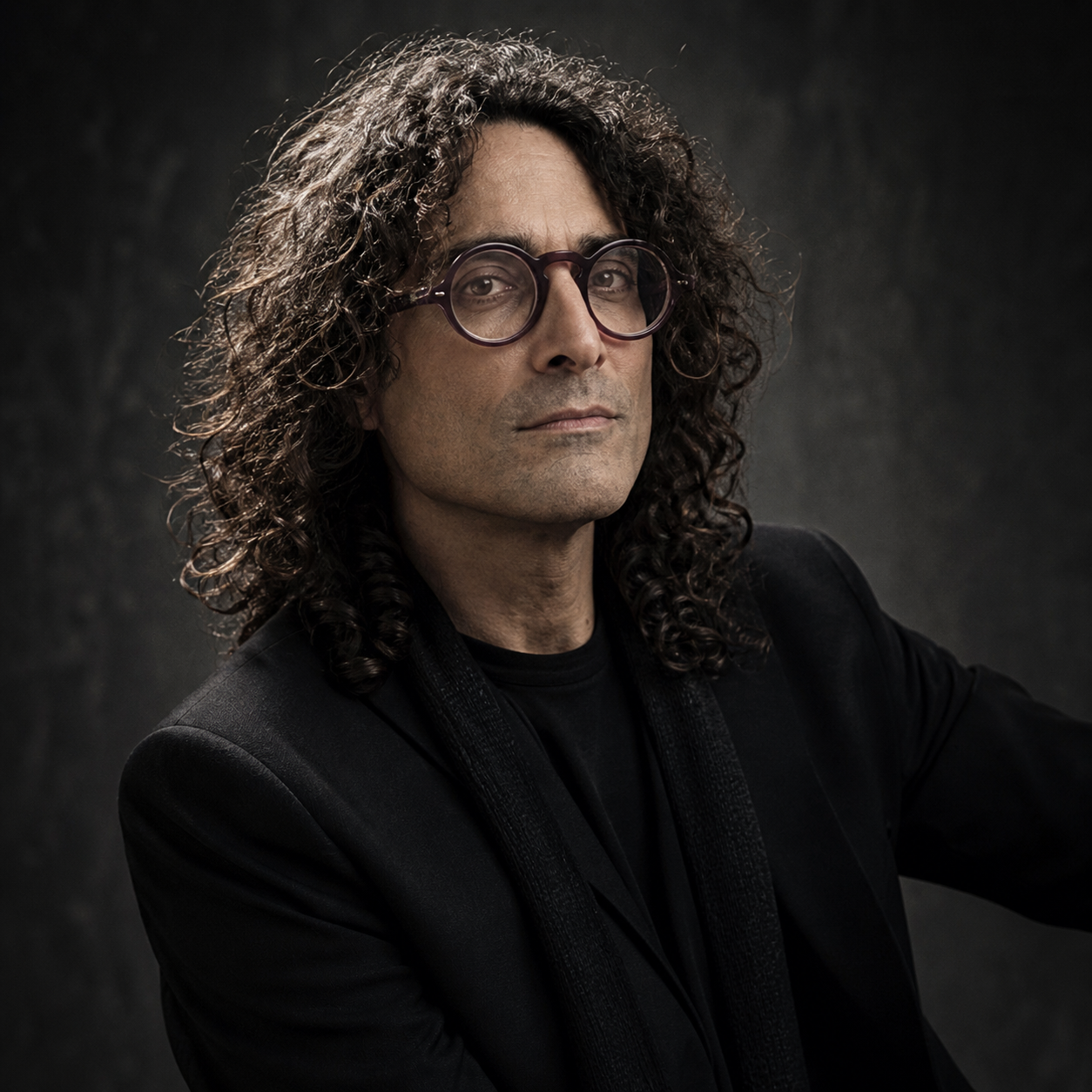
David Chesky
GREAT CHOICE: David Chesky!
Great music deserves to be discovered, enjoyed and shared.
CAN YOU SPARE A CUP OF COFFEE?
Audiophile-Streaming is a personal passion project, built with countless hours of discovering, selecting and sharing exceptional music.
I personally cover, without sponsors, the ongoing costs of hosting, software and subscriptions to keep the music discoveries coming. If you enjoy my work, your support is always appreciated.
A LITTLE THANK YOU IN RETURN
Just one coffee gives you lifetime access to the Coffee Club and all its playlists.
No subscriptions. No recurring fees.
David Chesky is one of those rare people in the music industry who understands both sides of a recording. He knows what happens when musicians perform, and he understands what it takes to reproduce that performance convincingly at home. As a pianist, composer, producer and recording pioneer, he has spent decades exploring the relationship between music and sound. Most audiophiles will recognise his name from Chesky Records or HDtracks, but his latest venture, The Audiophile Society, takes his ideas in a fascinating new direction. What I particularly appreciate about Chesky is that he has never treated recording quality as an excuse to forget about the music itself.
His musical background is much broader than many listeners might expect. Born in Miami Beach in 1956, Chesky developed an interest in jazz, Latin rhythms and classical composition, eventually establishing himself in New York. Together with his brother Norman, he founded Chesky Records, a label that became internationally recognised for its natural recordings and exceptional musicians. The catalogue grew to include artists such as Paquito D’Rivera, Ana Caram, Ron Carter, Rebecca Pidgeon and many others. Chesky was also involved in establishing HDtracks in 2007, helping high-resolution digital music reach a much wider audience. For me, however, his greatest contribution is not simply the technology he helped introduce, but his determination to make recorded music feel like a genuine performance.
David Chesky: The Musician Behind the Technology
A particularly interesting example of his musical thinking is The Great European Songbook, released in October 2022 on The Audiophile Society. On this album, Chesky takes familiar European classical compositions and transforms them into modern jazz arrangements. He is joined by bassist Peter Washington and drummer Billy Drummond, two experienced musicians who understand that a good jazz trio depends on interaction rather than individual displays of technique. I find the concept especially appealing because Chesky does not simply add a jazz rhythm to well-known classical melodies. He changes their harmonic structure, explores different rhythmic possibilities and gives the musicians room to develop their own ideas.
The opening track, Prelude No. 2, based on Bach’s The Well-Tempered Clavier, immediately introduces this approach. Chesky retains a connection to the original composition while introducing modern jazz harmonies that give the music a different character. The relationship between piano, double bass and drums is especially important here, because the arrangement depends on all three musicians contributing to the musical conversation. Ode to Joy, taken from Beethoven’s Ninth Symphony, receives a blues-influenced treatment that makes the familiar melody feel surprisingly relaxed and approachable. My personal favourite idea is the transformation of Johann Strauss’s The Blue Danube into a Brazilian-style samba. It demonstrates how Chesky can respect a composition’s identity without being afraid to change almost everything around it.
His interest in Latin music is equally clear on The New York Descargas, another release from The Audiophile Society. Here, Chesky works with percussionist Giovanni Hidalgo and bassist John Benitez, combining Afro-Cuban rhythms with contemporary classical harmony. It is quite a contrast to the European classical material, yet I recognise the same musical curiosity. The rhythmic interaction between piano, bass and congas is central to the project, and the combination of sophisticated harmonies and energetic Latin percussion gives the music its individual character. I particularly value this side of Chesky because it shows that his musical world is not restricted to carefully controlled, quiet recordings. Rhythm, improvisation and musical adventure are just as important to him.
Another revealing project is Graffiti Jazz, released in March 2022. Instead of assembling a traditional jazz group, Chesky created the album entirely with virtual instruments and electronic sounds. He replaced conventional harmonic accompaniment with unusual textures, bass lines and programmed rhythms, using these elements as the foundation for improvisation. I find this especially interesting coming from someone so closely associated with recording real musicians in natural acoustic spaces. Not every listener who enjoys his traditional jazz recordings will necessarily appreciate this electronic direction, but I admire his willingness to experiment. It makes clear that Chesky is interested in developing new musical ideas, not merely producing increasingly impressive demonstrations of recording technology.
His more recent compositions continue to show that variety. On the 2026 release Songs of New York, Chesky combines a mezzo-soprano voice with string orchestra and percussion, drawing on Baroque vocal writing, jazz harmony and the rhythms of New York City. The composition New York at 4 A.M. reflects the quieter side of the city, inspired by the atmosphere of nearly deserted streets after a late night in a jazz club. I like the contrast between this reflective musical idea and the more energetic compositions elsewhere in his catalogue. It also demonstrates how comfortably Chesky moves between jazz, classical composition and vocal music without abandoning his individual musical language.
The Audiophile Society: Taking Stereo Further
The Audiophile Society represents the next chapter in Chesky’s long involvement with audiophile recordings. After his years with Chesky Records, he established this new label with the ambition of creating a more convincing three-dimensional listening experience. Its approach is called Mega-Dimensional Sound, a recording and mixing process developed to reproduce greater width, height and depth through conventional two-channel audio. What I find particularly interesting is that the label does not regard loudspeakers and headphones as interchangeable listening environments. Instead, it offers dedicated mixes designed for the different ways we experience sound through speakers and headphones.
This distinction makes sense to me. With a traditional stereo recording, headphone listening can place instruments very clearly to the left and right, but the presentation often remains inside your head. Through loudspeakers, meanwhile, the interaction between the speakers and the listening room creates a completely different experience. The Audiophile Society attempts to take advantage of these differences rather than ignore them. Its releases are offered in high-resolution formats, including PCM and DSD, with separate speaker and headphone versions available in the download packages. Importantly, the concept does not require a special surround installation or additional speakers. It is intended to work with existing two-channel systems.
On The Great European Songbook, this approach gives the instruments an unusually broad stereo presentation. The piano occupies the left side, the drums are positioned centrally and the double bass appears toward the right. That is a wider arrangement than I would normally expect from an intimate jazz trio recording, and I can understand why some listeners might prefer a more compact presentation. Still, the intention is interesting because it encourages the listener to concentrate on how the musicians interact across the recorded space. For me, successful stereo imaging is not simply about how far apart instruments appear. It is about whether their individual positions, tonal character and musical relationships remain convincing.
The same philosophy becomes particularly relevant with larger works. On The Excommunication Mass, released in 2022, Chesky brings together orchestral forces, choir and vocal soloists, including J’Nai Bridges, Brandie Inez Sutton and Hugo Moreno. This type of music presents very different recording challenges from a small jazz trio. A choir needs enough space to sound like an ensemble, while solo voices must remain intelligible and connected to the orchestra. Large dynamic changes should communicate the emotional character of the composition rather than simply impress the listener with volume. These are exactly the qualities I consider important when judging serious classical recordings.
There is another aspect of The Audiophile Society that I appreciate enormously. Chesky wants to introduce talented musicians who might otherwise struggle to gain attention in an industry increasingly concerned with popularity and social media numbers. The label’s catalogue includes jazz, classical, Latin music, vocal recordings and experimental projects, alongside recordings designed to evaluate audio systems. I like that combination, provided the music always remains the priority. A spectacular soundstage can catch my attention immediately, but interesting compositions and convincing performances are what make an album worth exploring beyond the first demonstration.
For anyone interested in discovering the label, The Audiophile Society also offers a free sampler featuring music from different genres. I consider that a sensible introduction because it allows listeners to explore the recording philosophy without immediately purchasing an album. It also gives them an opportunity to compare the presentation with the recordings they already know. My advice is to concentrate first on the musicians, the arrangements and the relationship between the instruments. Only then pay attention to the spaciousness, stereo imaging and recording detail. When those qualities support the performance rather than distract from it, the technology has served its purpose.
David Chesky has made an important contribution to the audiophile world, but I would never want his reputation as a recording pioneer to overshadow his achievements as a musician. His work with Peter Washington and Billy Drummond, his adventurous Latin jazz projects and his orchestral compositions demonstrate genuine musical range. The Audiophile Society extends that creativity into the way recordings are produced and presented, while also creating opportunities for other artists. What I value most is his willingness to challenge established ideas, whether that means turning Bach into jazz, combining classical harmony with Afro-Cuban rhythms or developing different mixes for headphones and loudspeakers. For me, that combination of musical curiosity, accomplished musicianship and a serious commitment to recording is what makes David Chesky worth discovering.